Leonardo da Vinci’s Last Supper: Context and Sources
Painted between 1495 and 1498 (460 × 880 cm) in the Dominican refectory of Santa Maria delle Grazie in Milan, Leonardo da Vinci’s Last Supper is one of the major works of the Renaissance. It captures the moment when Christ announces: “One of you will betray me.” Leonardo unifies the scene and organises the apostles’ reactions into four groups, around a central, calm and symmetrical Christ, in a composition of remarkable expressive clarity.
The work is also one of the most fragile. Leonardo’s experimental technique on dry plaster, rather than true fresco, led to rapid deterioration. As early as 1517, Antonio de Beatis reported alterations, and in 1642 Francesco Scanelli described a state in which the figures were only partly legible.
For five centuries, successive restorations have been carried out, sometimes invasively. Several specialists, including Kenneth Clark, considered that the image visible today is largely reconstructed. The campaign completed in 1999 stabilised the whole and preserved original fragments; it also relied on early sixteenth-century copies, useful for guiding the restitution of the most damaged areas.
Under these conditions, a direct comparison between the present mural and the Head of Christ Drawing in the Accademia, Venice, is not methodologically secure. The comparison proposed here therefore relies on early copies, made when the work was still observable in a condition closer to its original state.
Art historians recognise a plausible contextual link between the Venice Drawing and the Last Supper, without being able to identify it as a direct preparatory study.
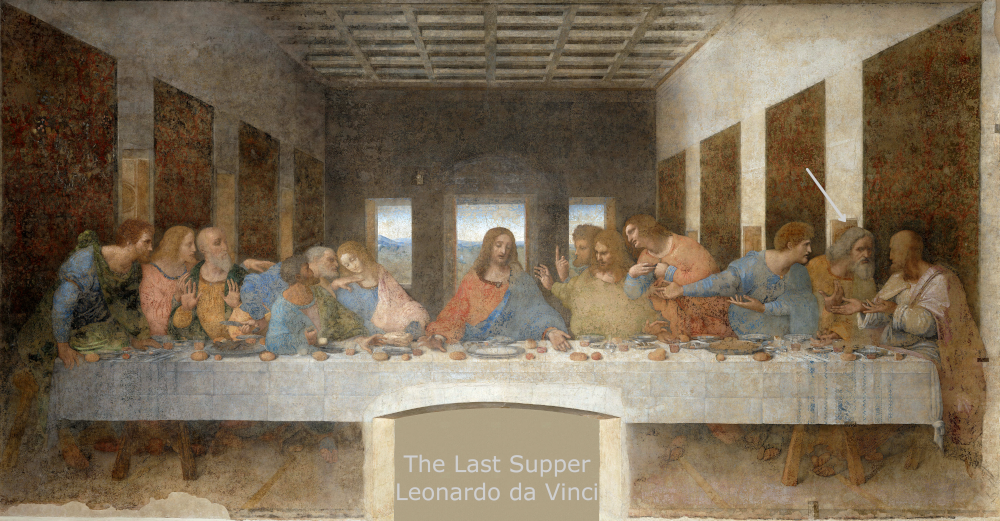
Leonardo da Vinci’s Last Supper, Santa Maria delle Grazie, Milan: Thaddeus at right
– Date: c. 1495–1498
– Dimensions: 460 × 880 cm
– Technique: experimental mural painting, not true fresco
The Last Supper: Preparatory Studies
Notes in the Codex Forster II (62v and 63r) show that Leonardo considered in detail the psychological and physical reactions of the apostles. A few compositional sketches also survive, notably at Windsor (RCIN 912542), together with several head studies in Venice (inv. 254) and Windsor. These rare but valuable documents testify to a long preparatory process, between expressive research and the overall arrangement of the scene.
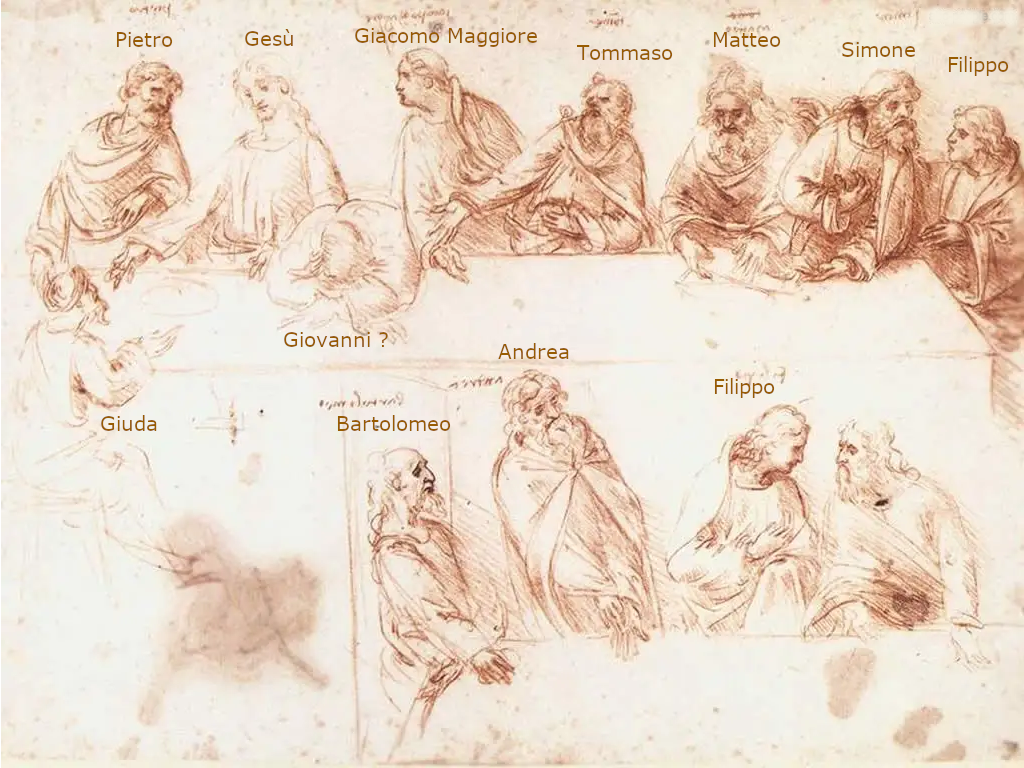
The Last Supper — preparatory study preserved in Venice, with added annotations
Gallerie dell’Accademia, Venice (inv. 254)
Important Note
A remark by Eugène Müntz (1) deserves attention: in the mural, only Christ and Saint John are shown frontally, while eight apostles are seen in profile and three in three-quarter view. These three figures can be identified as Thaddeus, James the Greater and John.
This point is decisive for the present study: since the Venice Drawing represents a three-quarter face, only a few figures in the mural can be compared with it. Thaddeus, placed at the far right of the composition, is one of the few figures that meet this criterion, which justifies a comparative examination.
(1) Müntz, Eugène (1899), Léonard de Vinci, l’artiste, le penseur, le Savant, p. 180 ff.