Thaddeus and the Venice Drawing: Comparison
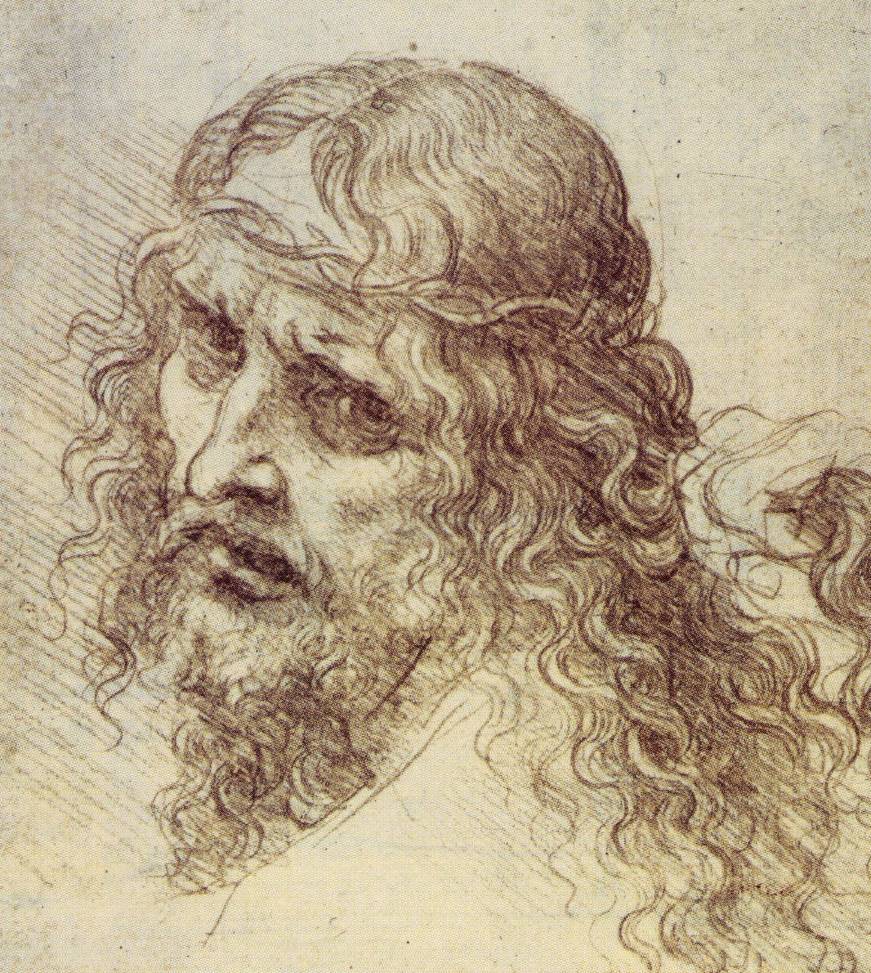
Giampietrino’s copy of The Last Supper is used as the main support for comparing the head of Thaddeus with that of Christ in Leonardo da Vinci’s Venice Drawing. The analysis, based on the overlay of the main lines and morphological points, is limited to the head, in order to assess the hypothesis of a common model.

Principle and Scope of the Comparison
The comparison is limited to the head, above the neck. Thaddeus’s portrait is shown in mirror image in order to match the orientation of the Venice Drawing. The overlay of the main lines then makes it possible to assess the proximity between the two figures.
Morphological Analysis
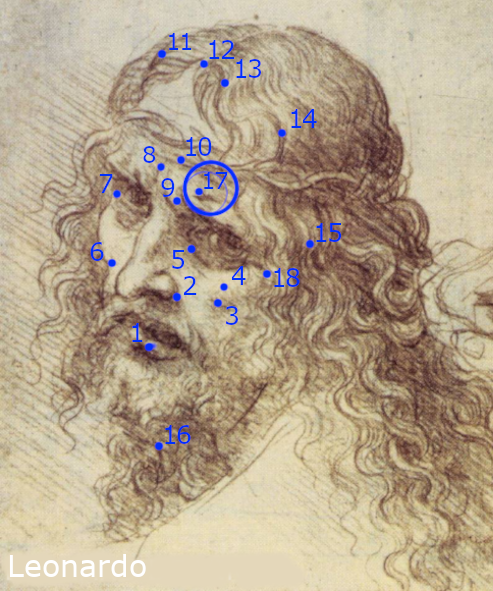
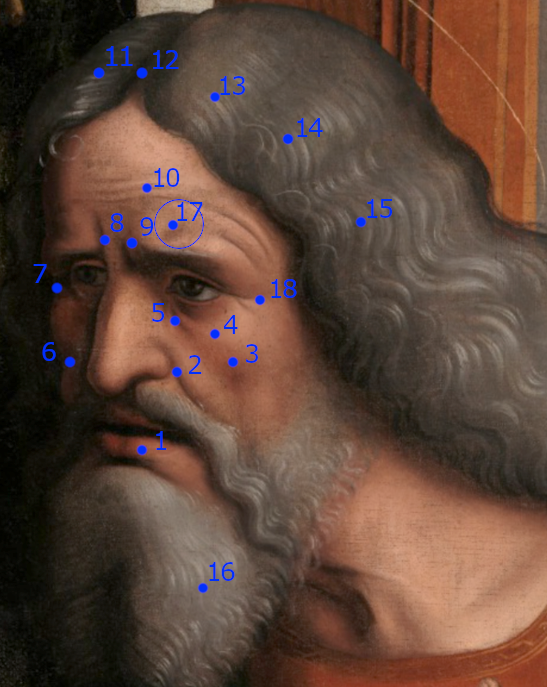
The outline of the fundamental structures of the Venice Drawing was overlaid onto the face of Thaddeus in Giampietrino’s copy, after being reversed to match its orientation. In addition, a precise record of eighteen homologous morphological points was made on the two figures, in order to validate the observed correspondences methodically.

Eighteen Homologous Morphological Points
For the comparison, Thaddeus’s portrait is shown in reverse.
Summary of the Morphological Observations
General Shape of the Skull
The Christ in the Drawing and Thaddeus in the painting show a very close general morphology: a broad, rounded forehead and a skull curve receding gently backwards. The hairline is comparable, with a clear central parting. The waves of the hair also coincide at the top of the head (point 13) and on the sides, especially on the left (point 14), suggesting an identical spatial construction and therefore a common model.
Facial Features
The correspondences multiply: a slightly curved nose, a marked nasolabial fold (2) and cheekbone (4). The parted mouth shows the same tension in the lower lip (1) and a dark area between the lips. The eyes are treated with the same care; beneath the left eye, a wrinkle (5) and a hollow at the outer edge of the orbit (7) are repeated. Finally, the two vertical wrinkles between the eyebrows (8 and 9) indicate the same frown.
Hair and Beard
The resemblance continues in the hair: long, wavy locks around a central parting (12), curls towards the temples forming spirals (11), and large folds (13–15) that are very close. The two-pointed beard (16) also follows the drawing’s outline.
Key Point: Wrinkles and Hollowing of the Forehead
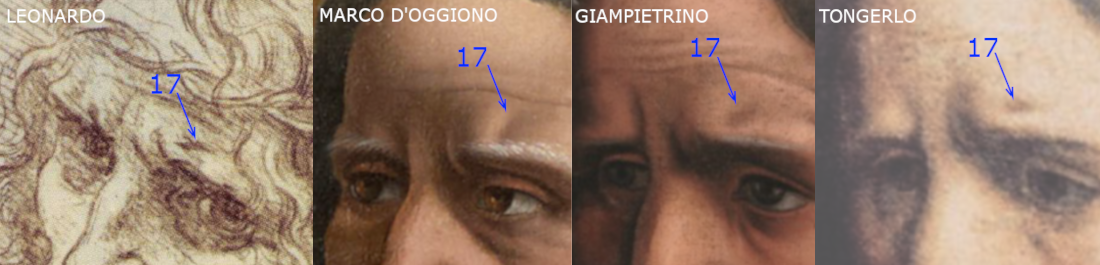
The most striking point is the hollow above the left eyebrow (point 17), in the upper part of the forehead. Visible in the Venice Drawing, it is faithfully repeated in Giampietrino’s portrait of Thaddeus, as well as in the Écouen and Tongerlo copies. Its form and localised shadow make it a remarkable expressive detail, difficult to explain without the hypothesis of a common model.
Conclusion
The Venice Drawing and the face of Thaddeus present too many similarities to be fortuitous. They strengthen the hypothesis that Leonardo reused, for The Last Supper, a type already developed in his graphic research.