Cross Assembly: A Difference from Giampietrino
The Painting: Orientation and Assembly of the Cross
This is a Latin cross, the principal symbol of Christianity. The two arms of the cross are designated by the letters A and B. The angle formed by the cross, measured from the lower edge of the panel, is approximately 65°.
The top of the cross
Since the cross is not entirely visible, one might assume that its top lies on arm B, which at first sight appears to be the longer arm.
However, the measurement of segments (1) and (2) of arm A contradicts this impression. These two segments should be of equivalent length if arm A were the short arm. Yet segment (1) is noticeably longer than segment (2), indicating that arm A is the long arm and that the top of the cross lies at the upper right.
Consequently, A corresponds to the long arm and B to the short arm.
This way of carrying the cross is physically coherent and corresponds to the traditional representation found in the iconography of the Way of the Cross.
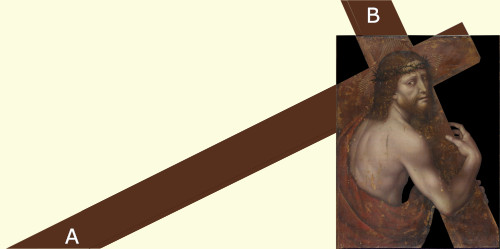
Diagram of the orientation of the cross
(arm A = long arm; arm B = short arm)
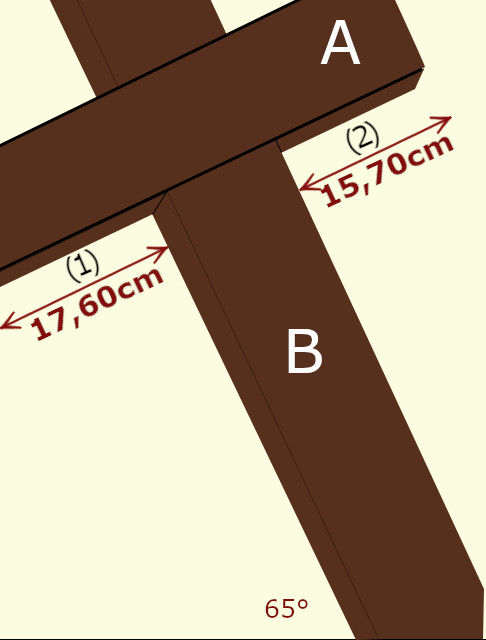
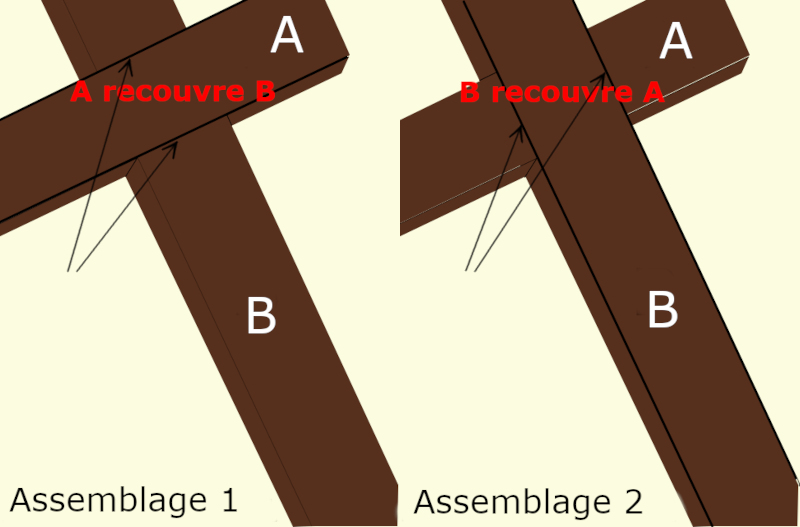
The Two Assembly Methods of a Cross
The assembly of the two arms of a cross may follow two distinct configurations:
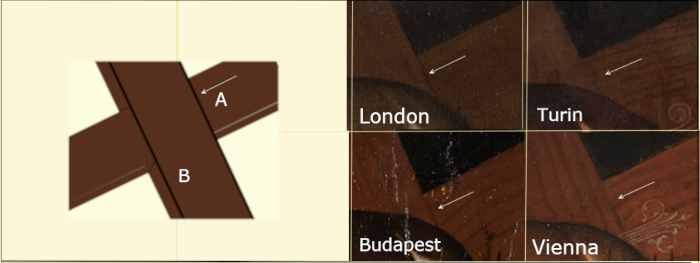
- Assembly 1: the short arm (B) is placed under the long arm (A)
- Assembly 2: conversely, the short arm (B) is placed over the long arm (A).
In assembly 2, the nails, or other fastening devices such as tenons, are more likely to remain visible on the face of the short arm (B). This argues in favour of assembly 1: by placing (B) under the long arm (A), the joint and fastenings become more discreet. This solution is also consistent with a carpentry logic: the long arm (A) acts as the supporting piece, onto which the short arm (B) is joined.
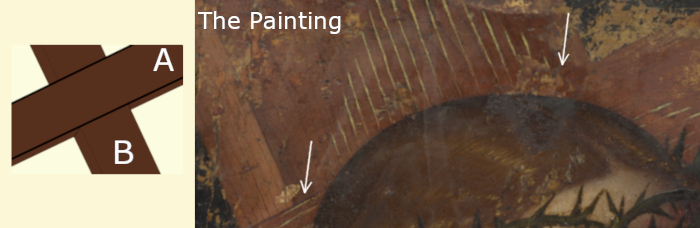
The Painting — Assembly 1
Assembly method 1: the short arm (B) is placed under the long arm (A).
Giampietrino — Assembly 2
Assembly method 2: the short arm (B) is placed over the long arm (A).
Conclusion
The Painting therefore stands out as the only composition in this group in which the long arm (A) appears in the foreground, with the short arm (B) passing underneath. The versions attributed to Giampietrino show the reverse assembly.