Hair Parting: A Divergence in Giampietrino
The superimposition of infrared images reveals a divergence: although the contours of the head remain largely consistent, the parting of the hair does not coincide. In a three-quarter head, its position and orientation are useful indicators of spatial construction. In Giampietrino, the parting appears set farther back and slightly shifted in relation to The Painting, giving the head a more frontal reading.
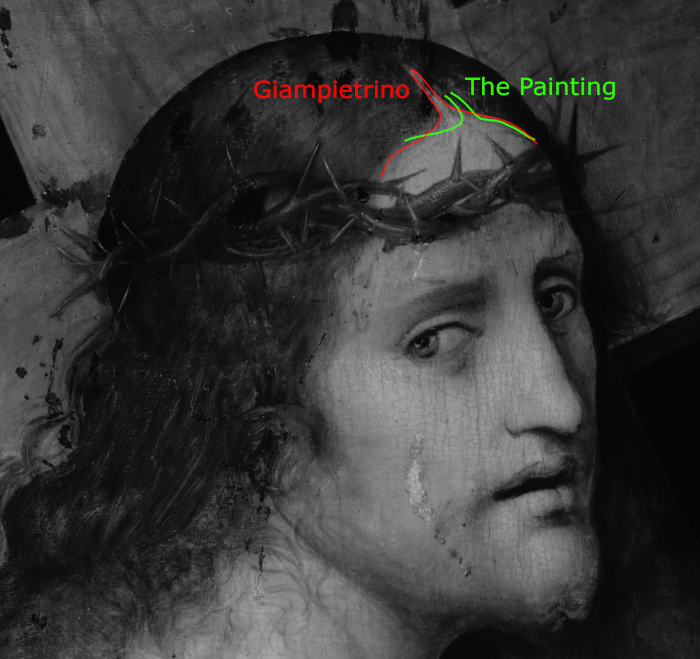
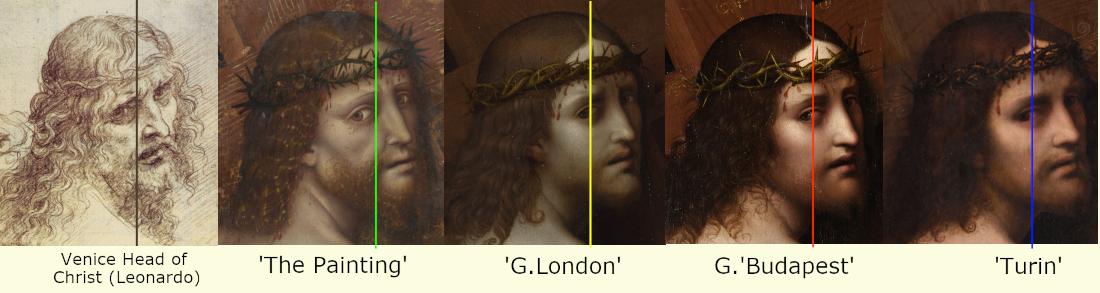
Shift in the Hair Parting: from the Venice Drawing to Giampietrino
It should be recalled that Leonardo da Vinci’s Venice Drawing is recognised by art historians as the source of the model used by Giampietrino, and therefore as an indirect reference for The Painting.
This shift can be visualised by drawing a vertical line from the beginning of the hair parting. In The Painting, as in the Venice Drawing, this vertical falls at the level of the corner of Christ’s right eye. In Giampietrino’s versions, by contrast, it passes farther inside the eye and systematically crosses its centre. The Painting thus remains aligned with the Venice Drawing, whereas Giampietrino’s versions slightly shift this reference point.
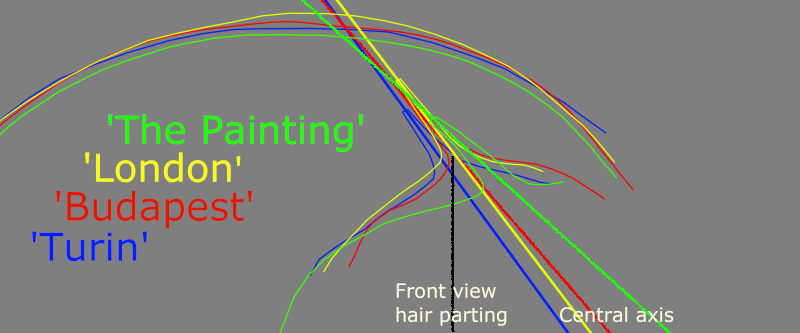
Orientation of the Hair Parting in Relation to the Central Axis
In The Painting, the parting, shown in green, is oriented as in a head seen in profile: it follows the logic of a turned face. By contrast, the partings in the versions attributed to Giampietrino, shown in other colours and placed farther to the left, depart from this logic and tend towards a more frontal construction, as if the head were less turned than in the overall representation.
Conclusion
This comparison shows that the divergence is not limited to a minor detail of the hair. In The Painting, the position of the hair parting remains consistent with the spatial logic of the head and corresponds to the reference point observed in Leonardo’s Venice Drawing.
By contrast, in the versions attributed to Giampietrino, the parting is shifted and tends towards a more frontal construction. This difference reinforces the idea that, although Giampietrino’s versions derive from the same Leonardesque model, The Painting preserves here a more direct conformity with the Venice Drawing.