Spolvero and Differentiated Transfer
Points of spolvero have been identified on Christ, but not on the right-hand figure at this stage of the analysis. This difference suggests a distinct transfer method. It is also consistent with the Seracini report, which refers to a “carbon copy” type of transfer for this figure, in contrast to the pouncing transfer observed on Christ.
Mapping of Spolvero
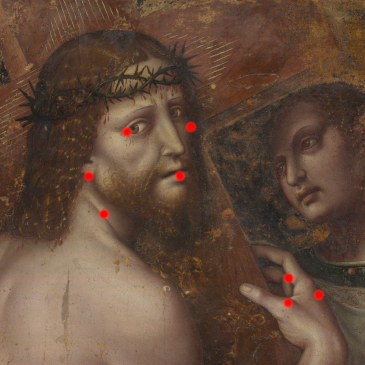
Spolvero dots have been identified on Christ in several structural areas:
- The right eye
- The left facial profile
- The lower lip
- The ear
- The neck
- The right hand
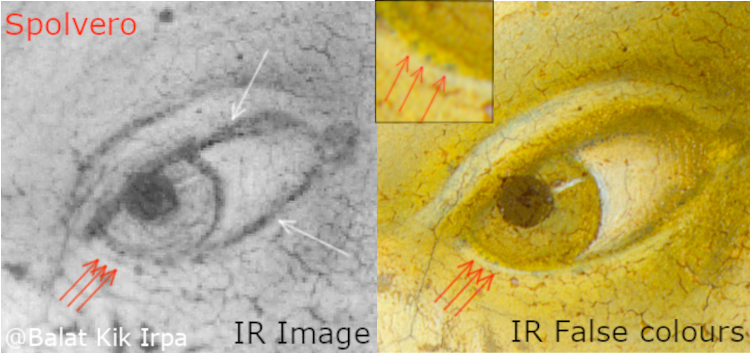
The Right Eye
Three spolvero dots are clearly visible, indicated by the red arrows:
• Left: infrared image; the white arrows indicate the preparatory drawing traced in charcoal or black chalk;
• Right: infrared false-colour image.
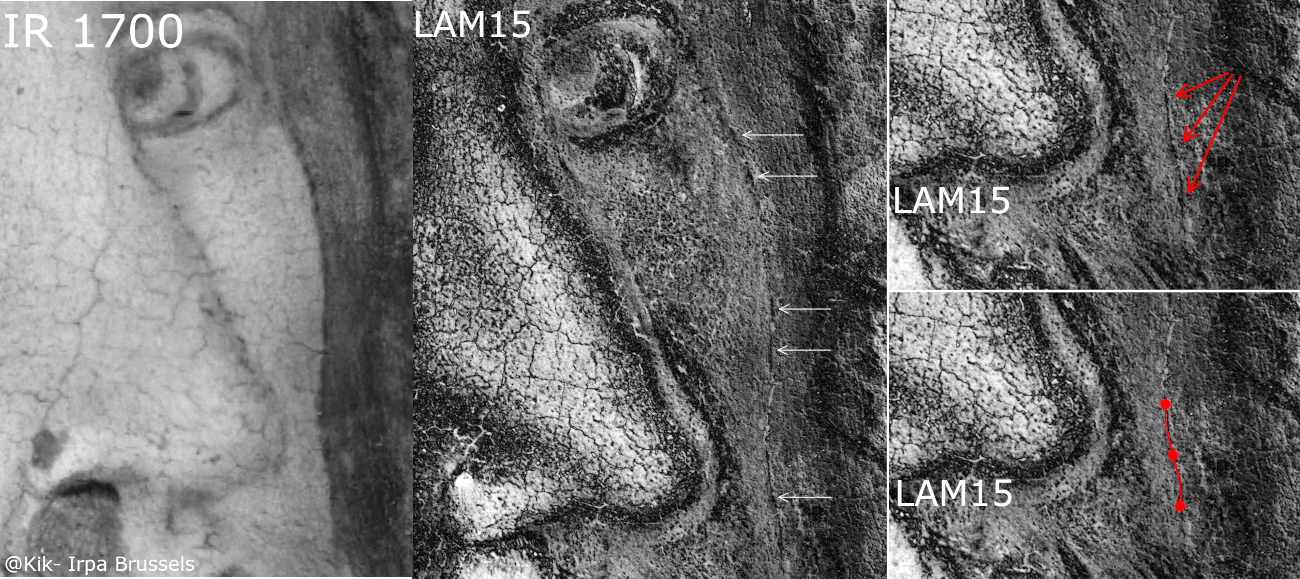
The Left Facial Profile
Along the left profile of Christ’s face, the preparatory drawing can be seen in IR1700. In the middle image, the spolvero dots are connected by a dark line, indicated by the white arrows (LAM15). In the enlargement on the right, the lines connecting the dots can be identified, indicated by the red arrows.
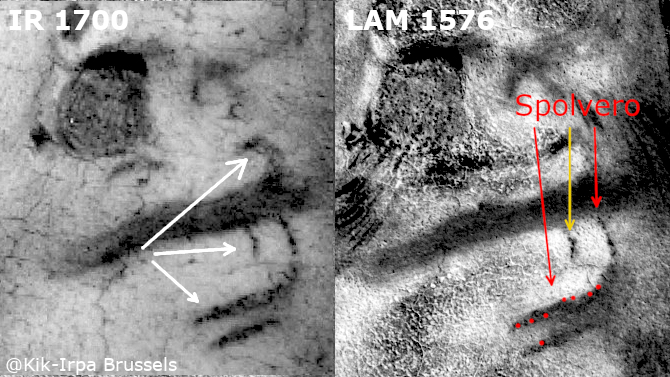
The Lower Lip
In the infrared image on the left, traces of the preparatory drawing can be seen on Christ’s lips, and spolvero dots can be faintly detected. In the LAM image on the right, these dots are clearly visible.
The Ear
At the junction between the earlobe and Christ’s right cheek, several spolvero dots can be seen in the LAM images, some of them connected by a line.
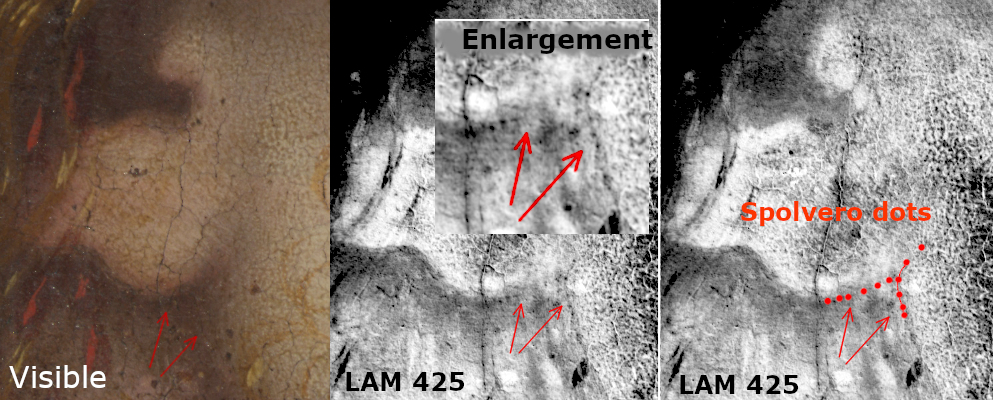
The Neck
Beneath the charcoal or black-chalk lines visible on the folds of Christ’s neck in the IR image, spolvero dots have been revealed by LAM imaging.
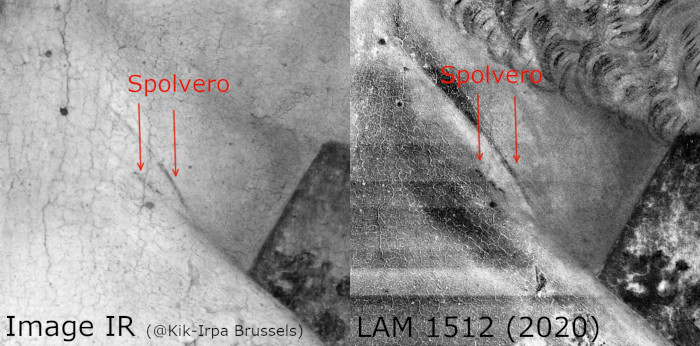
The Right Hand
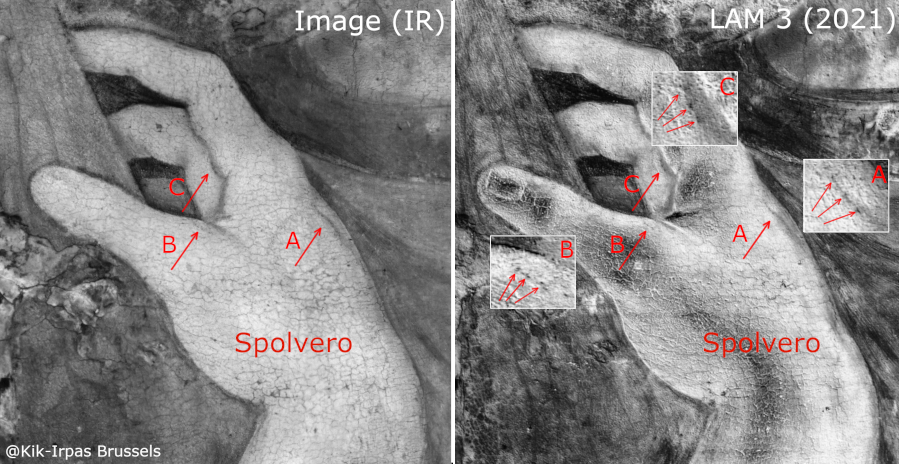
Several spolvero dots have been found in Christ’s hand at points A, B and C:
- the spolvero dots at A, located inside the hand rather than on its boundary corresponding to the final tracing, indicate a pentimento;
- the three dots at C were first identified using the infrared image.
Conclusion
The distribution of spolvero dots therefore confirms a pouncing transfer for Christ, at least in several structural areas. The absence of identified spolvero on the right-hand figure reinforces the hypothesis of a differentiated transfer, probably linked to a distinct stage in the execution.