Portrait of a Young Man and the Figure in The Painting
The Portrait of a Young Man, preserved at the Uffizi under inventory number 566 E, associated with the Leonardo da Vinci collection and recorded in the former Euploos entry as seguace (?) [follower (?)], is not securely dated. Its attribution remains debated: it has been associated with Sodoma, with an unknown Milanese artist, and later with Boltraffio, an attribution that has also been rejected by some scholars.
In this context, the comparison proposed here is limited to one specific element: the central decorative band of the garment, which shows a structural similarity to the green band worn by the Figure in the Painting.
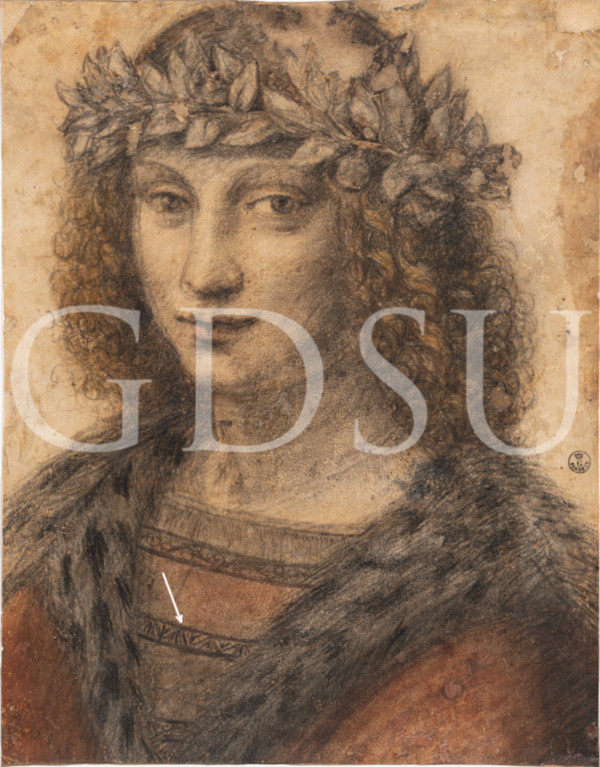


A Comparable Ornamental Motif
The comparison reveals a structural similarity between the decorative band in the Portrait of a Young Man and that of the Figure in the Painting. In both cases, the decoration is arranged within a narrow band around a sequence of chevrons accompanied by small branching motifs, alternately oriented.
The decorative band in the Uffizi drawing shows a more continuous and regular arrangement. That of the Painting is less homogeneous, notably because of its material condition and the alterations made in the area of the button, but its overall structure remains legible. The comparison therefore concerns less the exact identity of each individual sign than the repetitive organisation of the decoration and the association of the chevrons with these small branching forms.


Comparative Reading of the Decorative Bands
The tracings reproduce as closely as possible the lines visible in the two decorative bands. They reveal a sequence of chevrons accompanied by small branching forms, alternately oriented upwards or downwards.
This arrangement is particularly clear in the Portrait of a Young Man and remains legible in the Painting, despite the disruption caused by the button. The detail indicated by the red arrow shows that the button is now off-centre in relation to the two central chevrons.
The technical image provides an explanation: area 2, outlined in yellow, corresponds to the area where the button was enlarged towards the left during a repainting intervention. This alteration, examined in section 8 of the page devoted to repainting, does not prevent the overall structure of the decorative band from being recognised.


A Graphic Comparison with a Sheet by Leonardo at Windsor
A comparable graphic form can be observed in a sheet by Leonardo da Vinci preserved in the Royal Collection at Windsor, RCIN 912349. On both the recto and the verso, small branching structures formed by converging lines appear repeatedly, alternately oriented upwards or downwards.
The Royal Collection states that these “small branching lines” belong to Leonardo’s studies for the casting of the Sforza equestrian monument: they represent the channels through which the molten metal was intended to flow. Their function is therefore entirely different from that of the garment motifs examined here.
Official entry for RCIN 912349 — Royal Collection Trust
The comparison proposed here is exclusively graphic. It concerns the same formal principle: several lines converge towards a common point or line, producing a small fan-like or branching structure repeated in opposing orientations. This type of construction recalls the secondary motifs visible in the decorative bands of the Portrait of a Young Man and the Figure in the Painting.
This observation does not establish any direct relationship between the technical drawings at Windsor and the garment motifs. It therefore constitutes an additional comparative element, without any independent attributive value.


Comparison of the Branching Structures
The Windsor detail is shown between the tracings of the two decorative bands in order to compare their graphic construction exclusively.

