Giampietrino and The Painting: Presumption of a Shared Cartoon
Why speak of a “cartoon”?
Several Milanese versions of Christ Carrying the Cross attributed to Giampietrino show a striking proximity to one another and to The Painting, down to the structural framework of the figure: inclination of the head, axis of the torso, position of the arm, and relationship between the face and the cross. The simplest explanation is the use of a working template: a cartoon, or an equivalent model, allowing the composition to be transferred. The Cartoon and Spolvero page presents the material indications.
The cartoon presented here is not a surviving independent document: it reconstructs the tracings and main lines observable in The Painting. On this basis, it is treated as a reconstruction of the Christ figure’s structural scheme, with the working hypothesis that the right-hand figure was not included in the original cartoon.
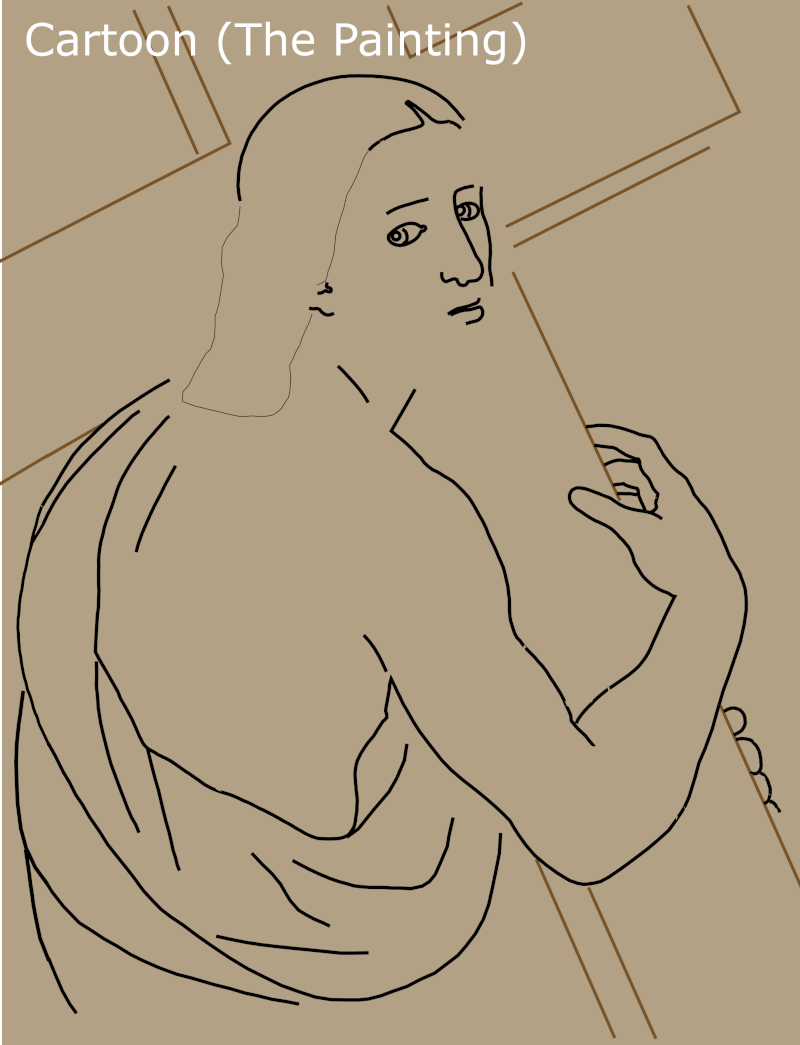
What the Comparisons Show
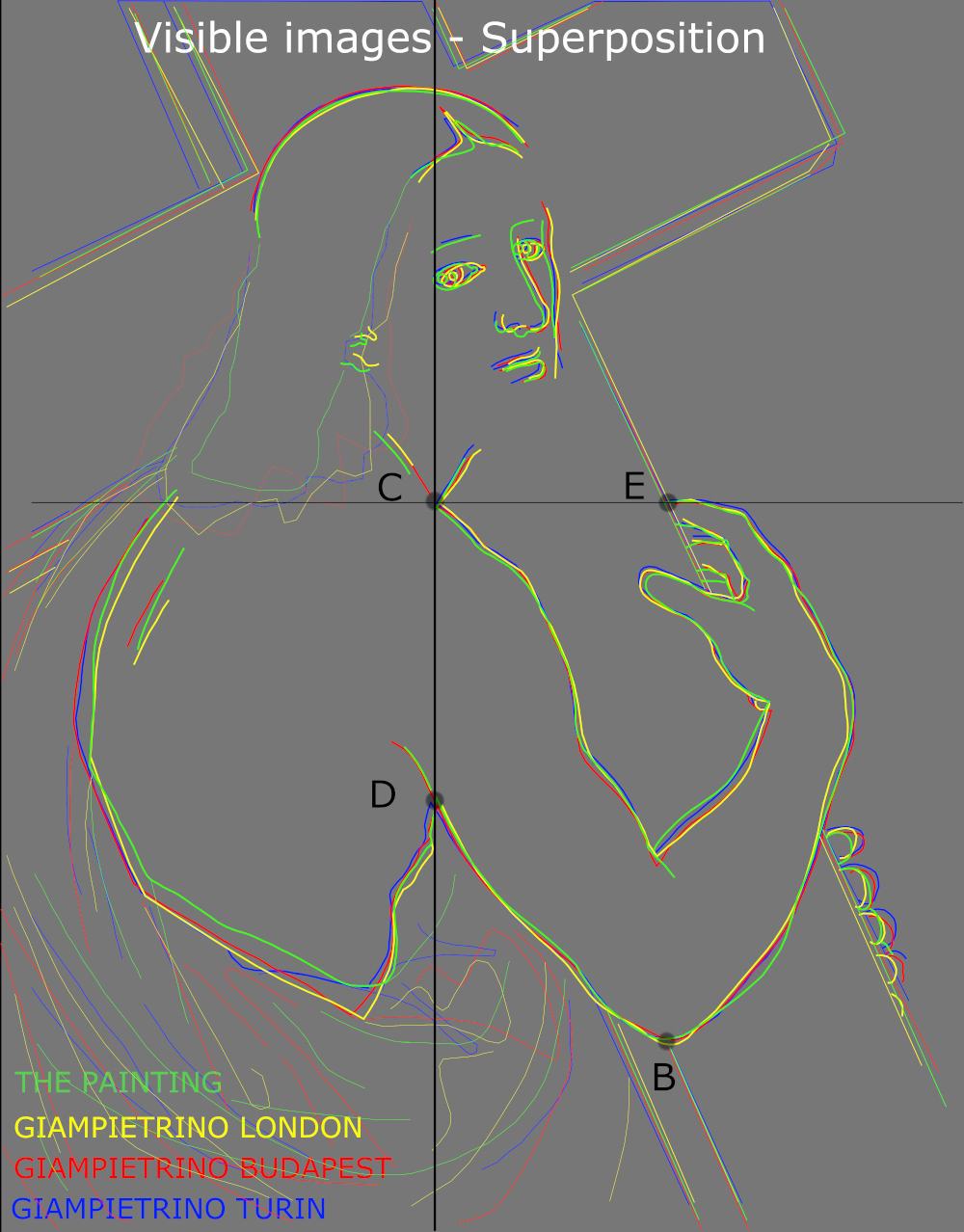
The image overlays, in visible light and infrared, indicate that:
-
The scheme of Christ recurs with great consistency in the London, Budapest and Turin versions, which form the most homogeneous group: the main guiding lines coincide, beyond differences of handling and condition.
-
The Painting belongs to the same general scheme: its constructional logic implies a shared model, either a cartoon or an intermediate model derived from the Venice Drawing.
-
The larger-format versions — Vienna and Milan — seem to belong to an adaptation: correspondences are still recognisable, but less systematic, suggesting either an enlarged cartoon or a freer reuse of the same model.
An Important Point: “Same Model” Does Not Mean “Same Hand”
Recognising a shared cartoon does not imply that the works are by the same author.
A single template may produce:
- workshop paintings, based on faithful repetition;
- freer variants, with adjustments;
- or a work that relies on the model while showing a distinct logic of execution.
This is precisely the value of the comparison: to separate compositional kinship, meaning the model, from the manner of painting, meaning the execution.
Scope and Limits of the Conclusion
The idea of a shared cartoon accounts for the strong proximity between several versions, including The Painting, without yet determining its exact form. Formats, cropping and restorations explain part of the differences. The central question remains: does The Painting belong to a workshop reuse, or to an autonomous execution based on the same model?