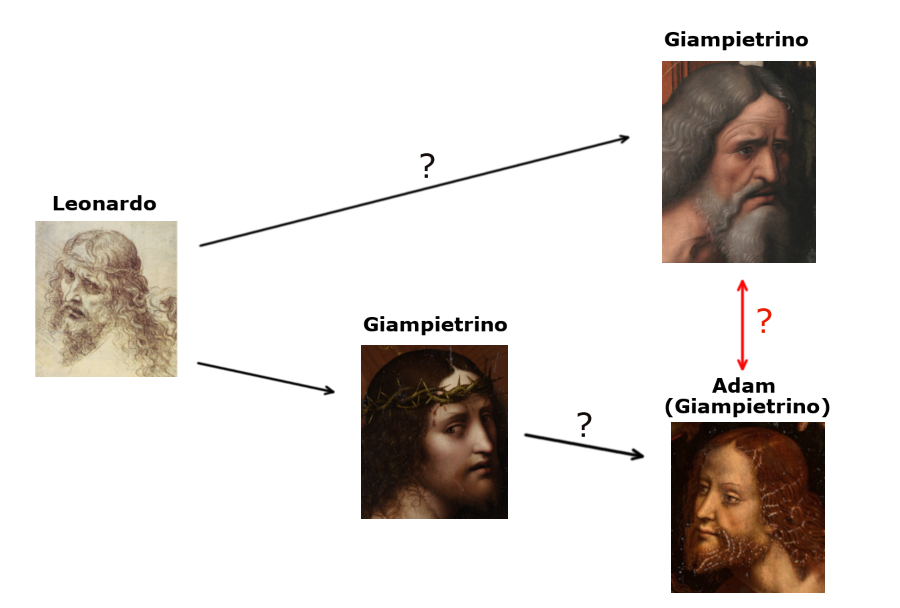
Adam–Thaddeus: Possible Reuses of the Model
After establishing the connection between Thaddeus and the Venice Drawing, it is useful to examine another face attributed to Giampietrino: that of Adam in Adam and Eve in the Garden of Eden. This page first explores the possible link between Adam and the Venice Drawing, then the resulting comparison between Adam and Thaddeus.
The painting Adam and Eve in the Garden of Eden, attributed to Giampietrino, provides a relevant field of observation. Early sources mention a lost cartoon by Leonardo representing Adam and Eve in a meadow “scattered with an infinite number of flowers” (Vasari, Anonimo Gaddiano), cited by Kenneth Clark (Leonardo da Vinci, 1939, p. 153).

Adam and Eve (Giampietrino)
Date: 1500–1548, Dimensions: 74.5 × 58 cm
Technique: oil on panel
The Venice Drawing and Adam
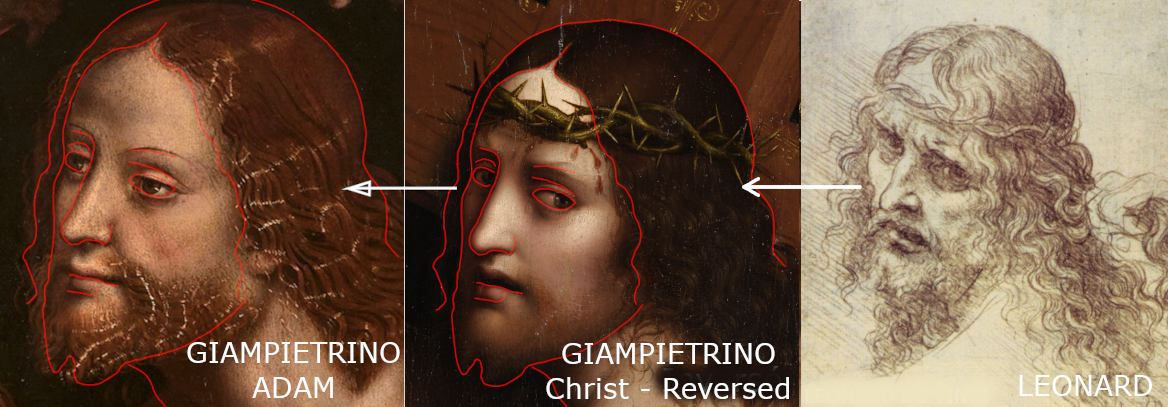
The analysis of Adam’s head reveals a structure very close to that of the Christ Carrying the Cross figures attributed to Giampietrino, themselves derived from the Venice Drawing. In the opposite image, the outline of Giampietrino’s Christ is transferred onto Adam’s face: the correspondence is almost perfect, with the same main lines and the same structure of the forehead, nose and hair.
The comparison suggests that, in constructing Adam’s head, Giampietrino reused a reversed model, then corrected its orientation and certain details. This process belongs to a logic of reuse: the same figure is displaced from one context to another while retaining its fundamental structure.
The two figures below illustrate this. The Venice Drawing, now placed on the right in each montage, provides the initial reference point. The reversed Christ figures follow its general scheme; Adam can therefore be understood as a further adaptation of the same model.
A Shared Outline: Adam and Christ
Giampietrino’s Christ image reversed
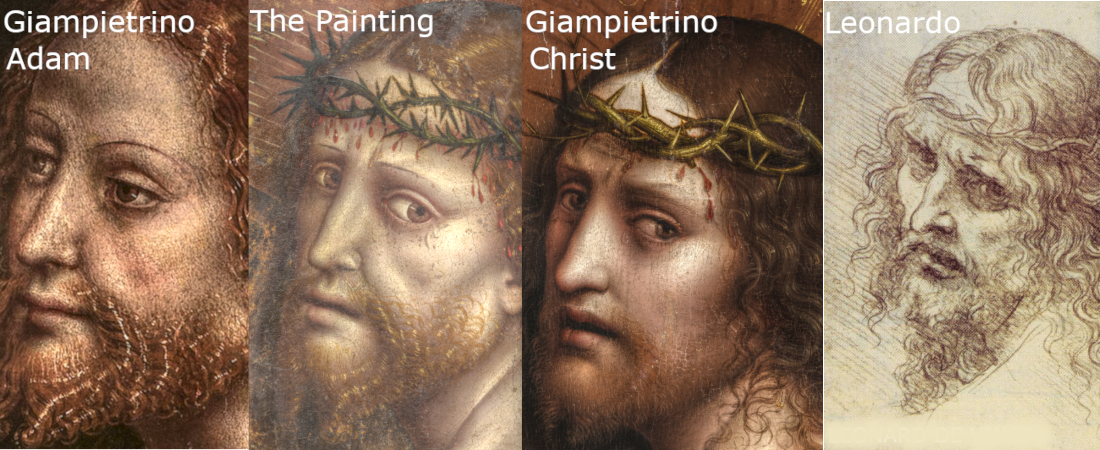
Adam and The Painting: an Almost Identical Beard
Adam’s beard shows a very close relationship with that of The Painting: the same bifid form, the same general rhythm, the same hook-shaped endings and the same logic of highlights. The beard of Giampietrino’s Christ in Budapest does not offer the same correspondence.
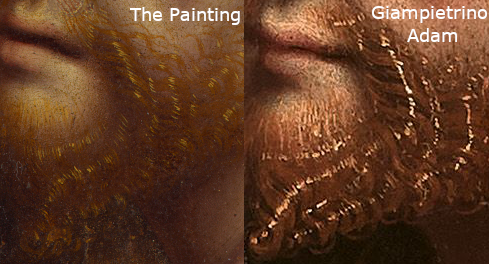
A Similar Distribution of Beard Highlights
Image of Christ in The Painting, reversed
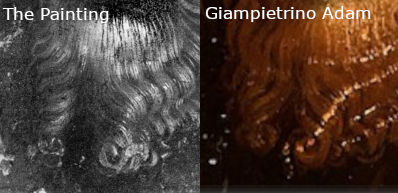
A Bifid Beard: the Same Hook-Shaped Structure
Image of Christ in The Painting, reversed
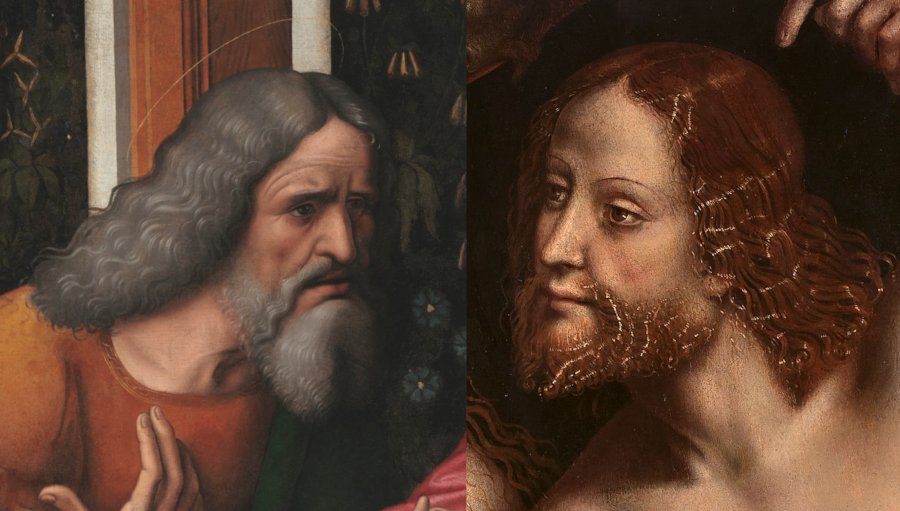
Adam and Thaddeus
The comparison between Adam and Thaddeus follows directly from a double observation: first, the preceding page showed the proximity between Thaddeus and the Venice Drawing; second, the analysis above showed that Adam’s head also belongs to the same type, transmitted through the Christ Carrying the Cross figures. The link between Adam and Thaddeus is therefore not an autonomous starting point: it emerges as the consequence of a common source.
A Comparison Noted by an Expert
This comparison between Adam and Thaddeus was also formulated independently. Regarding the painting Adam and Eve attributed to Giampietrino, La Gazette Drouot wrote in April 2019 that the man’s face would reuse a model also found in The Last Supper, according to the analysis of Cabinet Turquin:
“this panel representing Adam and Eve attributed to the artist is inspired, for the faces, by works of Leonardo, particularly for the Man, whose model is found in The Last Supper, as analysed by Cabinet Turquin”
Conclusion
The Venice Drawing appears as a reference model within the workshop. Its most direct extension can be seen in Giampietrino’s Christ Carrying the Cross figures. The comparisons with Adam and Thaddeus in turn suggest the circulation of a single Leonardesque type, adapted and reused in several compositions of the Milanese school.