Three Comparative Copies of The Last Supper
Because Leonardo’s mural is now in a highly altered condition, the study of Thaddeus cannot rely solely on its present visible state. Three early copies of The Last Supper are therefore used here as comparative material: those by Marco d’Oggiono, by Giampietrino/Boltraffio, and by Tongerlo. They make it possible to assess more precisely the structure of Thaddeus’s head and its relationship to the Venice Drawing.
Marco d’Oggiono’s Last Supper
- Location: Musée de la Renaissance, Château d’Écouen, France (on deposit from the Louvre Museum)
- Date: between 1506 and 1509
- Dimensions: 206 × 575 cm
- Technique: oil on canvas
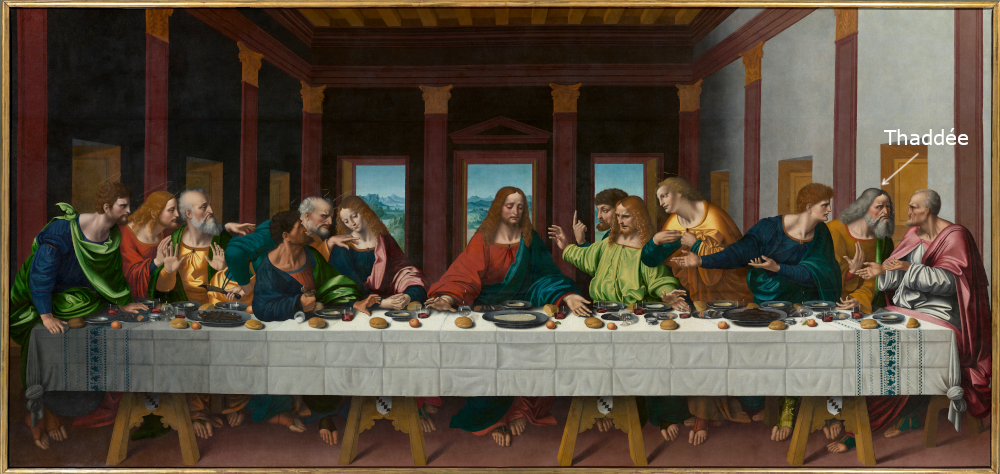
Commissioned in 1506 by Gabriel Gouffier, dean of the chapter of Sens Cathedral, this copy is among the earliest known versions. It is now preserved at the Château d’Écouen. Smaller than the original — about one third less in width — it remains close to Leonardo’s composition and is notable for the richness of its details, especially on the table.
The Last Supper attributed to Giampietrino/Boltraffio
- Location: Royal Academy of Arts, London
- Date: c. 1515–1520
- Dimensions: 302 × 785 cm
- Technique: oil on canvas

This full-scale copy is the most detailed and complete known version of The Last Supper. It served as a major reference during the restoration of Leonardo’s mural between 1978 and 1998. It preserves elements now lost from Leonardo’s work, including Christ’s feet, the transparent glass carafes on the table, and the floral motifs of the wall tapestries.
The Tongerlo Last Supper
- Location: Tongerlo Abbey, Belgium
- Date: c. 1507–1509, or c. 1520 according to some authors
- Dimensions: 418 × 794 cm
- Technique: oil on canvas

This version is preserved at Tongerlo Abbey in Belgium. Some authors have suggested that it may have been produced in Leonardo’s workshop, with the participation of his pupils — Giampietrino, Solario and Oggiono — and that it might even contain interventions by the master himself. These elements support the view that it is a faithful copy, close to the original in scale.