Paint Layer: What the Analyses Reveal
This page summarises the main available data on the paint layer: samples, non-destructive analyses, observed stratigraphies, identified pigments and thickness estimates. It brings together the principal material evidence that informs the execution technique of the panel. Alongside this analysis, a final section also offers a simplified reading of the lighting of the scene based on the visible image.
Available Data
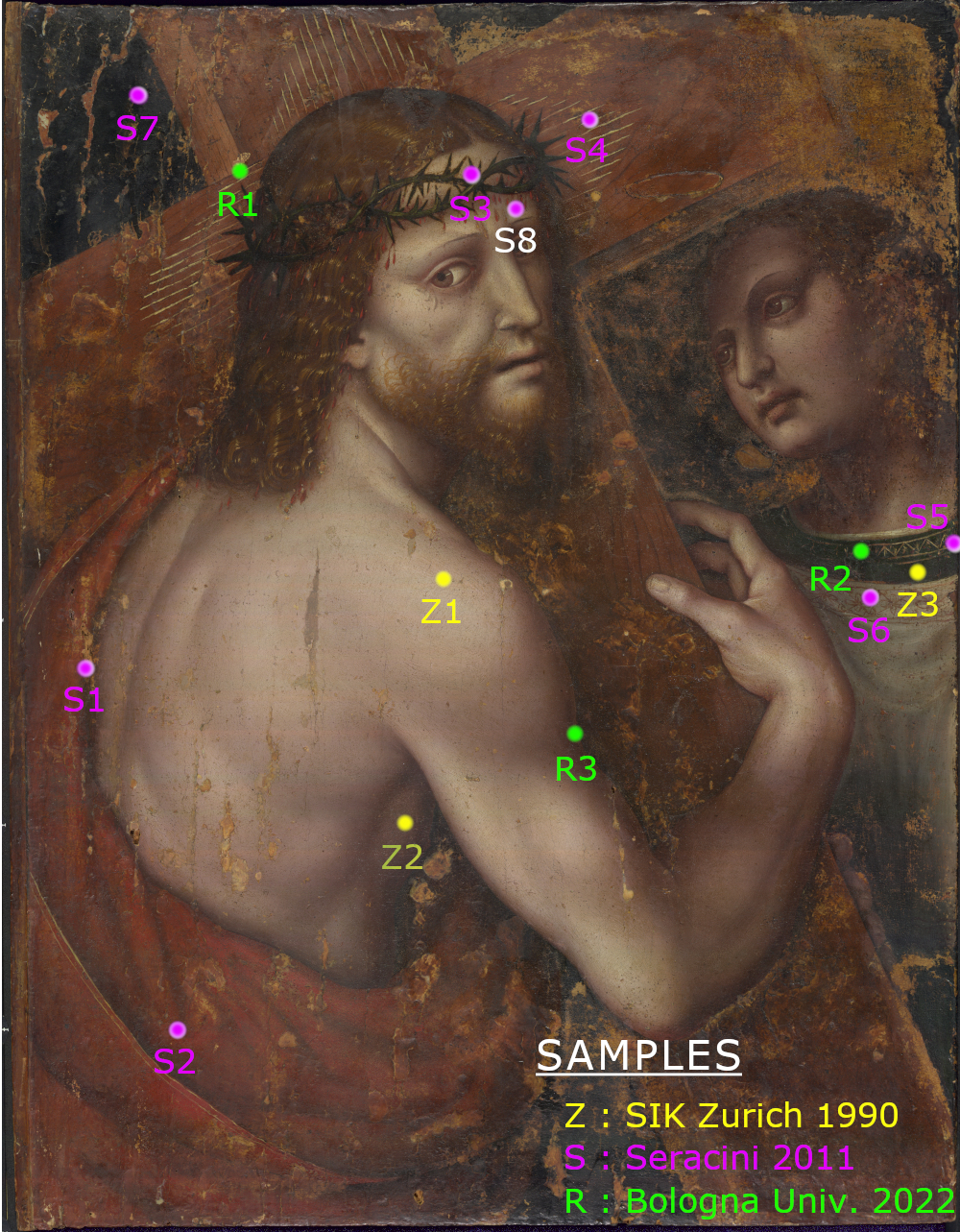
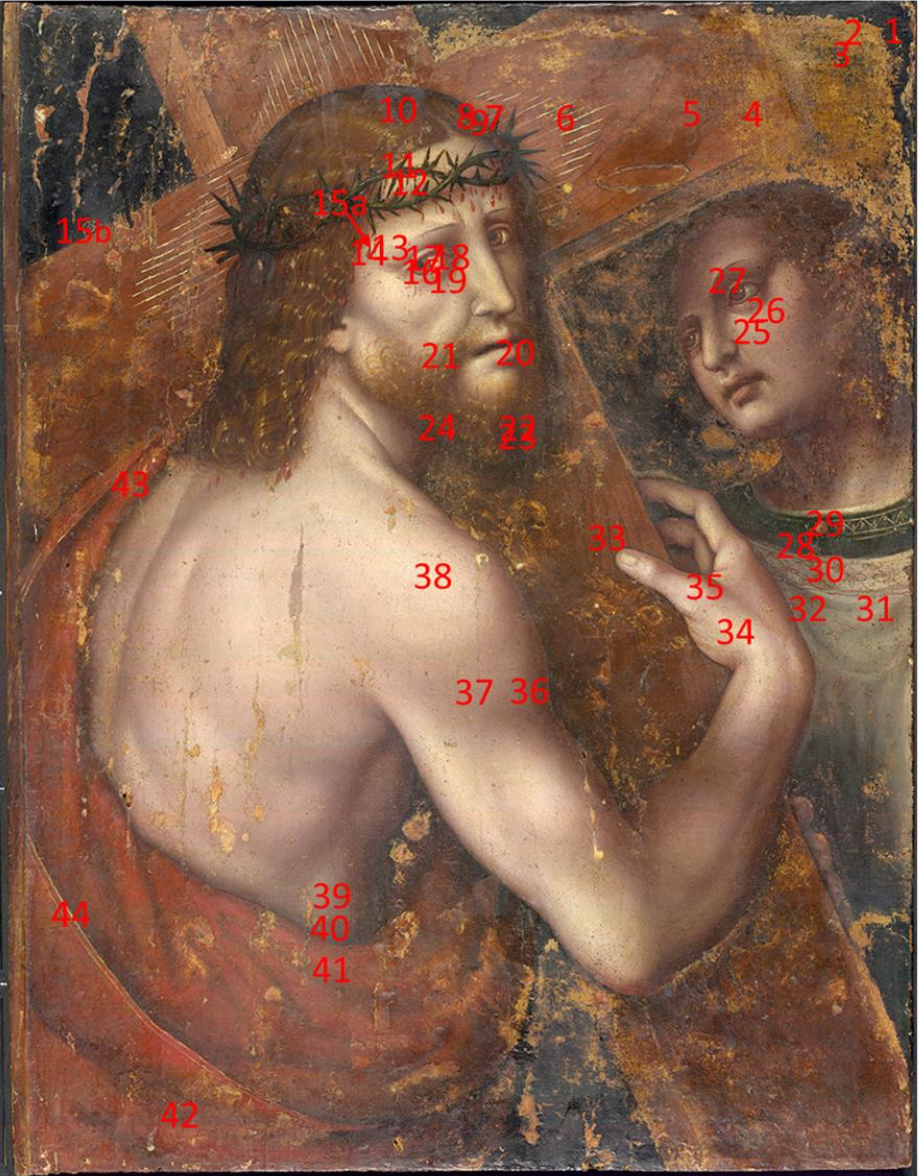
The paint layer is documented by 14 samples taken between 1990 and 2022: SIK ISEA Zurich (3), Seracini/Editech Florence (8), University of Bologna–Ravenna (3). In addition, the University of Bologna carried out a non-destructive campaign combining XRF and videomicroscopy on 44 measurement points. These data form the documentary basis of the study. They make it possible to examine, in turn, the preparation, underlayers, pigments and thickness of the paint.
Paint-Layer Stratigraphy
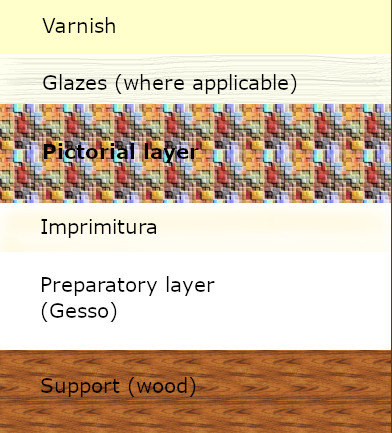
The diagram opposite presents a typical stratification of Italian Renaissance painting. The analyses of The Painting indicate an overall structure compatible with this model: wooden support, gesso preparation, imprimitura, paint layer and varnish. In some areas, a lead-white underlayer may be inserted above the imprimatura; this is the case in The Painting, as discussed below. No glazes, where applicable, have been identified at this stage; however, the cleaning of The Painting in the 1960s may have altered or removed possible glazes.
Preparation and Imprimatura
The analyses converge towards a gesso preparation (calcium sulphate). They differ, however, on the exact nature of this preparation and on the presence of an imprimatura. See the detailed study.
SIK ISEA (1991)
Gesso + organic imprimatura
Seracini (2011)
Gesso grosso (anhydrous CaSO₄) and no identified imprimatura
University of Bologna (2022)
Gesso sottile (CaSO₄·2H₂O) and an organic imprimatura, consisting of a single colourless layer rich in binder.
A 1991 report by the Centre de Recherches des Musées de France (C2RMF) stresses a methodological point: to characterise fully the preparation of an Italian panel, a sample taken down to the wood is normally required. This condition does not seem to have been met in the Seracini and Bologna campaigns, except where specifically noted.
Lead-White Underlayer
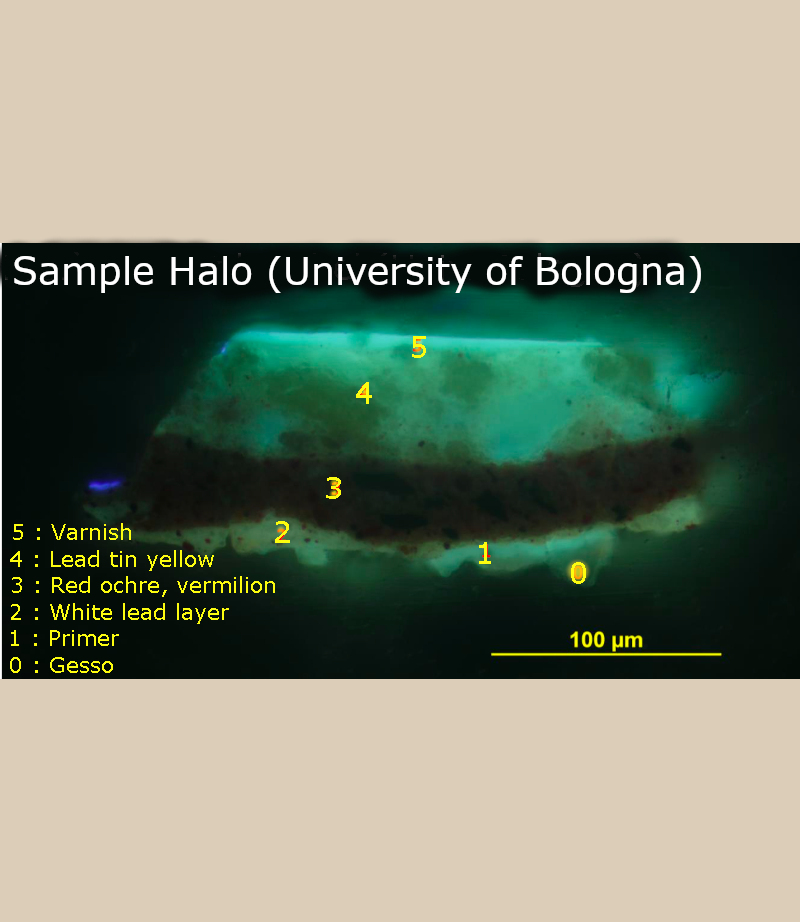
Above the gesso (layer 0) and the imprimatura (layer 1), the examinations frequently report a lead-white underlayer.
In the halo sample studied by the University of Bologna, a lead-white layer appears beneath the brown of the cross. The report interprets it as an underlayer intended to reinforce lighting effects coming from the background. This underlayer is reported in almost all analysed points, except in areas already dominated by lead white, such as some flesh tones and the tunic of the Figure.
Identified Pigments
The samples describe a palette compatible with an Italian Renaissance oil painting:
- Lead white
- Ochres / earth pigments
- Cinnabar / vermilion
- Carbon black
- Red lake
- Verdigris (reported by Seracini)
- Bone black (reported by Seracini)
Lead-tin yellow is reported in areas associated with interventions: the halo, absent from the original state, and the collar button of the Figure, identified as repainted.
The Bologna report also notes the frequent presence of copper in the XRF analyses. This may correspond to a siccative, but the interpretation remains open, especially in some black areas where the values are high.
Thickness of the Paint Layer
On 11 samples (Seracini + Bologna), the thickness of the paint layer, excluding gesso, is reported as thin, around ~50 µm. The report states that this thinness is consistent with earlier observations mentioned in restoration reports and technical examinations.
Measured samples: 11 — Thickness, excluding gesso: 50 µm to 80 µm
Reading of the Lighting
The visible image shown here has been digitally adjusted to make the areas of light and shadow more legible. In this type of adjustment, the areas that appear more “golden” generally correspond to highlights and zones receiving direct light, here from the upper left corner. They are also, as a rule, the areas richest in lead white.
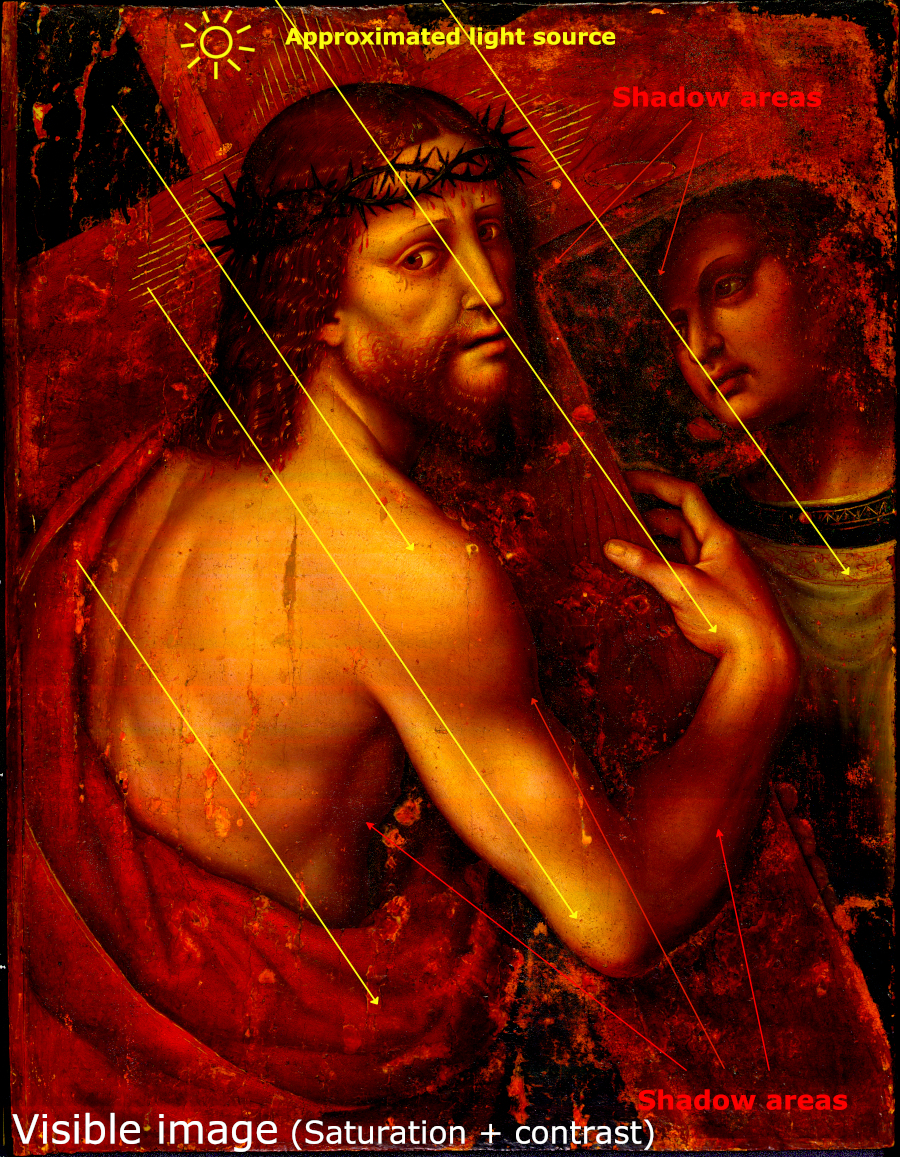
Lighting of the scene (enhanced visible image)
– Increased contrast and saturation (visualisation)
– Light source: upper left corner
– “Golden” areas: highlights / direct light, often richer in lead white