Red Wax Seal: Evidence of a Passage through Rome from 1814 Onwards
On the verso of The Painting, in the upper left corner, there is a red wax seal approximately 2 cm in diameter. It is one of the most explicit material markers in the recent history of the work. An identical seal has been identified on ten other works, suggesting the repeated use of the same matrix.
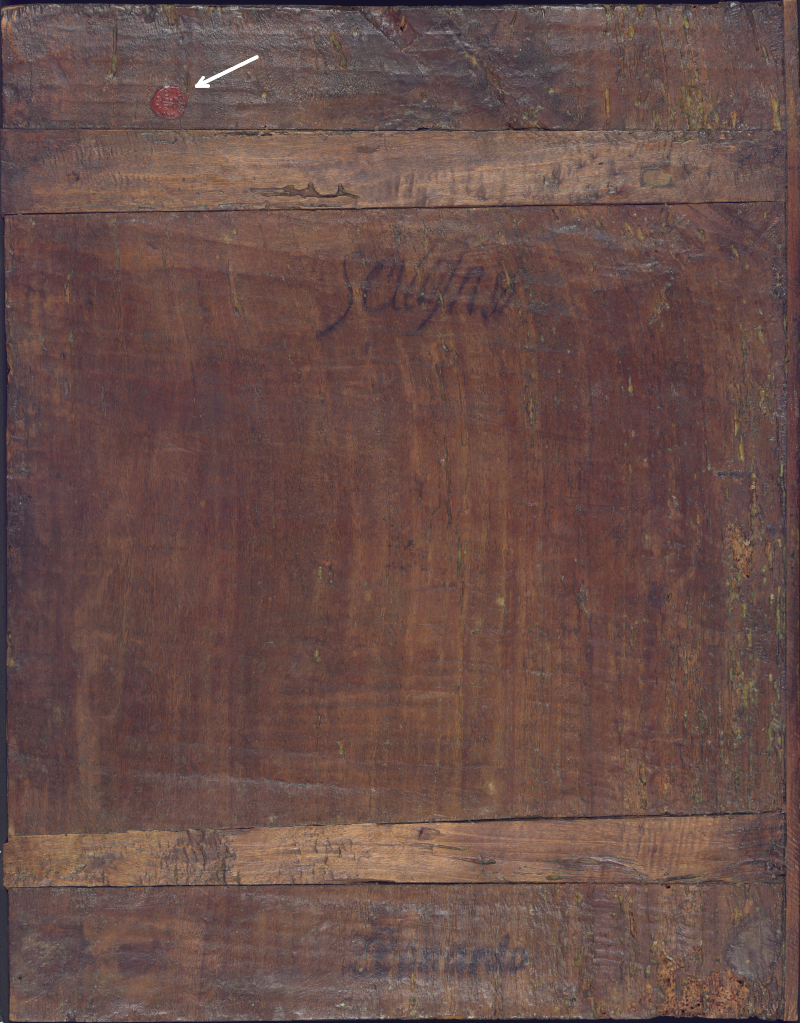
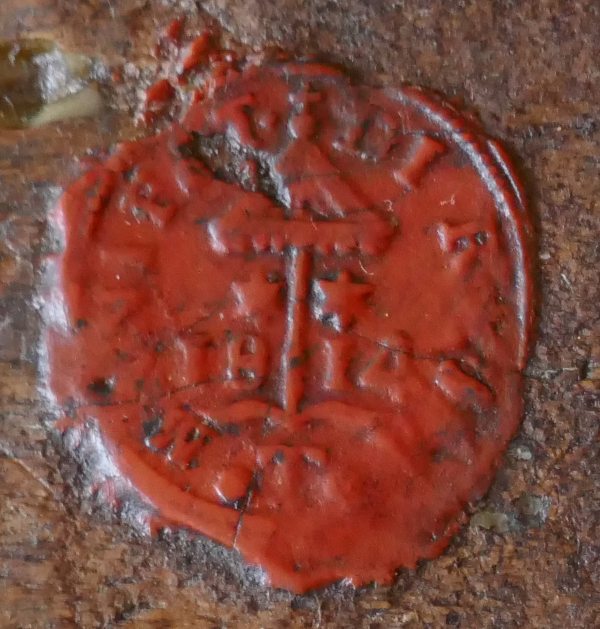
The red wax seal — matrix dated 1814
Material evidence of a passage through Rome from 1814 onwards.
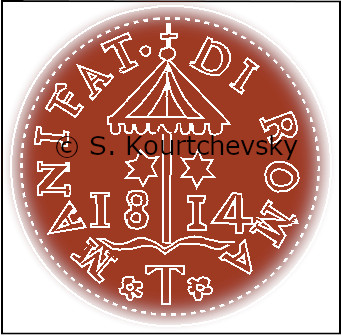
Reading and Reconstruction of the Motif
The reconstruction makes it possible to distinguish several elements:
- MANIFAT. DI ROMA — the inscription MANIFAT. DI ROMA can be read without ambiguity and refers to MANIFATTURA DI ROMA;
- a large letter T, framed by two motifs, interpreted as roses;
- the date 1814;
- a papal ombrellino, without crossed keys;
- two six-pointed stars;
- an orb surmounted by a cross.
A first hypothesis would identify the letter T as the initial of tabacco, “tobacco” in Italian, and would link the whole to the Rome Tobacco Manufactory in the early nineteenth century.
Works Bearing the Same Seal
The recorded works, dating from the fourteenth to the eighteenth century and mostly held in public collections, are:
- Saint John the Baptist (c. 1335), Pietro Lorenzetti — Vatican Pinacoteca.
- Madonna and Child with Angels (c. 1450), Sassetta — Metropolitan Museum (New York).
- Madonna and Child (c. 1450), Maestro di Pratovecchio — Brera (Milan).
- Madonna and Child, Saints and Scene from the Life of Christ (1346–1355), Giovanni da Milano — Galleria Corsini (Rome).
- Christ as Saviour (c. 1510), School of Parma (?) — Walters Art Museum (Baltimore).
- Young Child (Madrid, c. 1770), Lorenzo Tiepolo — private collection (Venice).
- The Peruzzi Madonna (c. 1500), attributed to Raphael or to a close collaborator — private collection.
- Private collection (unspecified).
- Lucretia and Collatinus (1450–1500), unknown artist — Louvre collections, on deposit at the Petit Palais (Avignon, France).
- The Storm, Gaspard Dughet (1655–1658) — Musée des Beaux-Arts de Reims (France).
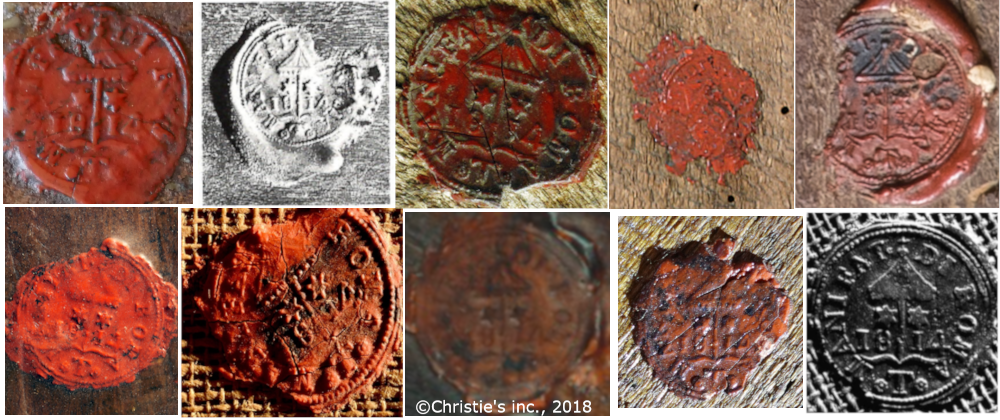
Comparison of seal impressions on other works
The Painting: upper left
Research into the Origin of the Seal
So far, it has not been possible to trace the provenance of these various works before 1814.
In October 2020, the seal was examined by Professor Luca Becchetti, curator of seals at the Vatican Apostolic Archives. He proposed the hypothesis of a seal from the Rome Tobacco Manufactory (Appendix 4), while specifying that the matrix dated 1814 may have been used well after that date. In the absence of any formal link established between this Manufactory and the art world, he nevertheless excludes no other interpretation.
The date 1814 is significant in itself: it corresponds to the return of Pope Pius VII to Rome after his exile under Napoleon, and to the restoration of papal authority. This context reinforces the idea of a seal connected with a Roman or papal administration re-established that year.
The documentation of the Metropolitan Museum of Art and the Walters Art Museum, for their part, refers to a customs seal of the Papal States.
A further important element comes from a reply by Claudio Dominicis, of the Istituto Moroniana in Rome. According to him, the letter T would probably refer to tabacco, “tobacco” in Italian; the central ombrellino, without crossed keys, would concern the temporal power of the Church. He adds that seals dated simply 1814 could correspond to the Pope’s return and to the restoration of the papal administration, in a context in which customs and monopolies were closely linked.
This hypothesis therefore brings together several converging indications: the letter T, the date 1814, the return of Pius VII and the mention of a customs seal. Given the number of works bearing the same seal, it now appears to be one of the most convincing lines of inquiry.