The Lower Motif on the Tunic of the young figure: A Later Addition
The figure to the right of Christ remained concealed for several centuries beneath a layer of black overpaint. Its rediscovery brought to light a series of later interventions affecting this part of the Painting. Following the identification of the later addition of Christ’s halo, a further observation concerns the lower decorative motif on the young figure’s tunic.
This study shows that the motif was added after the garment had been originally painted. This conclusion is based on two converging observations: the stratigraphic analysis of Sample No. 6 and the examination of the craquelure pattern visible in the macrophotographs.
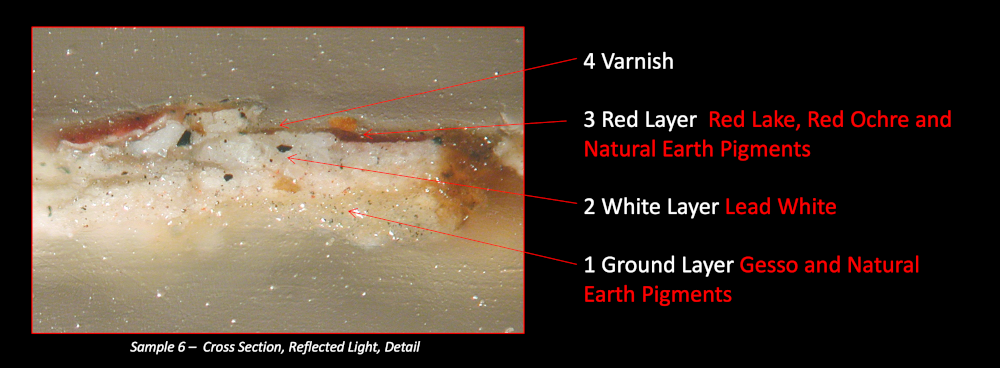
The stratigraphic cross-section demonstrates that the red paint layer of the motif lies on top of a white layer containing lead white. In addition, the macrophotographs show that the red paint penetrated cracks already present in this underlying light-coloured layer, indicating that these craquelures predated the application of the motif.
Two Motifs Executed at Different Times
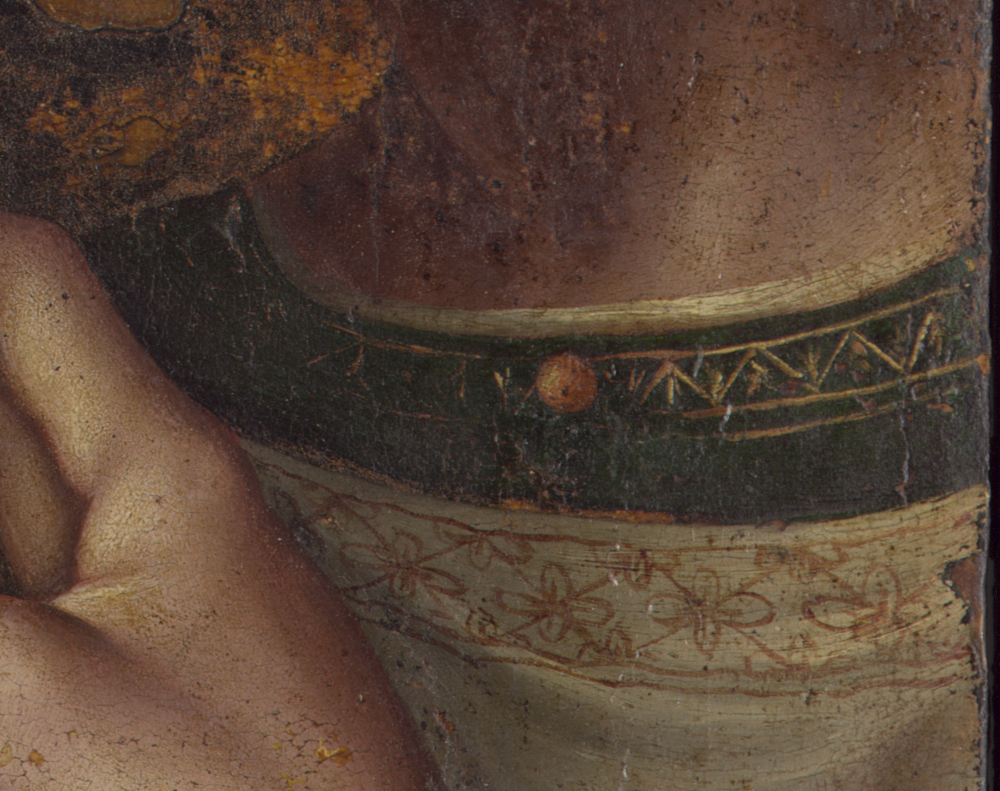
The tunic bears two distinct decorative elements. Beneath the collar, a geometric border consists of gilded triangles or chevrons arranged against a dark ground. Lower down, a red-brown motif composed of curved lines and vegetal forms is painted on a light-coloured band.
The first decoration is regular and integrated into the construction of the collar. The second is freer in design and is superimposed on the already painted surface of the garment.
This difference in conception is confirmed by the material analysis of the lower motif.
Stratigraphy Demonstrates the Superimposition of the Motif
Sample no. 6 was taken from the area of the red-brown motif. Its stratigraphic cross-section reveals four principal layers:
- a preparatory layer composed of gesso and natural earth pigments;
- a white layer containing lead white;
- a red layer composed of red lake, red ochre and natural earth pigments;
- a varnish layer.
The red layer corresponding to the motif lies above the white layer of the tunic. The decoration was therefore applied after the execution of the light-coloured paint of the garment.
This sequence establishes that the lower motif does not belong to the tunic’s initial paint layer.
The Red Paint Penetrated the Craquelure
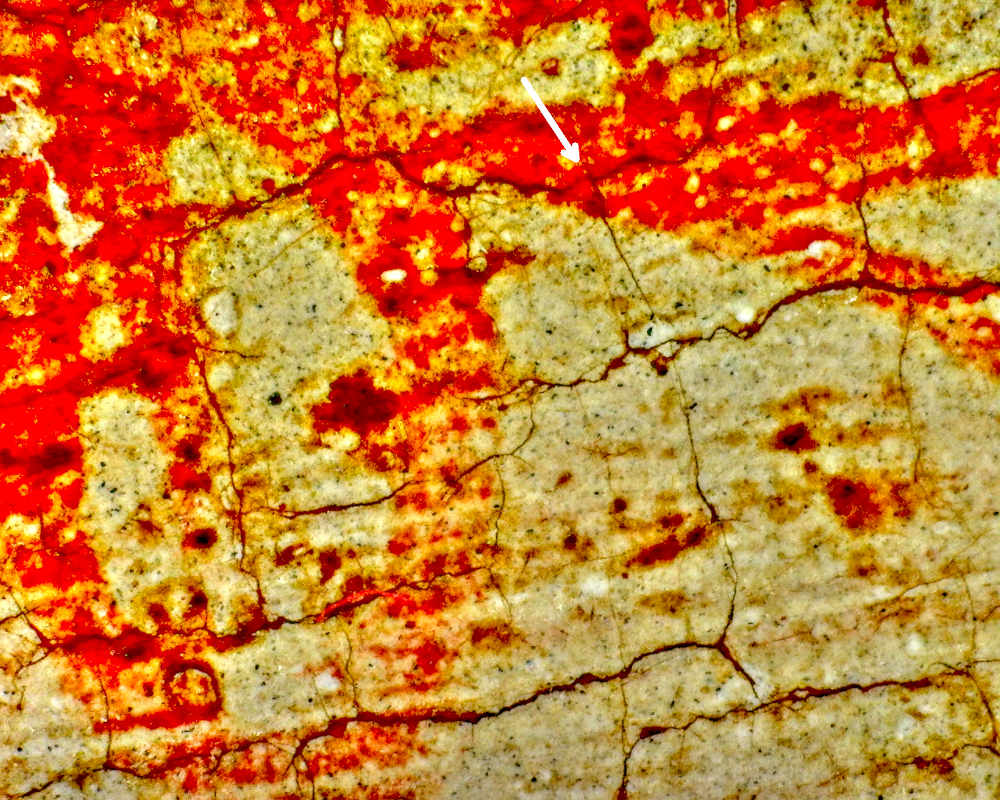
Macrophotograph A001 makes it possible to examine the relationship between the red paint of the motif and the craquelure network of the light-coloured layer. The image was digitally processed using the algorithm developed by Fattal et al. (2002) in order to enhance variations in surface and colour.
In the area indicated by the white arrow, red paint is present inside a crack. It follows the opening of the crack and locally covers its edges.
This configuration shows that the crack already existed when the red motif was applied.
Application over an Already Cracked Layer
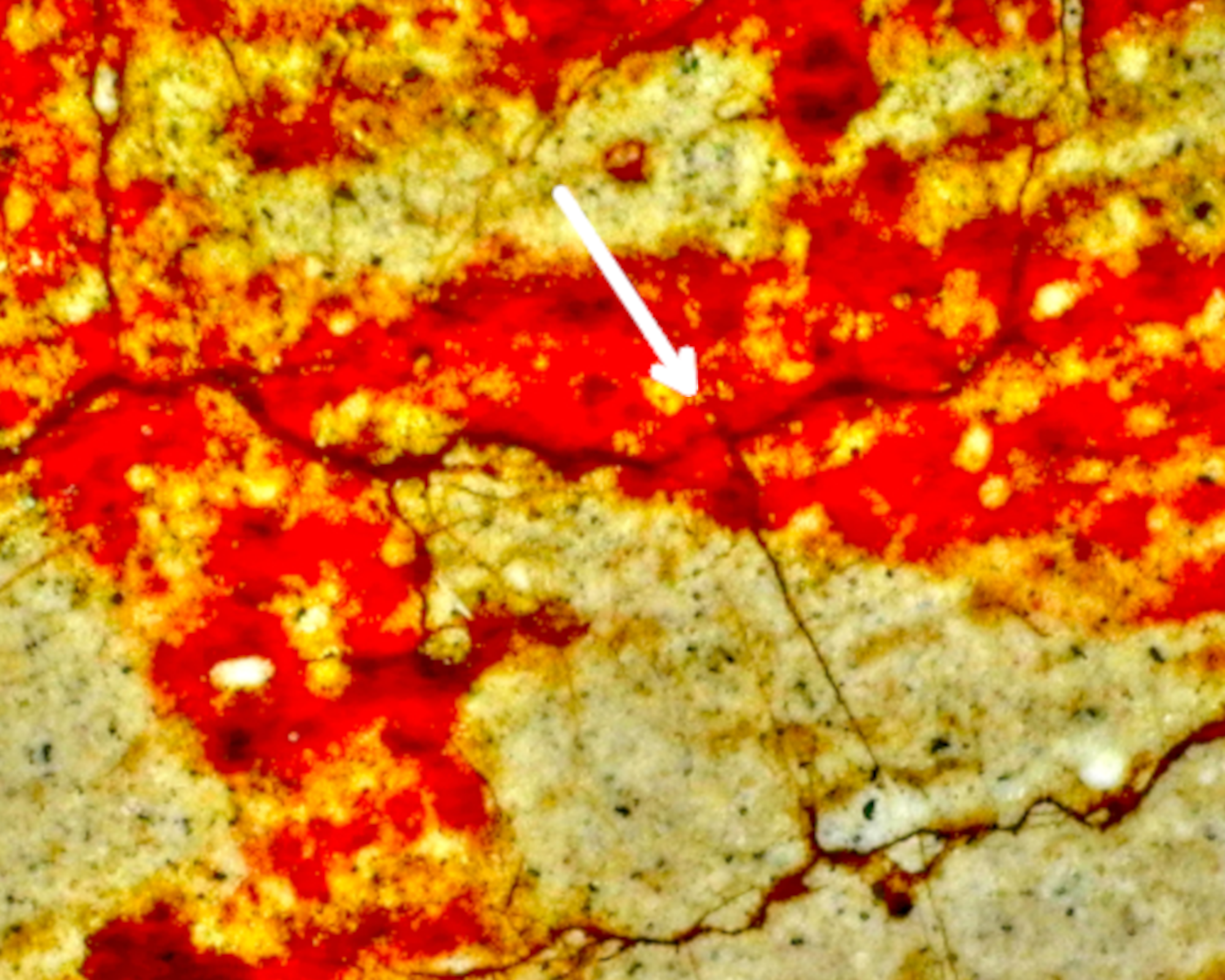
The 300% enlargement confirms the reading of the indicated area.
The red paint extends into the opening of the crack and locally covers its sides.
The motif was therefore painted over a white layer that had already dried and cracked.
Conclusion: A Motif Added at a Later Stage
The stratigraphic cross-section of sample no. 6 shows that the red layer of the motif lies above a white layer containing lead white. The macrophotographs also show that this red paint penetrated cracks in the light-coloured layer.
The material sequence can therefore be reconstructed as follows: the light-coloured tunic was painted first, its surface then dried and cracked, and the red-brown motif was subsequently applied.
The lower motif does not therefore belong to the garment’s initial paint layer. It constitutes a later addition. This relative chronology does not yet make it possible to date the intervention precisely or to identify its author.