Overpaints: detailed study of the intervention areas
The Christ Carrying the Cross has undergone several overpaints, additions and alterations, examined here area by area through the study of the paint layer, X-radiography, multispectral imaging, stratigraphic analyses and craquelure, as a complement to the page devoted to the six phases of intervention.
How should this study be read?
The identification of an overpaint and its relative dating rely on the comparison of several types of evidence — craquelure, pigments, X-radiography, infrared imaging, stratigraphy and photographic states — with a varying degree of certainty. Where the chronology cannot be established with certainty, interpretations are presented as hypotheses, distinct from the material observations.
Main areas studied
- The halo: a later addition
- The crown of thorns
- The blood drops
- The beard and hair
- Christ’s robe and its borders
- The cross
- The Figure’s tunic
- The upper motif and the tunic button
- The lower motif added to the tunic
- The Figure’s right shoulder and neck
- “Smudging”: a lead-white intervention
- The black overpaint covering the Figure
- The 1960s restoration: uncovering the Figure
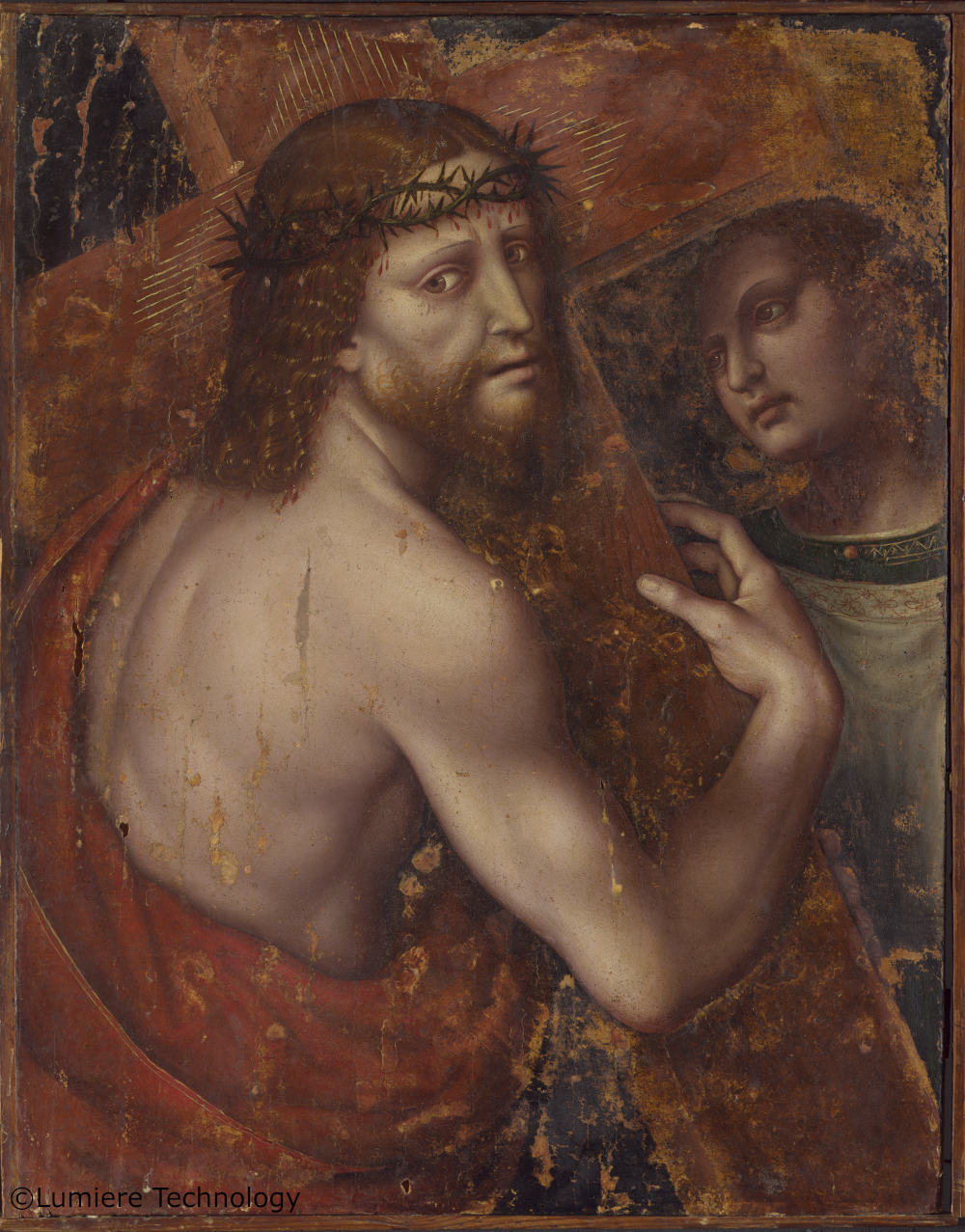
1. The halo: a later addition
The halo, represented by rays around Christ’s head, does not appear to belong to the Painting’s initial state. Several material observations converge in showing that it was added over an already aged paint surface.
The rays of the halo notably cover pre-existing craquelure. This superimposition is visible in raking light, macrophotography and under the microscope. A study carried out in 2024 by Conservation Cultural Heritage (Geneva) confirmed that the brushstrokes forming the halo pass over an already established network of cracks. This interpretation was also supported in 2025 by Ludovic Pauchard (Université Paris-Saclay, CNRS), a specialist in the mechanics and morphology of craquelure in old paintings.
Imaging further shows that the halo was painted over a brown veil that reduces the visibility of the wood grain of the cross. The relationship between the halo and the crown of thorns provides another chronological indication: some rays pass over elements of the crown whose underlying outlines remain perceptible in multispectral imaging.
These observations therefore indicate that the halo represents a later intervention than the initial execution. Its absolute date nevertheless remains uncertain.
See also Section 8: the same lead-tin yellow pigment was identified in both repaints, the halo and the button on the Figure’s garment.
→ See the detailed study devoted to the addition of the halo

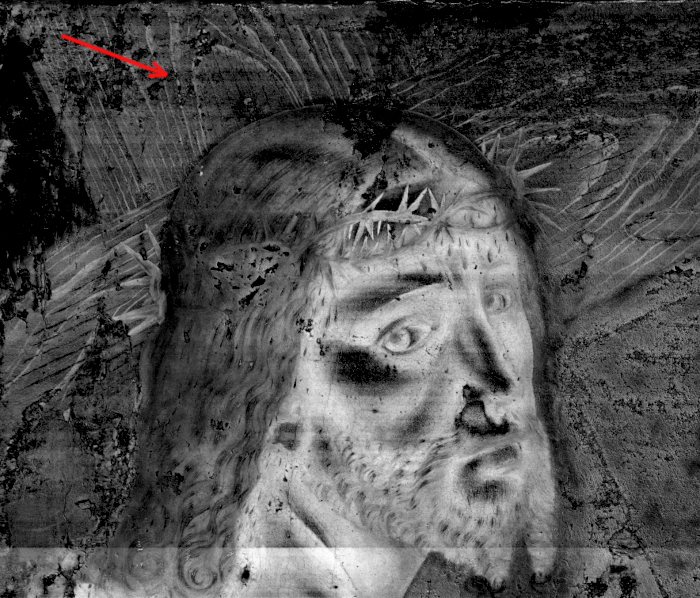
2. The crown of thorns
“Dark brush strokes were added to the crown of spikes in order to enhance the contrast of the crown over the Christ figure’s forehead (see white arrows)” (M. Seracini, Repainting).
The crown of thorns, originally based on verdigris, appears to have been retouched with a dark-coloured pigment (white arrows). It should be noted that verdigris has turned brown over time.

3. The blood drops
“Original blood drops were reinforced with thin pink coloured brush strokes (see arrows). It should be observed that these new drops cover the craquelure mesh of the original paint layer underneath” (M. Seracini, Repainting, p. 4).
In the adjacent image, the overpainting of the blood drops appears orange and covers already formed craquelure. According to the analysis of sample no. 8, the blood drops, originally painted with red lake, appear to have been repainted using a vermilion-based pigment.

4. The beard and hair
Christ’s beard and hair, as well as the hair of the Figure, show characteristics indicating significant pictorial reworking. Christ’s beard was notably enlarged during the repainting phase.
Multispectral imaging highlights these three areas particularly clearly. In LAM 790 (2020), the beard and hair stand out distinctly from the rest of the paint layer. This comparable response has led to the hypothesis that they may have been reworked during the same phase of intervention.
This observation is consistent with Maurizio Seracini’s 2011 comment concerning Christ’s hair: “Notice how the hair of the later repaint phase (2) is covering the underlying layer of Christ’s flesh craquelure.” (M. Seracini, 2011). The hair overpaint is therefore later than the formation of craquelure in the underlying paint layer.

5. Christ’s robe and its borders
According to Professor Seracini, at the time of the repainting phase the red robe showed several paint losses, visible in X-radiography as dark areas. Macrophotography shows that these losses were reintegrated with a lighter, orange colour: “At the time of the repainting phase, the red robe had several paint losses […] a lighter, orange color was used to integrate the missing parts” (M. Seracini, Repainting, p. 7).
During the same phase, the lines and borders of the robe were also reworked: “During the same phase, the lines of the robe were reworked”.

6. The cross
The cross presents several localized overpaints. According to M. Seracini, certain areas are distinguished by a more pronounced reddish-brown colour and by the absence of the craquelure network visible in the older paint: “The paint layer of this part of the cross has a more reddish brown color and additionally, doesn’t show a mesh of craquelure” (M. Seracini, Repainting, p. 12).

7. The Figure’s tunic
The Figure’s tunic is one of the most complex areas to interpret. X-radiographic, infrared and stratigraphic data suggest the presence of at least two pictorial states: an underlying state corresponding to an earlier form of the garment, and a later intervention affecting some of its lighter areas.
In his 2011 study, Maurizio Seracini observed that the fine craquelure network visible in infrared reflectography in the area of the Figure did not appear in the same way in X-radiography. He inferred that the garment may have been painted when ageing cracks in the ground had already formed. He also noted that the craquelure network visible on Christ’s robe, showing characteristics similar to that of the ground, did not appear on the Figure’s garment.
This interpretation led to the possibility that the Figure was executed later than certain already aged layers of the Painting. A new reading of the images, however, calls for a more cautious conclusion. Several fissures visible in both X-radiography and infrared imaging appear to correspond to the same cracks, making the relationship between the crack network and the different paint layers more complex.
X-radiography also reveals a material containing lead white, applied thinly and irregularly over certain parts of the garment. Comparable traces are visible on the narrow pale band projecting at the neckline: brushstrokes pass over the green collar and locally appear to cover already established craquelure.
These observations therefore suggest a distinction between an earlier pictorial state of the tunic and a later intervention affecting some of its lighter areas. They do not, however, allow the exact extent of each state or their complete stratigraphic sequence to be established with certainty.

8. The upper motif and the button on the Figure’s tunic
The upper motif of the Figure’s tunic is located in an area that has undergone significant overpainting. Professor Maurizio Seracini notably indicates that the right side of the Figure’s shoulder and neck were repainted, an observation which, according to him, is confirmed by X-radiographic analysis.
In this same area, the decorative frieze and the button near the neckline also show indications of modification. In the visible image, the button is now shifted upwards and to the left, its shape overlapping the upper border and disrupting the apparent continuity of the motif.
The enlarged view of the button also reveals a difference in tonality: its left side is lighter, with a golden hue, while the remainder has a more reddish-brown colour. This surface heterogeneity provides a first visual indication of a pictorial modification, which must be considered in conjunction with the stratigraphic, X-radiographic and multispectral data.

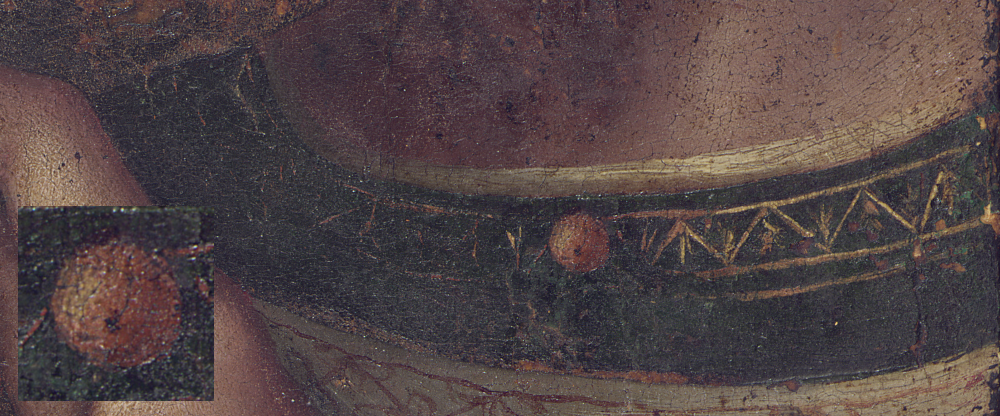
A button whose current position disrupts the continuity of the motif
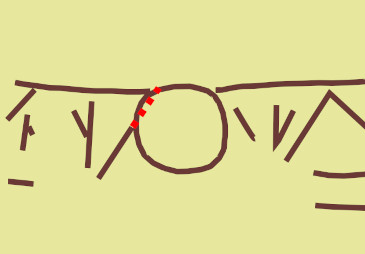
In the visible image, the button is shifted upwards and to the left. Its outline overlaps the upper border of the frieze and interrupts the left chevron of the motif.
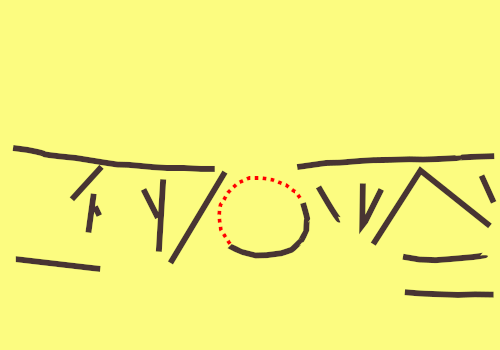
The reconstruction of the geometric design, by contrast, suggests a regular arrangement: the button was probably positioned between two chevrons. In the visible image, the right chevron remains partly legible; on the left, only its lower part is visible. Comparison with the reconstruction shows that this left chevron would continue beneath the current form of the button. In the diagram, the red dotted lines indicate this presumed continuation.
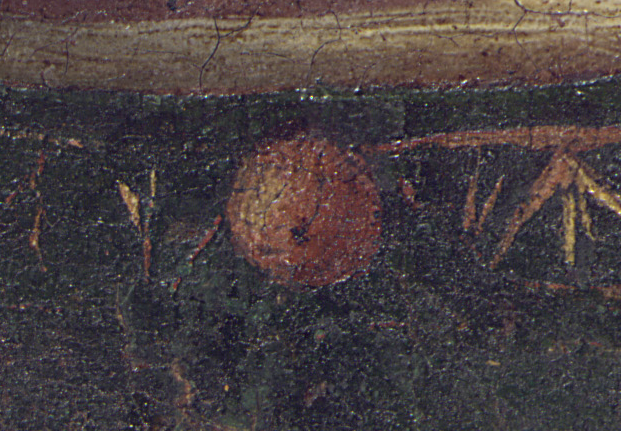
A surface layer containing lead-tin yellow
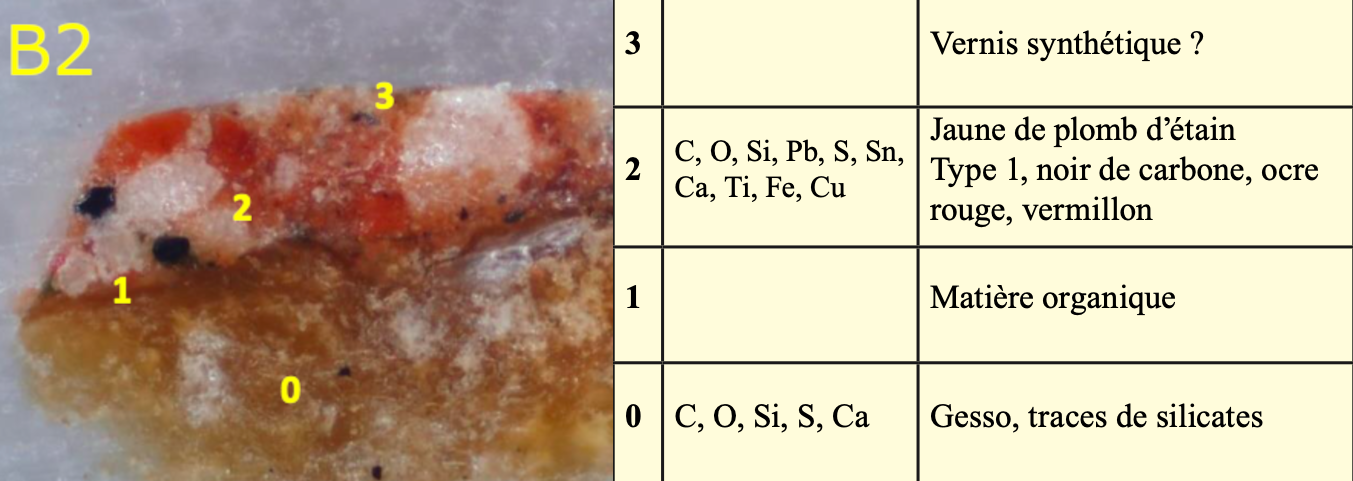
The University of Bologna carried out a microsample directly from the yellow-red area of the button. The report identifies this sample as the “Campione Giallo-rosso bottone”.
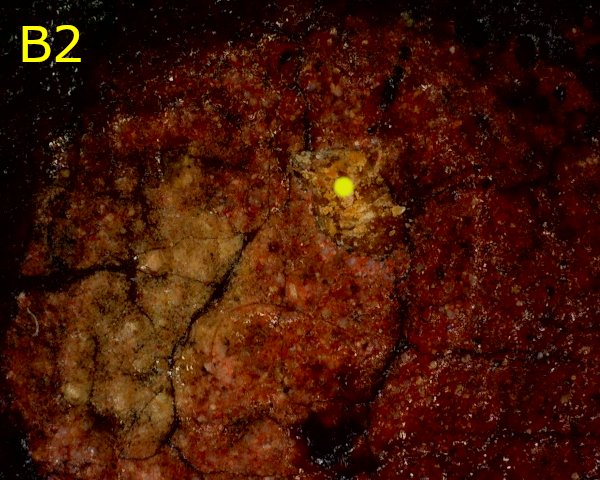
Videomicroscope examination precisely locates the sampling point within a small yellowish area of the button. The corresponding cross-section shows several superimposed layers. In the upper paint layer analysed, lead (Pb) and tin (Sn) were detected; the composition was identified as type I lead-tin yellow, associated in particular with carbon black, red ochres and vermilion.
This identification is important for the interpretation of the X-radiograph. Lead and tin are elements that strongly absorb X-rays: the presence of lead-tin yellow in this surface layer may therefore contribute to the strong radiopacity observed in the area of the button.
Comparison of the visible image and the X-radiograph
The comparison of the X-radiograph with the visible image makes it possible to relate the structure of the underlying motif, the current form of the button, and the results of the analysis of the sample taken by the University of Bologna.
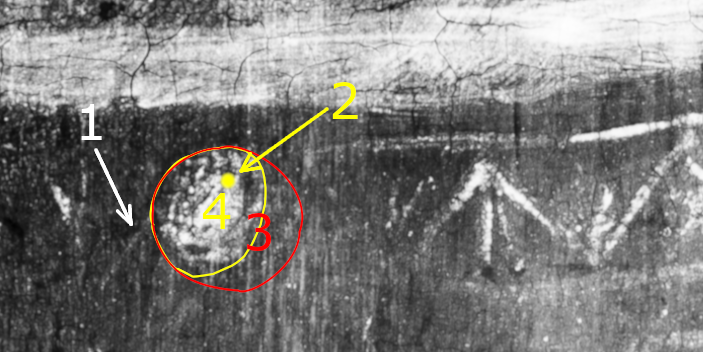
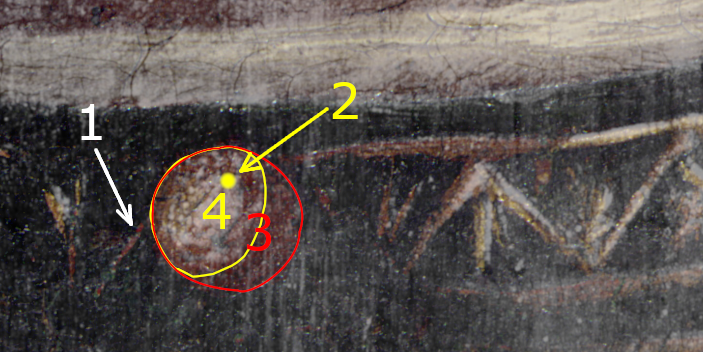
On the X-radiograph, the lower part of the original left chevron remains clearly visible (1). Its strong X-ray absorption is consistent with the presence of a lead-rich pigment, most probably lead white. The yellow arrow (2) indicates the location of sample no. 2 taken by the University of Bologna, from the yellowish part of the button, in which lead-tin yellow was identified.
The red outline (3) corresponds to the shape of the button as it appears in the current visible image. The yellow outline (4) delimits, on the X-radiograph, an area of very strong X-ray absorption. Its location, which includes sampling point no. 2, is consistent with the presence of the lead-tin yellow identified by stratigraphic analysis.
The superimposition of the visible image, rendered partially transparent, and the X-radiograph thus shows that the radiopaque area does not coincide with the entire visible button. It does, however, extend into the area where the upper part of the left chevron would be expected to continue. The X-radiograph alone does not make it possible to distinguish this part in that area, since lead-rich pigments themselves produce strong X-ray absorption. Multispectral imaging provides, as we shall see below, additional information on the continuity of this chevron.
LAM images reveal the continuity of the chevron beneath the button
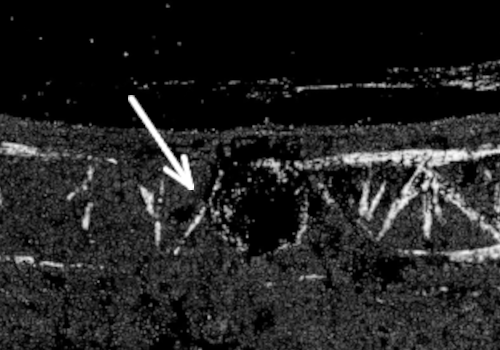
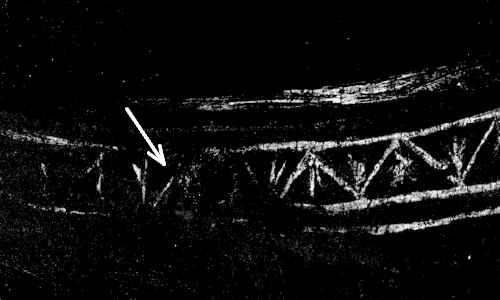
The multispectral images LAM 1215 and LAM 1145 provide a decisive element. Unlike the visible image, they make it possible to distinguish the continuity of the left chevron of the motif, including within the area now occupied by the button.
This observation is particularly important: in the visible image, only the lower part of the left chevron remains legible. The LAM images show that its upper part continues beneath the present form of the button. This is therefore no longer merely a geometric reconstruction of the motif: multispectral imaging materially reveals the presence of the chevron in the area concealed at the surface.
This continuity of the motif, considered together with the stratigraphy of the button and the radiograph, makes it possible to distinguish an earlier state, in which the left chevron continued through the area now occupied by the button, and a later state, corresponding to the button in its present visible form, which partially covers this motif.
The stratigraphy shows that the surface layer of the button contains lead-tin yellow, while the radiograph reveals strongly radiopaque material in the same area. The same pigment was also identified in the halo added at a later stage: by Professor Maurizio Seracini in 2011, and subsequently by the University of Bologna in 2022. Taken together, these data — stratigraphy, radiography and multispectral imaging — provide strong material evidence in favour of a repaint that altered the shape of the button.
The exact form of the earlier button cannot, however, be reconstructed with certainty. The geometry of the frieze, compared with the traces preserved in the visible image, the radiograph and the LAM images, nevertheless allows a plausible reconstruction to be proposed: a smaller button, positioned in a logical position at the centre of two inverted chevrons.
In the diagram below, the brown lines correspond to elements actually observable, while the red dotted lines provide an approximate reconstruction of the missing left-hand part of the button.
9. The lower motif added to the tunic
The red and yellow motif visible in the lower part of the Figure’s tunic presents several indications that it was applied later over an already cracked paint layer.
Stratigraphic sample no. 6, taken in 2011 by Maurizio Seracini in this area, reveals a distinct red layer corresponding to the motif, composed in particular of red lake and red ochre. This layer lies over a layer containing lead white.
Macrophotographs further show that the red material does not remain only on the surface: it penetrates into some of the cracks. In 2026, this observation was specifically examined by Ludovic Pauchard (Université Paris-Saclay, CNRS), a specialist in the mechanics and morphology of craquelure.

10. The Figure’s right shoulder and neck
According to the Seracini report, the Figure’s right shoulder and neck were reworked during a repainting phase. This intervention is confirmed by X-radiographic analysis, which reveals an earlier pictorial state beneath the forms now visible.
Seracini states: “The right side of the shoulder and the neck of the female figure has been reworked, as confirmed by X-ray analysis” (M. Seracini, Repainting, p. 8).
11. “Smudging”: a lead-white intervention
Seracini’s 2011 study identifies a particular intervention, described as smudging, consisting of spreading paint by hand, notably with the fingertips. Several fingerprints are consequently visible in X-radiography.
This intervention uses a material containing lead white, mixed with various pigments. It is particularly visible around Christ’s mouth and chin, along the left side of his face, in the dark background, on certain fingers and along the edge of the forearm, as well as on the face of the Figure.
In the areas concerned, the smudging covers or strongly attenuates the pre-existing craquelure network and may obscure traces of brushwork. On the cheek of the Figure, this material also locally altered the contour of the face, producing the appearance of a second profile.
According to Professor Seracini, this intervention belongs to a pictorial phase later than a major campaign of overpainting.

12. The black overpaint covering the Figure
Before the restoration carried out in the 1960s, the Figure to Christ’s right was almost entirely concealed by a layer of black paint. Old photographs of the Painting document this earlier state before the Figure was uncovered.
This intervention profoundly altered the reading of the composition: the Figure disappeared into the dark background, while Christ remained almost the only visible figure. Removal of this layer revealed the Figure’s face, hair and a large part of the garment.
The date when the black layer was applied is unknown. Its appearance and integration into the aged state of the surface make it particularly difficult to identify through visual examination alone. It appears to have been an old intervention, although no precise date can currently be assigned to it.
→ See the study devoted to the right-hand Figure

13. The 1960s restoration: uncovering the Figure
At an unknown date, the entire background and the Figure on the right were covered by a layer of black paint. This layer was removed in the 1960s, but only from part of the Painting.
Comparison of photographs taken before and after restoration allows several observations:
- (A) The black layer covering the Figure was removed.
- (B) Remnants of this layer survive in the lower-right area. Christ’s little finger, visible before restoration, has disappeared.
- (C) The uncovering appears to have been particularly extensive and may have affected the underlying paint layer.
- (D) Removal of the black layer left a severely degraded area.
- (E) In the upper-left corner, the black layer was not removed.
- (F) Its removal revealed the underlying background.
- (G) Between the two photographs, a pictorial retouch appears in Christ’s hair; it is not mentioned in the restoration report.
The uncovering also appears to have affected part of the Figure’s curly hair and ear. Several losses of paint are visible in the background.
The report further states that the Painting was unvarnished and then revarnished. Varnish removal can affect superficial paint layers and possible glazes, but the available documentation does not allow the observed alterations to be attributed with certainty to this operation.

Conclusion
The study shows that several additions, reworkings and alterations succeeded one another over the history of the Painting.
Superimpositions, craquelure, stratigraphic analyses and X-radiographs make it possible to establish a relative chronology, without precisely dating most of the interventions.
The 1960s restoration provides a documented chronological marker, notably through the removal of the black layer concealing the Figure and a modern retouch in Christ’s hair.
Taken together, these observations lead to a proposed chronology in six phases of intervention, which may be refined by future technical examinations.