Thaddeus: the Reference Copy by Giampietrino
A Common Reference Point and a Rigorous Protocol
In this first phase, each version of Thaddeus’s portrait was digitally traced, following the essential contours of the face and its main components: hair, brow ridges, nose, lips and beard.
To ensure comparability, two reference points were selected:
- a scaling segment A (white lines in the figure below), from the base of the lower lip to the top of the skull;
- an anchor point B, at the intersection of the wing of the nose and the nasolabial fold.
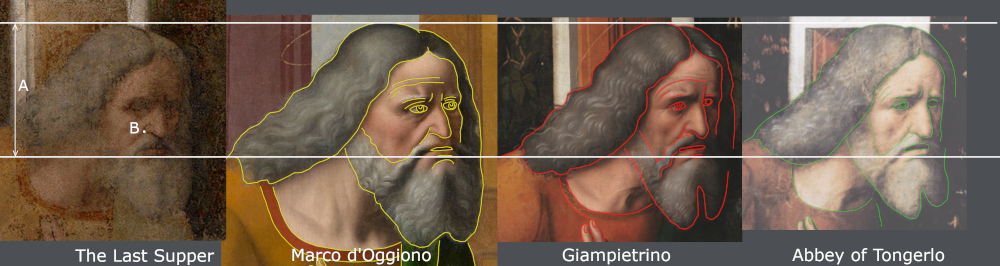
Overlays at the Same Scale and with a Common Anchor Point
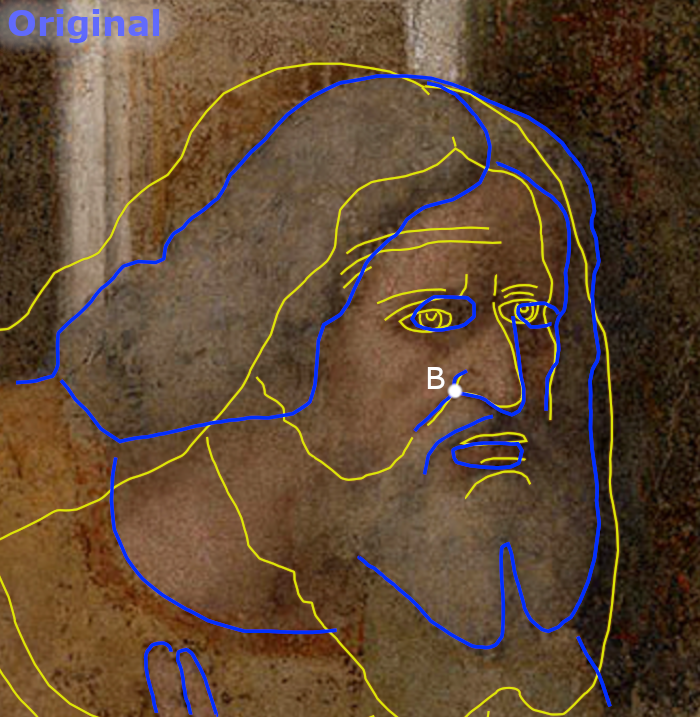
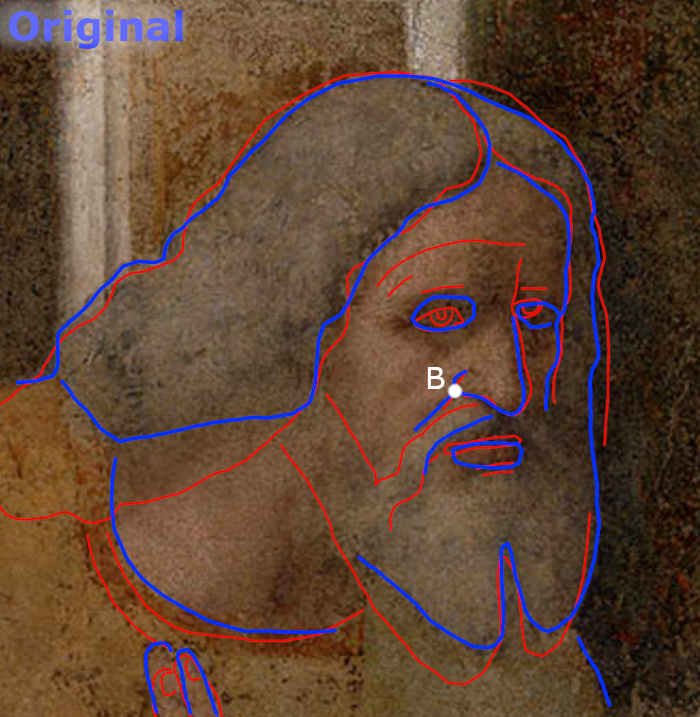
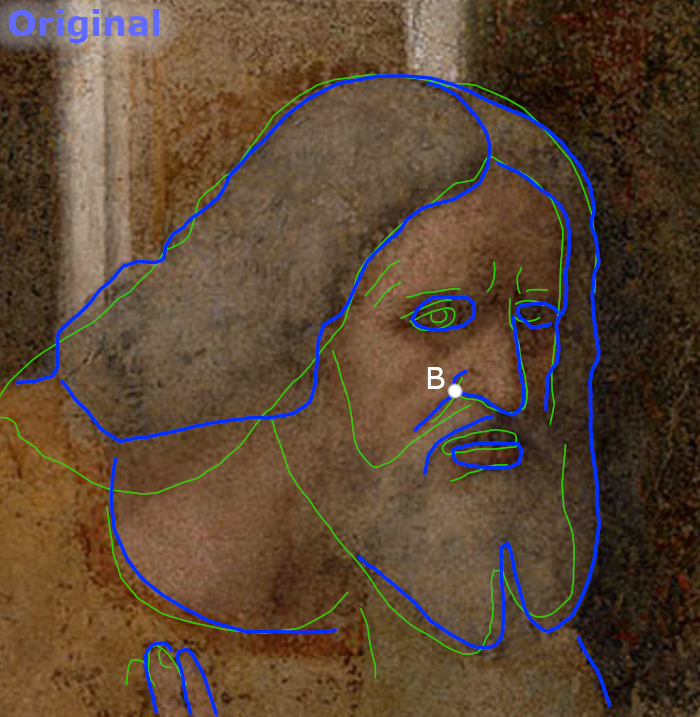
These three figures illustrate the comparison between Thaddeus’s portrait in the mural (background image, outlines in blue) and the outlines of the copies by Marco d’Oggiono (Écouen, in yellow), Giampietrino (Royal Academy of Arts, London, in red) and Tongerlo Abbey (Belgium, in green).
All overlays, set to the same scale, were aligned from point B, as defined above.
Before comparing Thaddeus with the Venice Drawing, it is first necessary to select the most reliable copy of The Last Supper, since the present mural is too degraded for fine analysis. The method therefore follows two steps: (1) comparing the copies and selecting the most legible one; (2) comparing Thaddeus, in the selected copy, with the Venice Drawing through overlays.
General Visual Observations
The Écouen Version
The overlay of the outline of Marco d’Oggiono’s copy (Écouen, in yellow) onto Thaddeus’s portrait in Leonardo’s mural (in blue) shows an overall correspondence: the eyes, nose and mouth occupy positions close to those in Leonardo’s mural. The general contour, however, departs from the model: fuller hair, a wider neck and a skull slightly stretched horizontally. These differences are largely explained by format constraints: the Écouen version is about one third narrower than the mural.
The Giampietrino Version
The overlay of the outline of Giampietrino’s version (London) onto Thaddeus’s portrait in the mural reveals a particularly precise correspondence: the proportions of the skull, the placement of the features and the drawing of the beard are very close to the mural. Through the coherence of its structure and the quality of its preserved image, this version provides the most reliable basis for the comparative analysis and for the confrontation with the Venice Drawing. It therefore plays a central role in the study.
The Tongerlo Version
The overlay of the outlines of Giampietrino (red) and Tongerlo (green) shows a very close relationship. The contours of the face, the hair and the hands coincide closely, with only minor variations. This proximity confirms Laure Fagnart’s analysis (2005): the Tongerlo version would derive from models based on Giampietrino’s version.
Why Giampietrino Is Selected as the Reference Copy
For the comparison with the Venice Drawing, Giampietrino’s copy is selected as the main reference. It has four advantages:
- it was used during the restoration of The Last Supper at the end of the twentieth century;
- it is available in a very high-quality image, unlike Tongerlo;
- its structural resemblance to the mural is particularly strong;
- it has long held a recognised place in research on The Last Supper.