Provenance of the Painting
The provenance of Christ Carrying the Cross remains only partially documented. In the absence of an early inventory or a continuous chain of ownership, its history can only be reconstructed from material evidence: restorations, inscriptions on the reverse, the red wax seal, and technical analyses.
1960s: Rediscovery of the Right-Hand Figure
The first documented milestones date back to the 1960s, during restoration work. The removal of a dark layer revealed the secondary figure placed to the right of Christ, significantly altering the iconographic reading of the work.
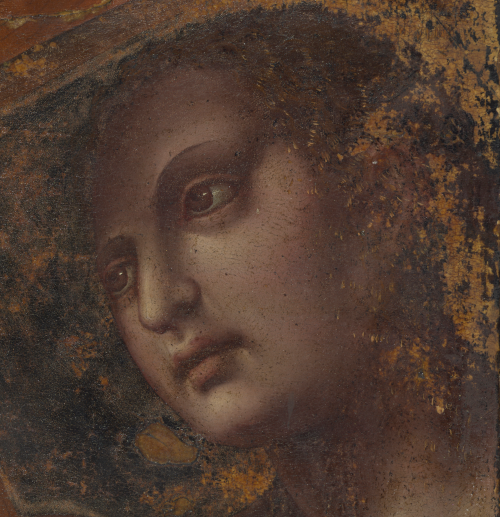
The “Asta” Inscription (Recto)
The inscription “Asta”, visible on the recto, probably refers to the Italian term for an auction. It may therefore indicate an episode in the commercial circulation of the work, without in itself specifying either the date or the context.
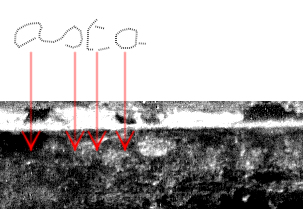
Chronological Framework of the Support
Radiocarbon dating places the felling of the wood between 1470 and 1650, with a probability of 95.4%. Within this range, the distribution is not uniform and shows more marked concentrations around certain decades, especially around 1500–1550, according to the calibration curve.
This information concerns the poplar support, not the exact date at which the painting was executed.
Evidence of a Devotional Painting
The format of the panel, the close framing of Christ, and the absence of a developed narrative setting correspond to the type of image intended for private devotion, widely circulated in Northern Italy during the fifteenth and sixteenth centuries.
Professor Maurizio Seracini proposed interpreting the vertical traces visible on Christ’s back as possible effects of candle flames placed below the painting. If this hypothesis is accepted, it would reinforce the idea of a concrete devotional use of the work.
The old covering of the right-hand figure and the later addition of the halo, both revealed by technical analysis, also attest to early modifications in the presentation of the image.
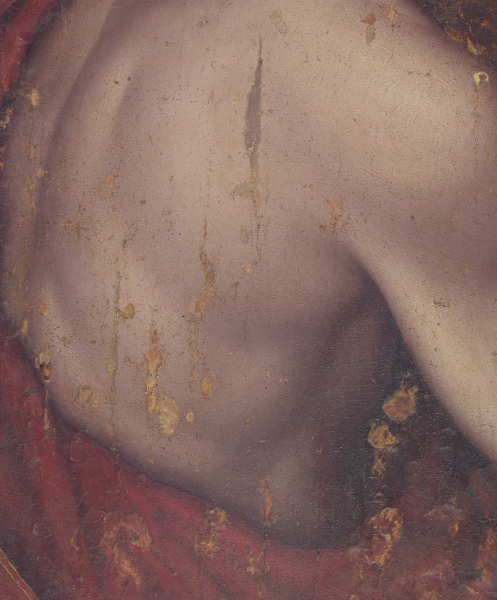
Christ’s back (detail)
Visible vertical traces
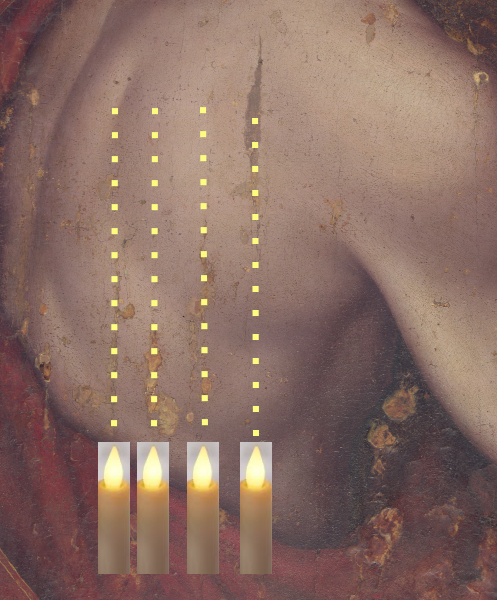
Vertical traces (interpretation)
– Candle-flame effect?
– Devotional use?