Recto of the Panel: Support and Conservation
The support of The Painting is a single poplar panel, cut along the grain and approximately 15 mm thick. The xylological analysis carried out by the CNRS confirms the species. The lower part, heavily damaged, appears to have been slightly reduced, according to the assessments. Until 2010–2011, the panel was bordered by four thin battens (8–9 mm), nailed in place: only the left batten, glued, is still preserved today, which explains the visible variations in earlier documentation.
Modifications to the support
Horizontal woodworking marks
Scientific imaging reveals horizontal woodworking marks on the panel, comparable to the grooves visible on the reverse. Their appearance is consistent with planing of the panel.
Two crossbars added to the reverse
The reverse of the panel has two horizontal crossbars added at a later date. According to the examination carried out by Professor Seracini in 2011, their installation required the creation of a tongue-and-groove system cut into the thickness of the support. At the time of this intervention, the wood already showed damage caused by wood-boring insects as well as pre-existing knots.
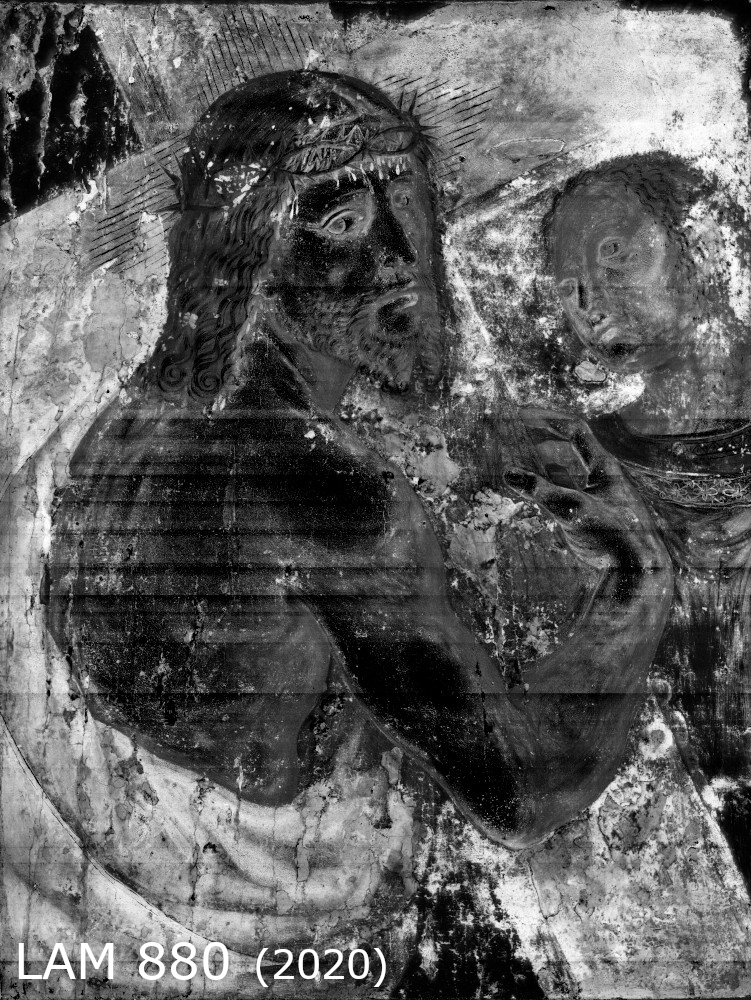
Surface condition of the recto of the panel
LAM image showing the surface condition and areas of overpaint / alteration.
General State of Conservation
The Painting is in an overall medium state of conservation, marked by several centuries of interventions and reworkings.
The flesh tones appear better preserved; the significant use of lead white, frequent in these areas, may have played a protective role.
The main alterations observed are:
– woodworm damage, especially on the left, also visible on the verso;
– gesso fillings followed by overpainting;
– earlier overcleaning in the upper right corner, affecting the black background and the top of the cross.
Since the old overpaints are now often altered in the same way as the original paint layer, some areas remain difficult to read.
Earlier Interventions: Consequences
The removal, in the 1960s, of the black layer that concealed the right-hand figure probably weakened the underlying paint.
The ear and part of the hair have become difficult to read; the layer was not removed uniformly, with residues remaining at the bottom and in the upper right. The ring finger of Christ’s left hand also disappeared during this intervention.
Inscription on the Lower Batten
On the now-missing lower batten, an undeciphered inscription, approximately 2 cm long, is visible only in X-radiography (processed image). No formal reading can be proposed at this stage.
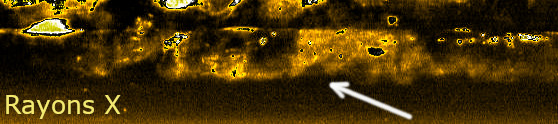
Undeciphered inscription — former lower batten
Visible in radiography
The “asta” Inscription
Still on this batten, slightly further to the left, appears an inscription readable as “asta”, possibly followed by other characters. Approximately 20 mm long and about 2 mm high, it is perceptible only in emissiography, which facilitates surface reading.
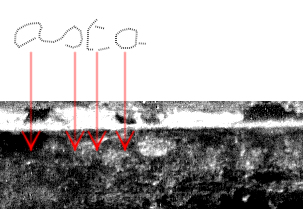
“asta” inscription
Visible in emissiography
Traces of Devotional Use
By its format and its composition centred on Christ, the work probably belongs to the category of private devotional images, common during the Renaissance.
On Christ’s back, vertical alterations are visible. Maurizio Seracini suggests that they may have been caused by candle flames placed beneath the image, a hypothesis based on comparable cases.
From this perspective, the old black covering of the right-hand figure may be understood as an intervention intended to concentrate devotion on the figure of Christ.
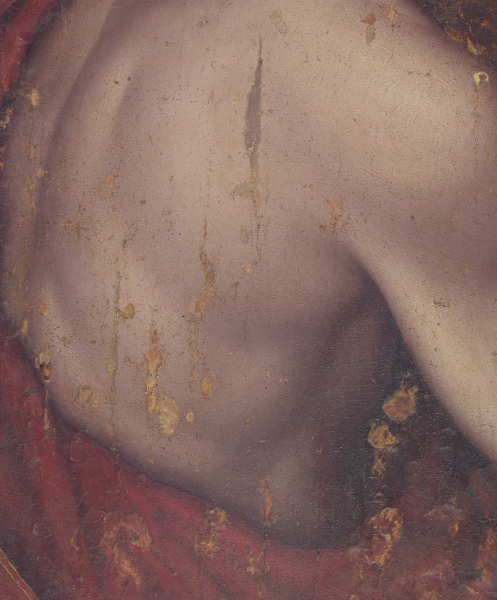
Christ’s back
– Visible vertical traces
– Candle-flame hypothesis
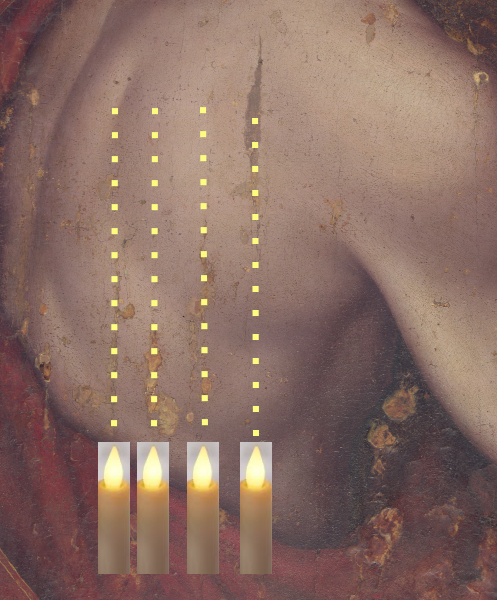
Christ’s back
– Vertical traces shown with dotted lines
– Probable devotional use