Expert Reports on Christ Carrying the Cross
The aim is to better understand the process of execution and to assess whether the technical features observed belong to workshop practice or to a more individual mode of execution. This material basis then supports the stylistic and attributional discussion.
1960s
Discovery of the Figure
1987 / 1991
Paint layer

2011
paint layer – C14
2011 / 2020 / 2021
Lumiere Technology
LAM imaging
2022
Paint layer

2024 / 2025
Scientific review
– OSE Art Services:
Inscriptions report
Chronology of the Examinations
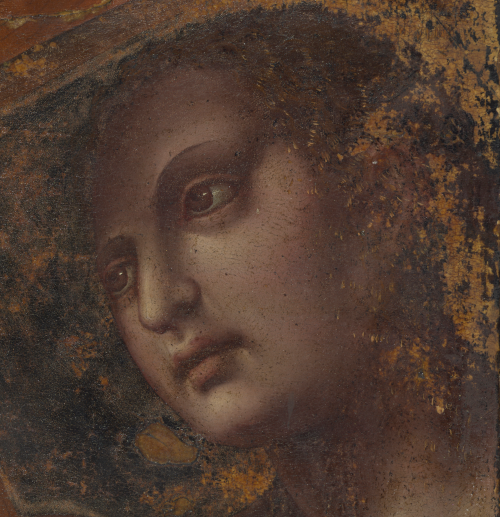
1960s – Restoration and discovery of the second figure
An earlier cleaning revealed the figure on the right, which had previously been covered by a black layer. The intervention appears to have caused losses, including the little finger of Christ’s left hand and probable damage to the hair and ear of the figure. See the 1960s restoration report.
1987 / 1991 – SIK-ISEA Zurich: first examinations of the paint layer
The Swiss examinations considered the condition of the support and paint samples. Their conclusions placed the work within a broad early chronological range, in the 15th or 16th century, before the more extensive campaigns of the 2010s and 2020s. See: SIK-ISEA 1987 and SIK-ISEA 1991.
2011 – M. Seracini (Florence): paint-layer report
The report examines the support, the condition of the paint layer and the overpaint. Later imaging has made it possible to clarify several points, particularly the spolvero traces and pentimenti. Maurizio Seracini’s full report is available as a PowerPoint presentation.
See the conclusions “Editech – Seracini”.
2010 / 2011 – Carbon-14 dating
Two C14 analyses carried out around 2011 frame the dating of the wood panel: Lyon 1470–1654 (95.4%) and Zurich 1486–1676 (85.4%). The results are consistent with one another and remain compatible with a Renaissance dating, while covering a broad range.
See the dedicated page : Carbon-14 dating
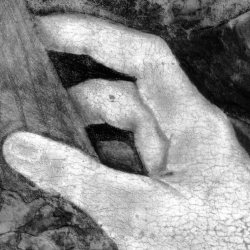
2011 / 2020 / 2021 – Lumiere Technology: multispectral imaging and LAM
The multispectral digitisation and LAM processing produced very high-definition images. These have become decisive for comparative analysis and for detecting certain technical traces, from the underdrawing to restoration interventions.
2022 – University of Bologna (Ravenna): paint-layer report
Methods used
The University of Bologna (Ravenna) combined non-invasive analyses, including multi-point XRF and videomicroscope observation, with stratigraphic cross-sections to characterise pigments, binders and layers.
Material conclusion
- The UNIBO report describes a traditional gesso preparation, made of gypsum and glue, covered by an organic imprimatura, then by paint layers with an oil binder; a localised underlayer of lead white is observed in certain areas.
- This stratigraphy corresponds to well-attested practices in Italian painting between the second half of the 15th century and the 16th century. The conclusion of the UNIBO report therefore places the work within a material framework compatible with the Italian Renaissance, without proposing a specific attribution.
2024 – Geneva Fine Arts (Geneva): scientific review
The Geneva review compares the earlier dossier with direct observation and verifies the technical coherence of several points: the added halo, the stronger radiographic contrast in The Painting, and the discussion of spolvero and painting procedures. See the Geneva Fine Arts report.
2025 – OSE Art Services: report on the inscriptions “Salaj/?” and “Salajno / Salaino”
The reverse bears several superimposed inscriptions. The examinations distinguish an incised / engraved inscription in the wood from an ink inscription applied to the surface.
The OSE Art Services report concerns the ink inscription “Salajno / Salaino” and the engraved or incised inscription “Salaj/?”. The TNF would correspond to the “Salaj/?” trace, and the TEE to “Salajno / Salaino”. This reading helps order the interventions, without allowing the inscriptions to be attributed or dated.
Points of Convergence
The expert reports carried out between the 1960s and 2025 converge on several material observations: a panel compatible with an Italian Renaissance production in a broad chronological sense, a preparation and paint layers belonging to the Italian tradition, and a readable stratigraphy.
They also confirm a documented history of workshop practice and conservation: earlier interventions, overpaint, the concealment and later revelation of the figure on the right, and the addition of the halo after the initial conception.
The study of the reverse reveals an underlying engraved inscription, partly covered by carbon-black ink. It helps order certain interventions without identifying their authors, while recent imaging stabilises these observations.
Points Requiring Further Documentation
- Provenance
- The chronology of earlier interventions: halo, black layer, overpaint
- The red wax seal
- The reading and interpretation of the inscription “Salaj/?”
- Possible further analyses of the paint layer
- Additional iconographic research