Inscriptions on the Verso: Leonardo, Salajno and Salaj/?
On the verso of the panel, three distinct inscriptions can be observed: Leonardo, Salajno and an incised inscription reading “Salaj/?”. Salaj, the nickname given by Leonardo da Vinci to Gian Giacomo Caprotti, refers to the young boy whom Leonardo took into his household at the age of 10, in 1490, and who later became his pupil and companion.
Summary
1. The three inscriptions observed
2. Overlay of “Salaj/?” and “Salajno”
3. Contribution of the Ose Art Services assessment
4. Methodological conclusion
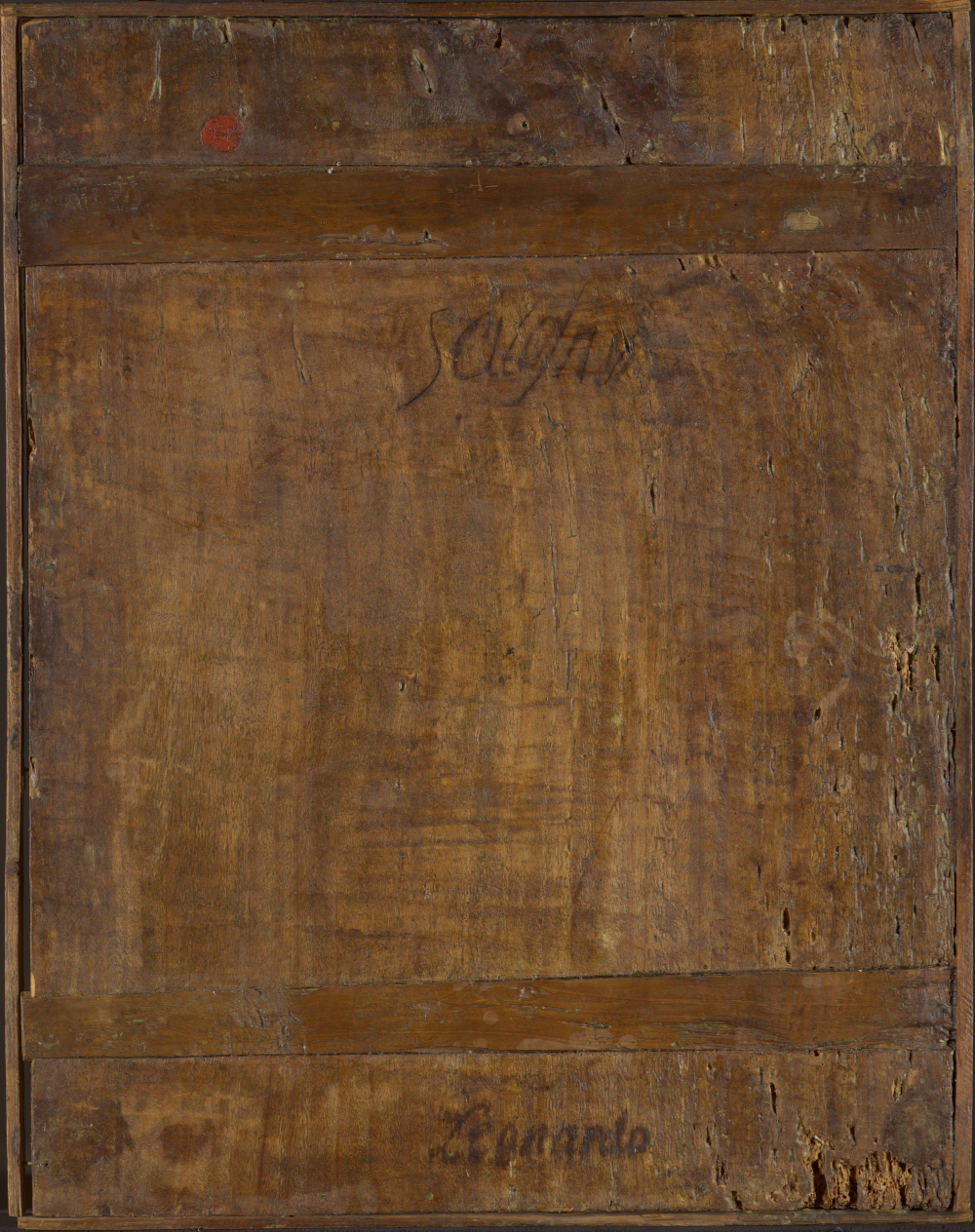
The Three Inscriptions on the Verso of the Panel
The three inscriptions on the verso — Leonardo, Salajno and Salaj/? — are not of the same nature and do not have the same status.
The ink inscription Leonardo appears later. The reading Salajno, for its part, is supported by the University of Bologna assessment, which confirms this spelling for the visible inscription. It must, however, be distinguished from the underlying inscription Salaj/?, whose characters are incised into the wood.
This incised inscription calls for particular attention. In Leonardo’s writings, and in the current state of knowledge, Gian Giacomo Caprotti is referred to as salaj. This graphic stability reinforces the interest of the underlying inscription.
An inscription incised into the wood does not have the same status as a simple ink notation: it implies a more durable and more demanding gesture. Without constituting proof, this mode of execution makes a casual or purely opportunistic addition less likely, and suggests a deliberate intention, possibly early.
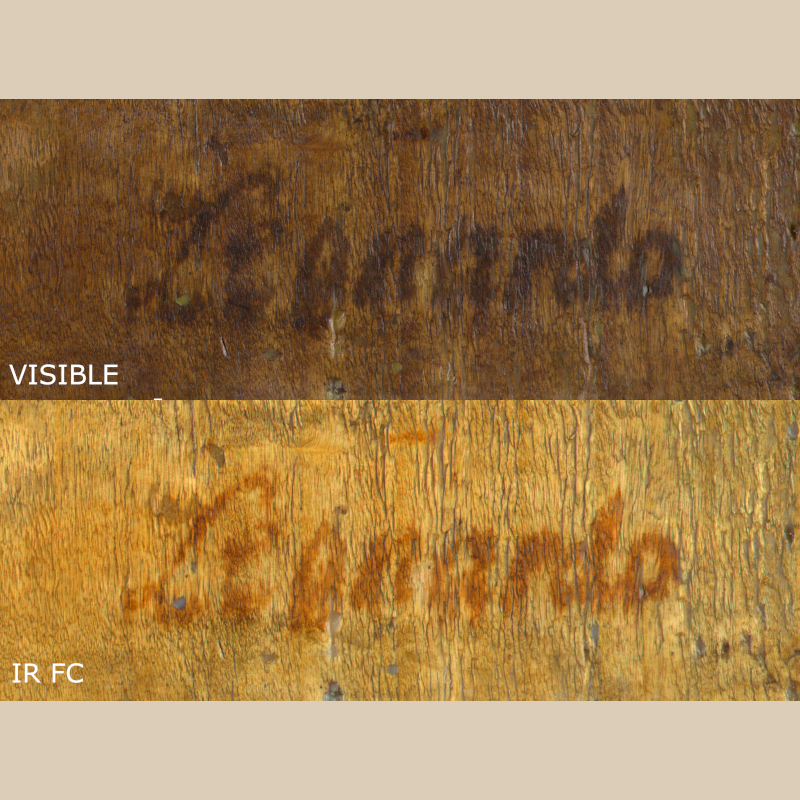
Leonardo
Ink inscription — carbon black
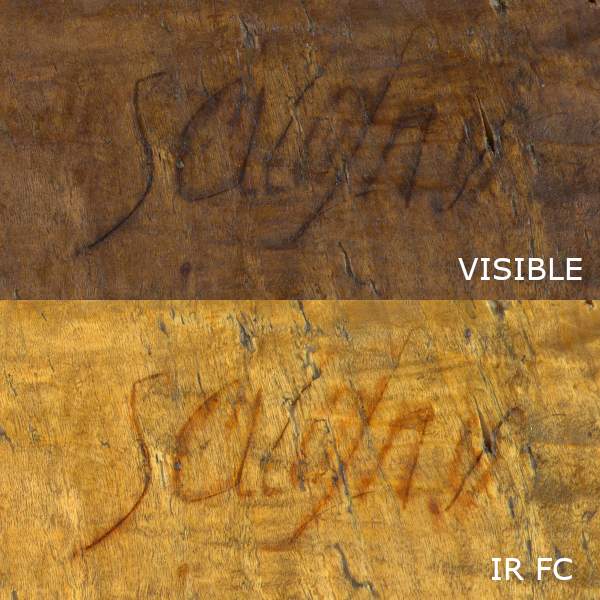
Salajno
Surface ink: covering an earlier tracing
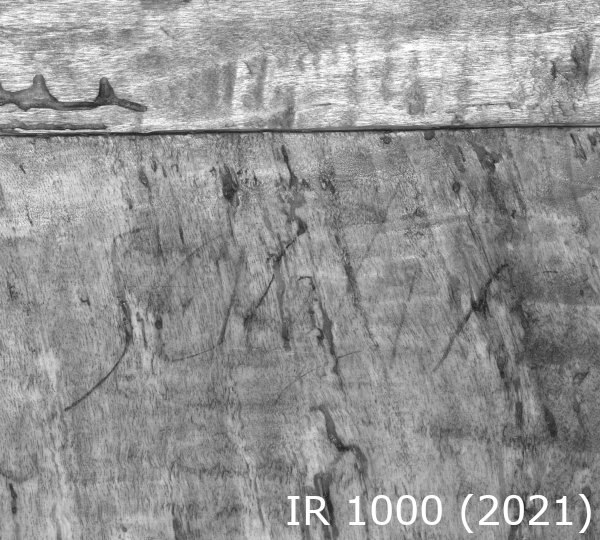
Salaj/?
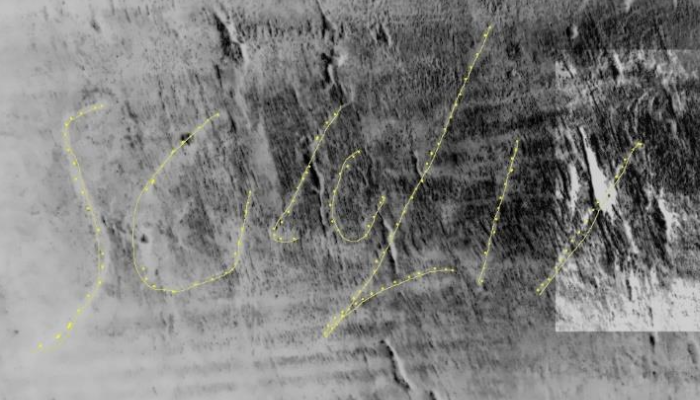
Incision/engraving: Salaj/? – Image IR 1000
Final character (?) unidentified
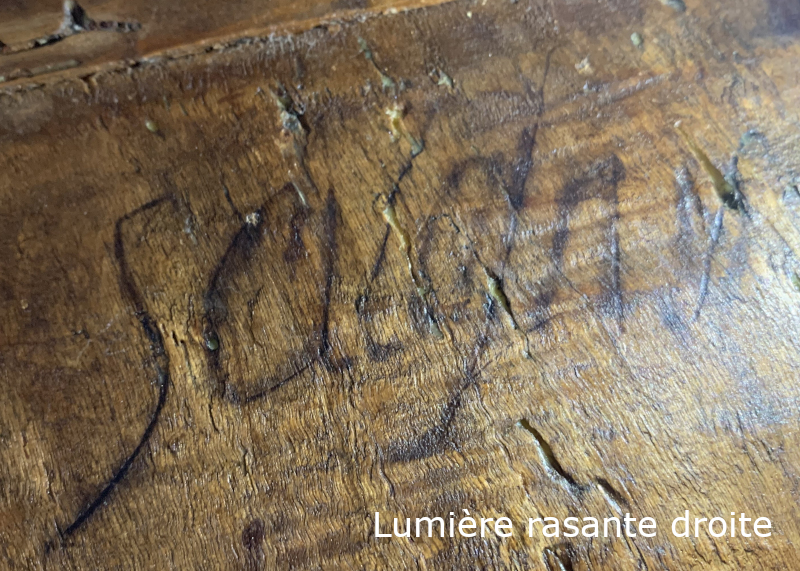
Inscriptions Salajno / Salaj/?
Salaj/?: engraving visible from the right
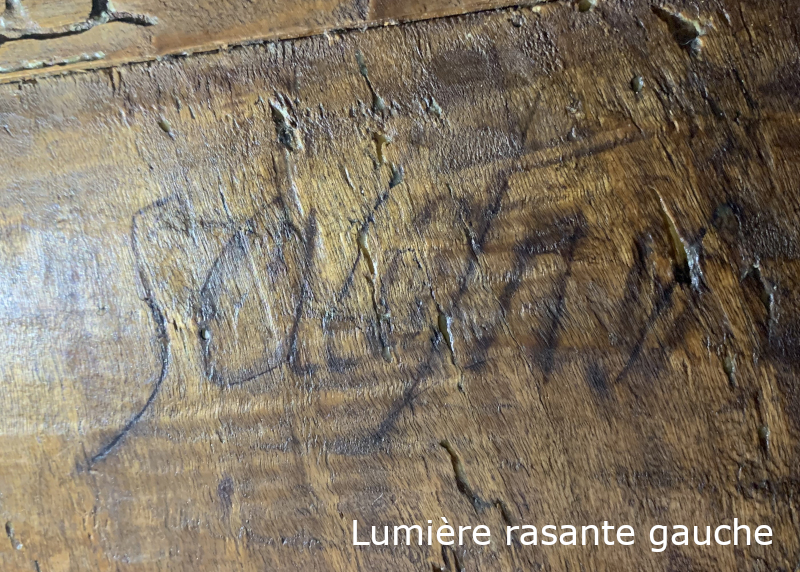
Inscriptions Salajno / Salaj/?
Salaj/?: engraving visible from the left
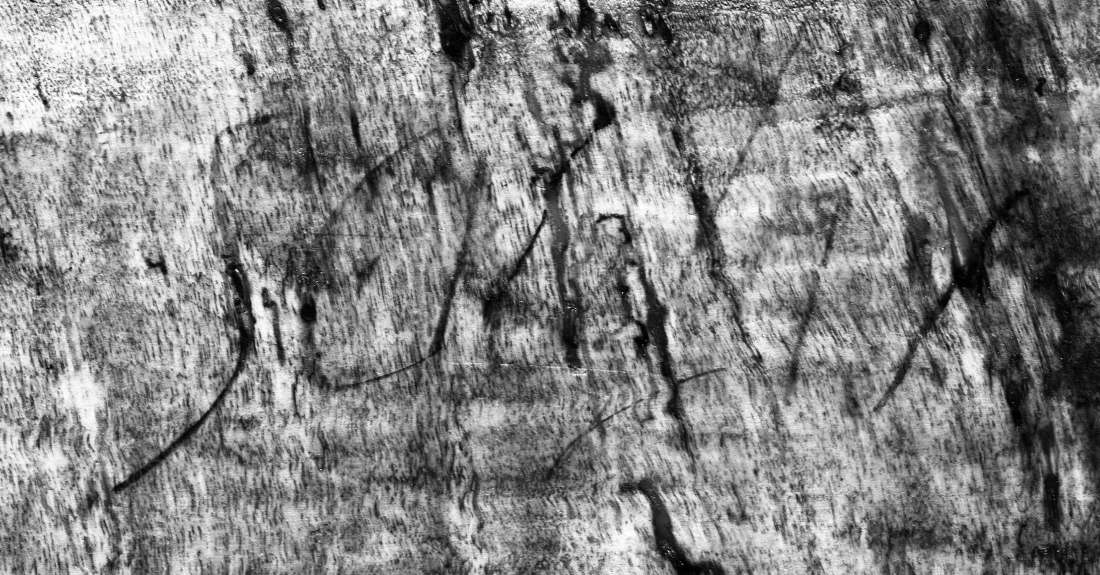
Salaj/? inscription
LAM 66 image, 2021
Overlay and Relative Chronology
(Salajno and Salaj/? inscriptions)
The overlay diagram reveals two distinct inscriptions and their relative order:
-
In blue: the ink inscription “Salajno”.
-
In red: an incised tracing reading “Salaj/?”, visible beneath the ink.
The proposed reading is based on a simple point: the ink covers the incised tracing. A letter-by-letter covering can in fact be observed: the letters S, a, l, a, j of “Salaj” are repeated and masked by the inscription “Salajno”. The n of “Salajno” is placed over the oblique stroke (/), while the o covers the final character (?).
The incised tracing “Salaj/?” is therefore earlier, while the ink inscription “Salajno” corresponds to a later intervention, applied over the initial marking.
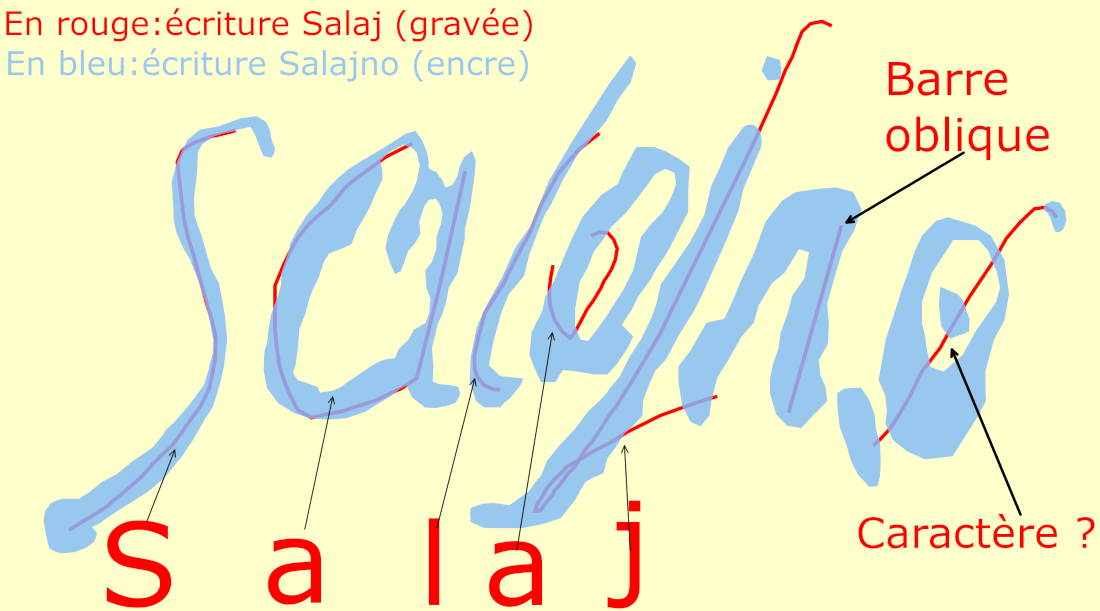
Overlay diagram
Order of the tracings: ink inscription Salajno (blue) over the incised inscription Salaj/? (red)
Contribution of the Ose Art Services Assessment
(Technical complement – Ose Art Services report)
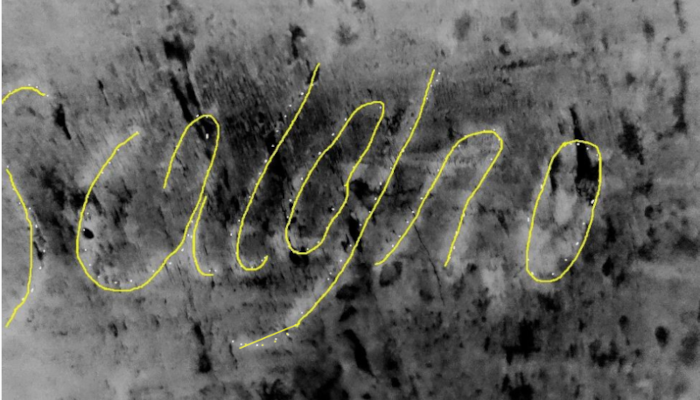
This assessment was mainly intended to reconstruct the tracings of two superimposed inscriptions, previously identified as “Salajno” and “Salaj”, without seeking to read or interpret them.
Ose Art Services distinguishes two superimposed writings:
-
TNF — fine black line: underlying tracing, more difficult to read, compatible with an earlier inscription; in places, the surface shows signs of pressure or grooving.
-
TEE — thick ink line: ink tracing, more legible, applied on the surface; it is later than the TNF, since it covers it.
Conclusion
These three inscriptions document the material history of the panel and the succession of interventions on the verso. The overlay shows that the ink inscription “Salajno” was added over an incised tracing “Salaj/?”: the ink covers the engraving letter by letter. The mention “Leonardo”, also added in ink, belongs to a separate addition.
The main interest therefore lies in the relative chronology: the incised inscription “Salaj/?” appears earlier than the visible inscription “Salajno”. This observation is not an attribution, but it constitutes an important material indication in the history of the panel.