Influence of the Drawing on Leonardo da Vinci’s Contemporaries
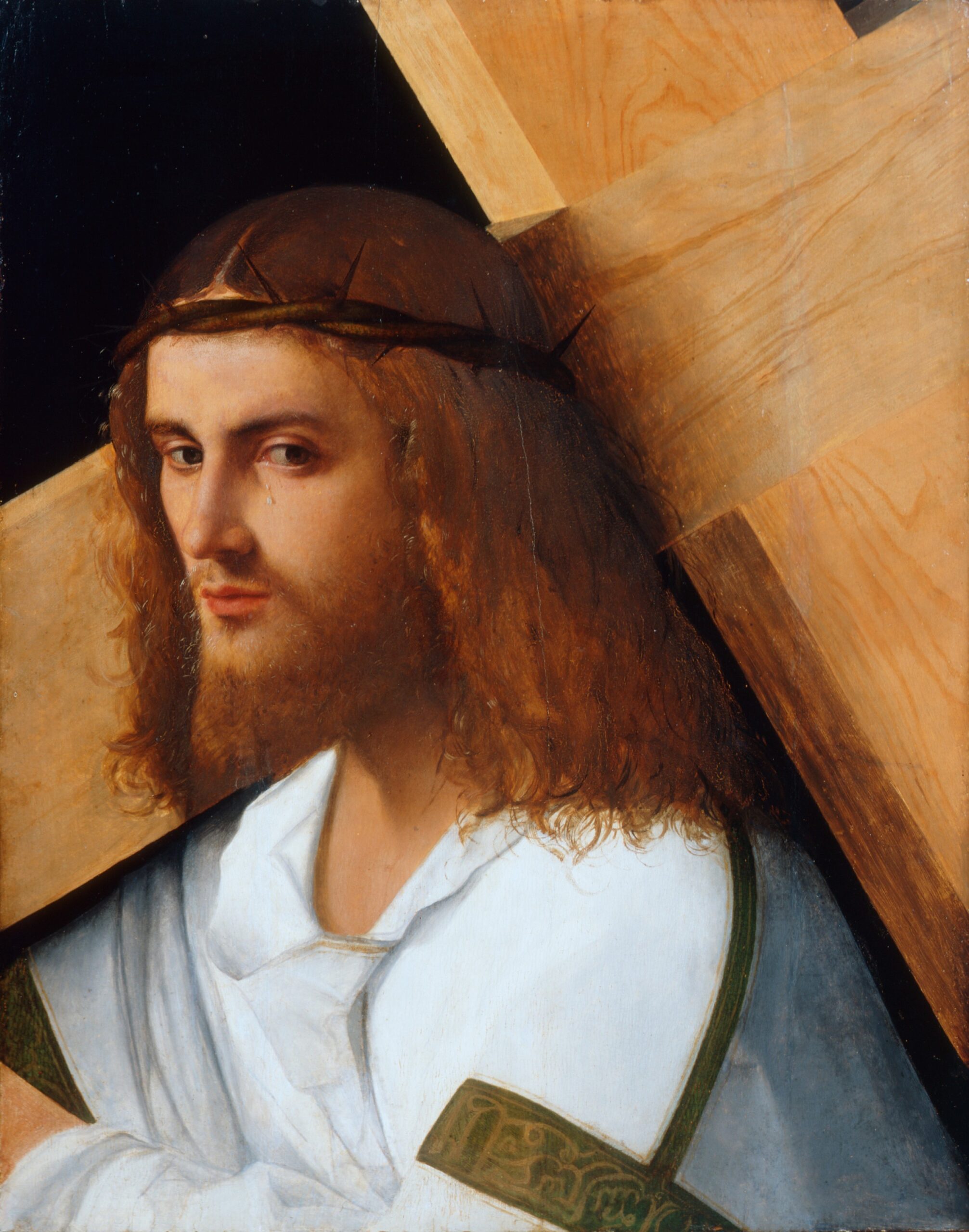
The influence of the Venice Drawing on representations of Christ Carrying the Cross in the early sixteenth century is generally acknowledged.
It does not concern style alone, but the very structure of the type: orientation of the head, construction of the skull, placement of the hair, and the logic of the three-quarter portrait.
The comparisons below show the diffusion of the model in the Venetian and Milanese schools.
Diffusion of Christ Carrying the Cross around 1500
Influence in Venetian Painting
In the Venetian milieu — Giorgione (1), the young Titian (2), and Bellini’s circle — Christ is most often turned to the left, as in the Venice Drawing.
The issue is not literal copying: it is the reuse of a shared scheme, subsequently modulated according to format, function and pictorial sensibility.
Milanese School (3)
In Milan, the motif circulated with remarkable stability. It appears in the work of Giampietrino (4), Solario (5), and also within the orbit of Luini or Cesare da Sesto.
Technical studies by the National Gallery (Larry Keith, 1996) indicate that certain versions — Giampietrino, London and Budapest — derive from the same cartoon, as suggested by the coincidence of their tracings.
Other Schools
The motif also appears beyond the two Venetian and Milanese centres. Sodoma (6) offers a Sienese interpretation, with possible Milanese connections.
Some variants modify the iconography more substantially, such as the rare versions of Christ Pulled by the Hair, the only ones to show a hand pulling Christ’s hair.
Other painters, such as Marco d’Oggiono (7) or Francesco Maineri, took up the theme while adapting it to their own idiom, without breaking the lineage of the type.
Notes
(1) Giorgione (1477–1510), Venetian painter.
(2) Titian (c. 1488–1546), Venetian painter.
(3) Marani (1987): success of the motif among Milanese followers, and treatment by Giovanni Bellini around 1500 (Leonardo e i Leonardeschi a Brera, p. 37).
(4) Giovan Pietro Rizzoli, called Giampietrino (c. 1480–1485; 1549), Milanese painter.
(5) Andrea Solario (1460–1524), Milanese painter.
(6) Giovanni Antonio Bazzi, called Sodoma (1477–1549), trained within a Lombard culture and later associated with the Sienese milieu.
(7) Marco d’Oggiono: some versions of Christ Carrying the Cross have sometimes been associated with Francesco Maineri in older corpora.

Scholarly Consensus
Despite differences of interpretation, several points recur:
- The Venice Drawing is recognised as a major source for the motif.
- The Milanese versions derive from it, directly or through an intermediary workshop template.
- The existence of a cartoon — or of an equivalent transferable model — is considered highly probable.
- The hypothesis of a higher-quality prototype, possibly a painting now lost, is discussed, but without decisive proof.
None of the historians cited presents these versions as independent inventions.
Conclusion
The Venice Drawing thus appears as a reference model, above all for the versions produced in Milan, with freer echoes in the Venetian milieu. The differences observed are less a matter of independent invention than of adaptations of the same initial scheme.