Glossary
This glossary brings together the technical, iconographic, and historical terms used throughout the site. It is intended to clarify the vocabulary of the study and to make the analyses easier to follow, for both specialists and non-specialists.
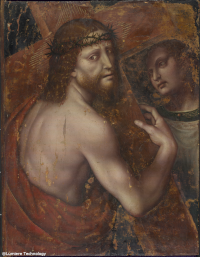
Bambach Carmen C.
Art historian and curator, widely recognized as a specialist in Leonardo da Vinci’s drawings and, more broadly, in Italian Renaissance drawing. Her work is authoritative on autograph sheets, Leonardo’s graphic practice, and the transmission of his models.
Bifid (Beard)
Refers to a beard divided into two points or two distinct masses at its lower end. The term describes a form rather than a style in itself; it may have comparative value in the morphological analysis of a figure.
Caprotti, Gian Giacomo
See Salaj.
Carbon 14
Carbon 14 is a dating method based on the radioactive decay of a carbon isotope present in organic materials. Applied to the wood of a panel, it makes it possible to estimate the date at which the tree ceased exchanging carbon with the atmosphere. It dates the support, not the exact execution of the painting.
Carbon Black
Carbon black is a black pigment obtained by incomplete combustion of organic materials. Very fine and very stable, it is used in underlying drawings, shadows, or certain paint layers. In infrared imaging, it may remain particularly visible, depending on the case.
Carbon Copy
English term for a transfer made by black tracing. The preparatory drawing is transferred by rubbing or retracing a dark material on the reverse, so that the lines appear on the support. This method differs from pouncing, which transfers the drawing through a series of perforations.
Cartoon
A cartoon is a full-scale preparatory drawing (a large assembled sheet or similar support) that fixes the final composition. It serves as a model for accurately transferring the contours onto the painted support (panel, canvas, wall).
Emissiography
Emissiography is an infrared imaging technique that records radiation emitted or reflected by the work at certain wavelengths. It often makes it possible to see the underlying drawing, pentimenti, or alterations hidden by the paint layer more clearly. Its effectiveness varies according to the pigments and the thickness of the layers.
Entrelace
An ornamental motif formed of lines, bands, or branches crossing one another in a regular or complex way. In art history, the term often refers to a braided linear decoration used in borders, friezes, manuscripts, sculpture, or textiles.
Flesh Tones
Flesh tones refer to the pictorial treatment of the flesh, especially the face, hands, and body. Their execution generally combines preparation, base tones, modelling, shadows, half-tones, and highlights. Their study provides information about technique, palette, and sometimes the painter’s hand.
Fresco (Fresco Painting)
Fresco: A fresco is a wall painting executed directly on an architectural support (wall, vault, ceiling). The term refers both to the finished work and, more broadly, to the type of painted decoration integrated into architecture.
Fresco painting: Fresco painting is a pictorial technique consisting of applying pigments diluted in water onto still-fresh lime plaster (intonaco). As it dries, the lime carbonates and permanently fixes the pigments into the very substance of the wall.
Gesso
Gesso is a white preparation applied to the support before painting, especially on wooden panels. Traditionally composed of animal glue and calcium sulphate, it forms a smooth, absorbent surface suitable for receiving the paint layers. It plays an essential role in the material structure of the work.
Giampietrino
Giampietrino was a Lombard painter of the early sixteenth century, closely connected with the Leonardesque sphere. His biography remains partly uncertain, but the works attributed to him show genuine stylistic coherence. He seems to have had direct or close access to Leonardo’s models. See biographical note.
Glaze
A very thin, transparent or semi-transparent paint layer applied over an already dry layer in order to modify tone, depth, or transitions without completely concealing the underlying layer. A glaze enriches the coloured matter and contributes to effects of modelling, vibration, and unity.
Gummed label
A label whose reverse is coated with an adhesive gum, usually gum arabic, activated by moistening, allowing it to be attached to a support. The term belongs to the older vocabulary of paper and labelling.
Halo
Halo: see Nimbus.
Highlight
A highlight is a light touch added to accentuate an area of illumination, a relief, or a detail of form. It often appears in hair, drapery, flesh, or reflected objects. Its study sheds light on the painter’s technique and way of constructing modelling.
Imprimatura
An imprimitura is a thin layer, often slightly tinted, applied over the ground before painting begins. It reduces the brightness of the white preparation and unifies the surface. It also establishes an overall tone that influences values and the chromatic balance of the image.
Infrared
Infrared is an imaging technique that uses wavelengths invisible to the human eye to examine a work. It often makes it possible to pass partially through certain paint layers and reveal underdrawing, pentimenti, or later reworking. Its effectiveness depends on the pigments, the binder, and the thickness of the layers.
Infrared False Colour
An infrared false-colour image combines a visible image and an infrared image by assigning artificial colours to certain types of information. It therefore does not show the real colours of the work, but helps distinguish materials, overpainting, restorations, or pigment differences. It is a comparative reading tool, not a direct documentary image.
Invasive (process)
An invasive process involves sampling or a material intervention on the work itself. It may consist, for example, of taking a sample for stratigraphic or chemical analysis. This type of examination is generally limited, justified, and carefully controlled, since it physically affects the object under study.
IR
See Infrared.
LAM
A LAM image (Layer Amplification Method) is produced by a multispectral imaging technique developed by Pascal Cotte (Lumiere Technology), which digitally amplifies very faint information contained in the different layers of the painting. It makes it possible to reveal details invisible to the naked eye (preparatory drawing, pentimenti, internal structures) without contact with the work.
Leonardo’s Last Supper
Leonardo da Vinci’s Last Supper is the great representation of Christ’s final meal with the apostles, painted in the refectory of Santa Maria delle Grazie in Milan. It is famous for its perspectival construction, psychological intensity, and variety of gestures. Damaged at an early date, it is also known through numerous old copies.
Macrophotography
Macrophotography makes it possible to photograph very small details of the work at close range with high magnification. It reveals the texture of the paint layer, craquelure, highlights, wear, or minute interventions. It is a valuable tool for technical and comparative examination.
Marani, Pietro C.
Italian art historian and one of the leading specialists on Leonardo da Vinci and Lombard Renaissance painting. His work deals in particular with Leonardo, his workshop, his followers, and questions of attribution and Milanese artistic context.
Morelli, Giovanni
Giovanni Morelli (1816–1891): art critic and figure in nineteenth-century Italian politics, author of several works, including Italian Masters in German Galleries (1883).
Multispectral Scanning
Multispectral scanning consists of recording the work in several spectral bands, from the visible to the infrared, and sometimes beyond. It makes it possible to compare how materials react at different wavelengths and to reveal information invisible in ordinary light. It is a non-invasive method of exploration and analysis.
Nimbus
A circle or luminous halo placed around the head of a sacred figure. In Christian iconography, it indicates holiness or divinity; it may also take a cruciform shape, especially for Christ.
Overpaint
An overpaint is a later intervention added onto the original surface, often during an old restoration. It may be intended to conceal a loss, correct wear, or alter the appearance of the work. Technical imaging often makes it possible to distinguish it from the original paint.
Pedretti, Carlo
Italian art historian and major Leonardo specialist, particularly well known for his work on drawings, manuscripts, and Leonardo’s chronology. His name is frequently associated with studies on the diffusion of Leonardo’s models and on the Leonardesque tradition.
Pentimento
A pentimento is a modification made by the painter during execution. It may concern a contour, a position, an anatomical detail, or an element of composition. It is an important indication of the creative process and may help distinguish a worked-out original from a simple copy.
Pouncing Pattern
A pouncing pattern is a cartoon made transferable: the drawing on the cartoon is pierced, or pricked, along the contours with a point, creating a line of tiny perforations.
Radiocarbon
See carbon 14.
Radiography
Radiography uses X-rays to pass through the work and record differences in the density of materials. It makes it possible to observe the structure of the support, joinery, certain pentimenti, old overpainting, or areas more heavily loaded with dense pigments. It thus provides access to an internal image of the painting.
Radiopaque
A radiopaque material strongly blocks X-rays and therefore appears lighter on a radiograph. This is often the case with pigments containing heavy elements, such as lead. Radiopacity helps distinguish certain forms, thicknesses, or interventions invisible to the naked eye.
Raking Light
White light refers to broad-spectrum visible illumination used to observe the work under conditions close to ordinary vision. It serves as the basis for visual examination, documentary photography, and comparison with other technical imaging methods. It shows the apparent condition of the surface, but not what is hidden beneath the paint layers.
Ritratto di spalla
Ritratto di spalla refers to a type of bust-length or half-length representation in which the figure is seen in three-quarter view, with the shoulder playing a strong role in the construction of movement. This formula gives greater presence to the torso and the twist of the neck. It plays an important role in the expressiveness and dynamism of the portrait.
Salaj
Salaj is an old spelling of the name Salaì, that is, Gian Giacomo Caprotti, pupil and companion of Leonardo da Vinci. The variants Salaj, Salai, and Salaino appear in old sources, but their use remains variable and sometimes confused. The texts confirm his place within Leonardo’s immediate circle; by contrast, his own oeuvre remains poorly defined, and the attributions associated with him remain, for the most part, uncertain. See bibliographical notes.
Seracini, Maurizio
Italian art diagnostician, born in Florence in 1946, and author of an expert report on the paint layer of the Painting, carried out in 2011.
Sfumato
Sfumato is a pictorial method based on very soft transitions between shadow and light, without sharply defined contours. It makes it possible to model forms through subtle passages and transparent superimpositions. In Leonardo, it contributes to giving faces atmospheric depth and great visual supplenes
Smudging
Smudging refers to an effect of blurring or softening produced by rubbing, diffusion, or the softening of a line or material. In drawing, it may result from a deliberate effort to blend values; in imaging or conservation, it may also indicate alteration or loss of sharpness. The term must therefore be interpreted according to its technical context.
Solario, Andrea
Painter (probably born in Milan around 1465, died in 1524), Andrea Solario was the brother of Cristoforo. He stayed with him in Venice between 1492 and 1495, where he was influenced by Giovanni Bellini and Antonello da Messina (Madonna between Two Saints, 1495, Milan, Brera). He worked in France, in Normandy, at the château of Gaillon (1507–1509), for Cardinal Georges d’Amboise. On his return to Milan, he was chiefly affected by Leonardo’s activity (Crucifixion, 1503, and Annunciation, 1506), two paintings now in the Louvre, Paris (Source: Treccani.it).
Spolvero
Spolvero is a drawing-transfer technique: the contours of a cartoon are perforated (pouncing pattern), then the cartoon is laid on the support and dusted with a powder (often black) that passes through the holes and deposits a dotted line. These dots then serve as a guide, generally connected by a drawn line (carbon point, black chalk, etc.) for the execution of the painting.
Thaddeus
Thaddeus is one of the twelve apostles represented in Leonardo da Vinci’s Last Supper. Placed in the group on the right, he takes part in the gestural and psychological exchange structuring the scene. Within the framework of this study, his face shows significant morphological affinities with the Venice Head of Christ Drawing.
Titian
Titian: “Painter (Pieve di Cadore 1488–90 – Venice 1576). Divergences among the sources make Titian’s date of birth uncertain, and consequently his exact place in the Venetian artistic panorama of the early sixteenth century remains a question not yet resolved by consensus. After training with the mosaicist S. Zuccato, Titian entered the workshop of Gentile Bellini and later worked with Giovanni Bellini. His artistic orientation appears from the outset both assured and brilliant: his references (Bellini, Giorgione, Dürer, but also Raphael and Michelangelo) …” (Source: Treccani.it).
UV
UV, or ultraviolet, is an examination technique based on the work’s reaction under ultraviolet illumination. It often makes it possible to see varnishes, restorations, overpainting, retouchings, or surface differences more clearly through variations in fluorescence. It does not directly reveal the underlying drawing, but rather the surface condition and certain later interventions.
White Light
White light refers to broad-spectrum visible illumination used to observe the work under conditions close to ordinary vision. It serves as the basis for visual examination, documentary photography, and comparison with other technical imaging methods. It shows the apparent condition of the surface, but not what is hidden beneath the paint layers.
X-ray Fluorescence — XRF
X-ray fluorescence, or XRF, is a non-destructive analytical method that identifies the chemical elements present in an area of the work. It makes it possible in particular to detect elements such as lead, iron, copper, mercury, or calcium, which are useful for characterizing pigments and materials. It provides information on elemental composition, not on the exact structure of compounds.
XRF
See X-ray Fluorescence — XRF.