Carbon-14 Dating of the Support
Two carbon-14 analyses were carried out on the wooden support of the Painting, by two different laboratories: ETH Zurich and CDRC Lyon. These analyses do not directly date the pictorial execution, but the organic material sampled from the panel.
The results nevertheless form an important part of the dossier: they place the support within a chronology compatible with an ancient panel, mainly between the late 15th century and the mid-17th century.
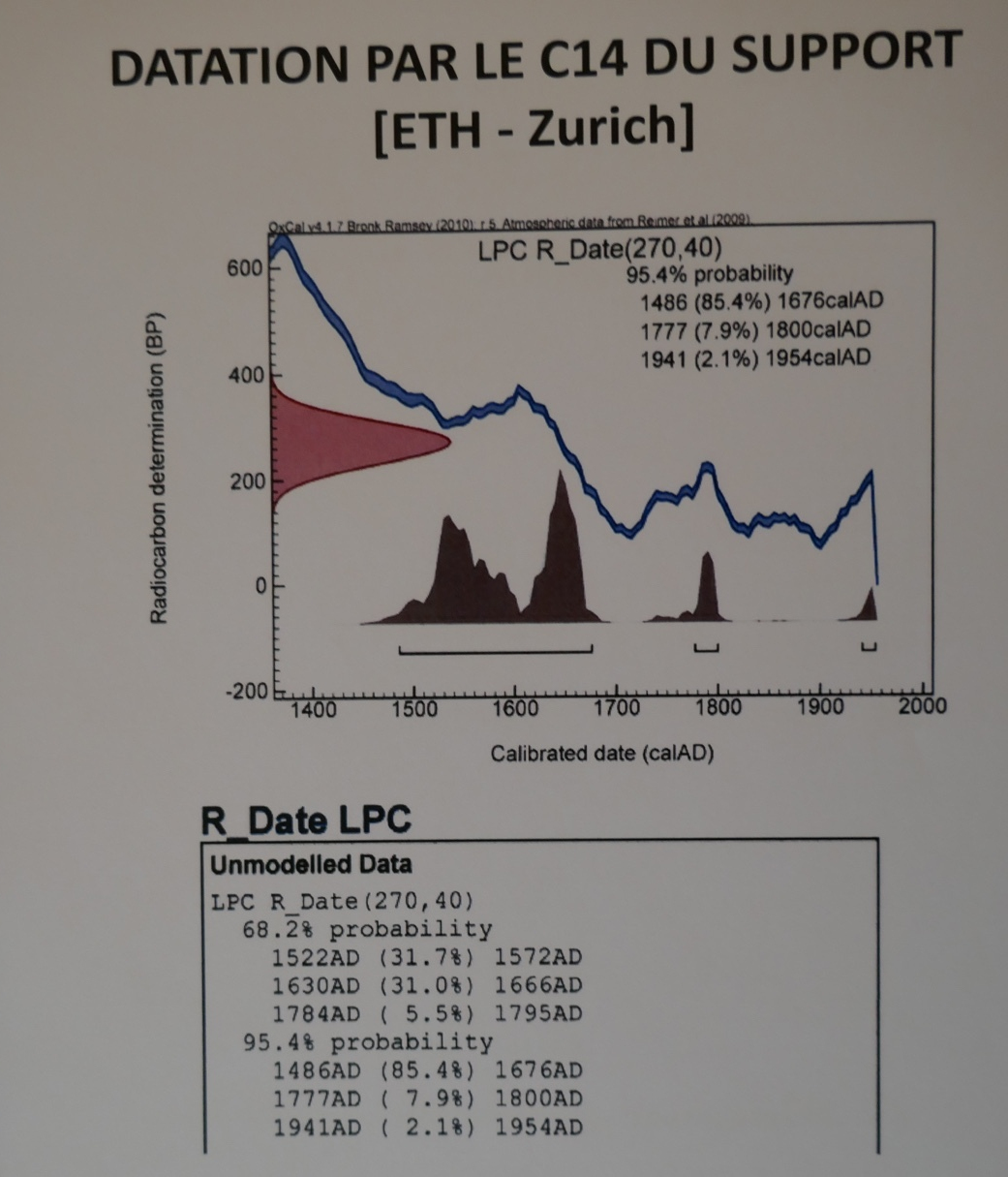
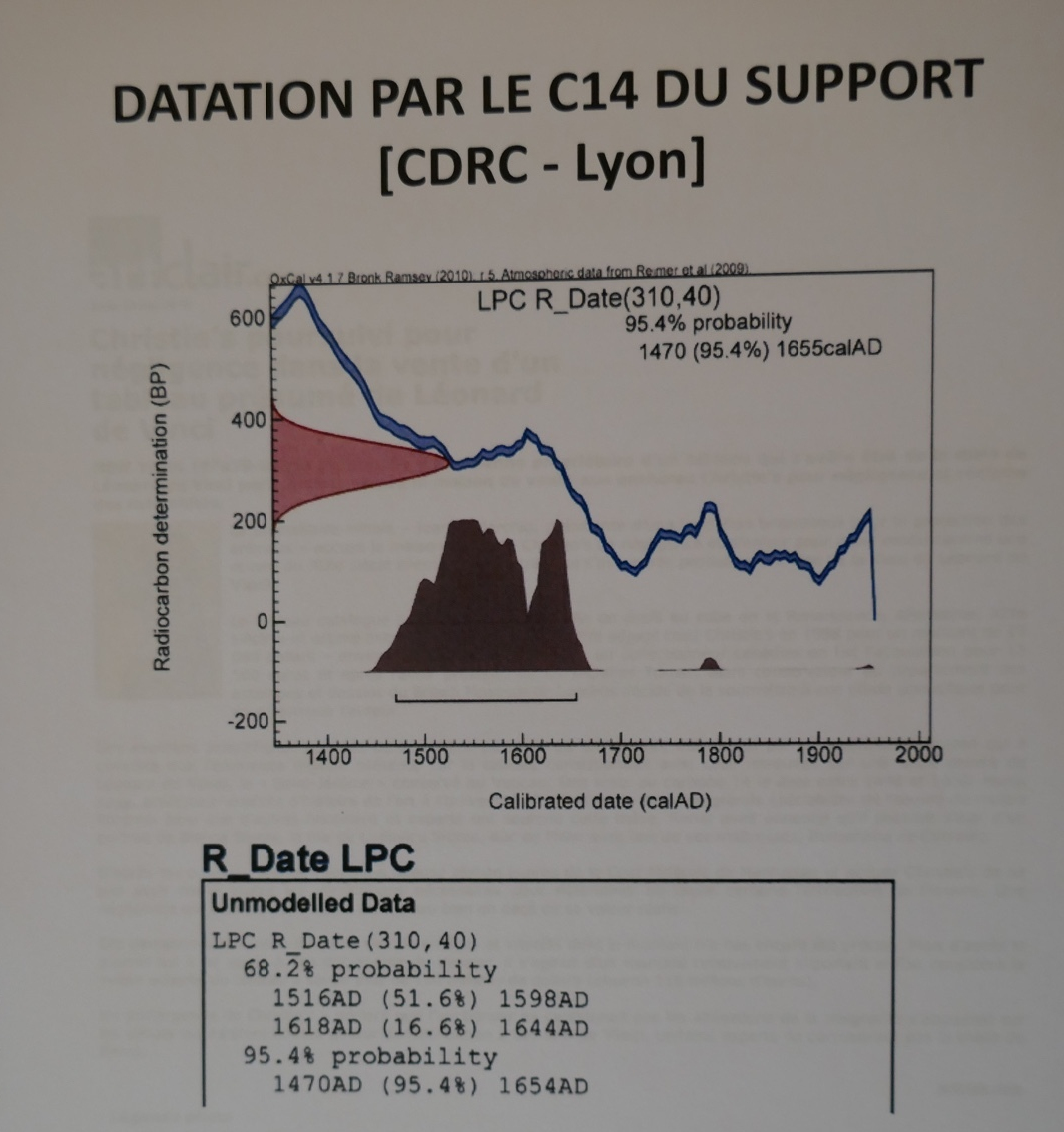
Results of the Two Analyses
The two measurements are close and should be considered compatible. They place the wood of the support within an ancient chronological range, with a notable concentration of probability in the 16th century, particularly in the CDRC Lyon analysis.
| Laboratory | Radiocarbon age | Calibrated result | Observation |
|---|---|---|---|
| ETH Zurich | 270 ± 40 BP | 1486-1676 cal AD at 85.4% 1777-1800 cal AD at 7.9% 1941-1954 cal AD at 2.1% |
At 68.2%, two main ranges appear: 1522-1572 and 1630-1666. |
| CDRC Lyon | 310 ± 40 BP | 1470-1654 cal AD at 95.4% | At 68.2%, the probability is mainly concentrated between 1516 and 1598, with a second range between 1618 and 1644. |
Interpretation
Carbon-14 dating applies to the wood of the support, not to the paint layer. It therefore cannot, by itself, precisely date the execution of the work.
The results nevertheless support the chronological coherence of the dossier. They make the hypothesis of a modern support difficult to sustain and confirm that the panel may belong to a period compatible with the ancient practices examined here.
The hypothesis of an execution around 1495 must therefore be assessed on the basis of other evidence: comparison with the Venice Drawing, relationship with the Giampietrino versions, study of the pictorial stratigraphy, pentimenti, traces of spolvero, and scientific imaging.
Methodological Limits
- Carbon-14 dates the sampled wood, not the painting itself.
- The wood may be earlier than the pictorial execution.
- A delay may have existed between the felling of the tree, the cutting of the panel, its drying, and its preparation.
- The results must be compared with the other technical examinations and with the historical analysis of the Painting.