The Young Figure at Right
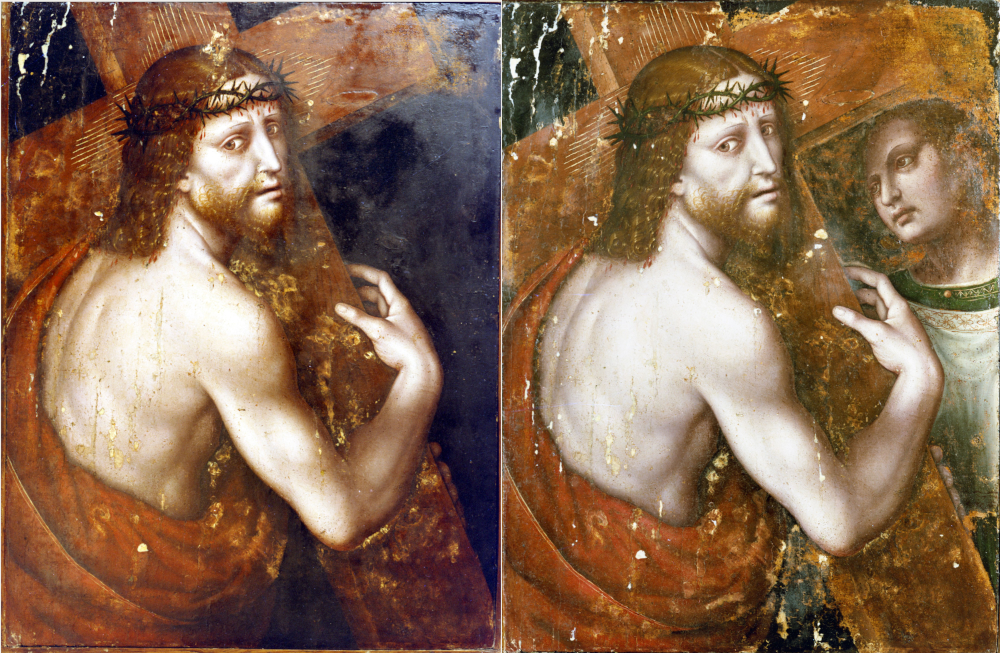
The presence of a young figure placed to the right of Christ is one of the most distinctive features of The Painting. Absent from the known versions by Giampietrino and from the traditional Milanese variants of Christ Carrying the Cross, this figure introduces a new dimension, both iconographic and technical. Long hidden beneath a black layer, it was only fully taken into account after its revelation by scientific imaging.
Appearance and Status within the Composition
The right-hand figure was revealed in the twentieth century by X-radiography, after having been covered by a black layer probably added in the sixteenth century. Brought to light by scientific imaging, its presence changed the reading of The Painting.
In his report, Professor Seracini describes it as a “female figure”, a formulation that draws attention to the ambiguity of the figure.
A Leonardesque Expressive Type
Formal parallels may be proposed with certain figures from the Leonardesque and Milanese milieu: The Rape of Proserpine from Giampietrino’s workshop, John in Plautilla Nelli’s Last Supper, and Raphael’s Saint Catherine (see also the page Iconography).
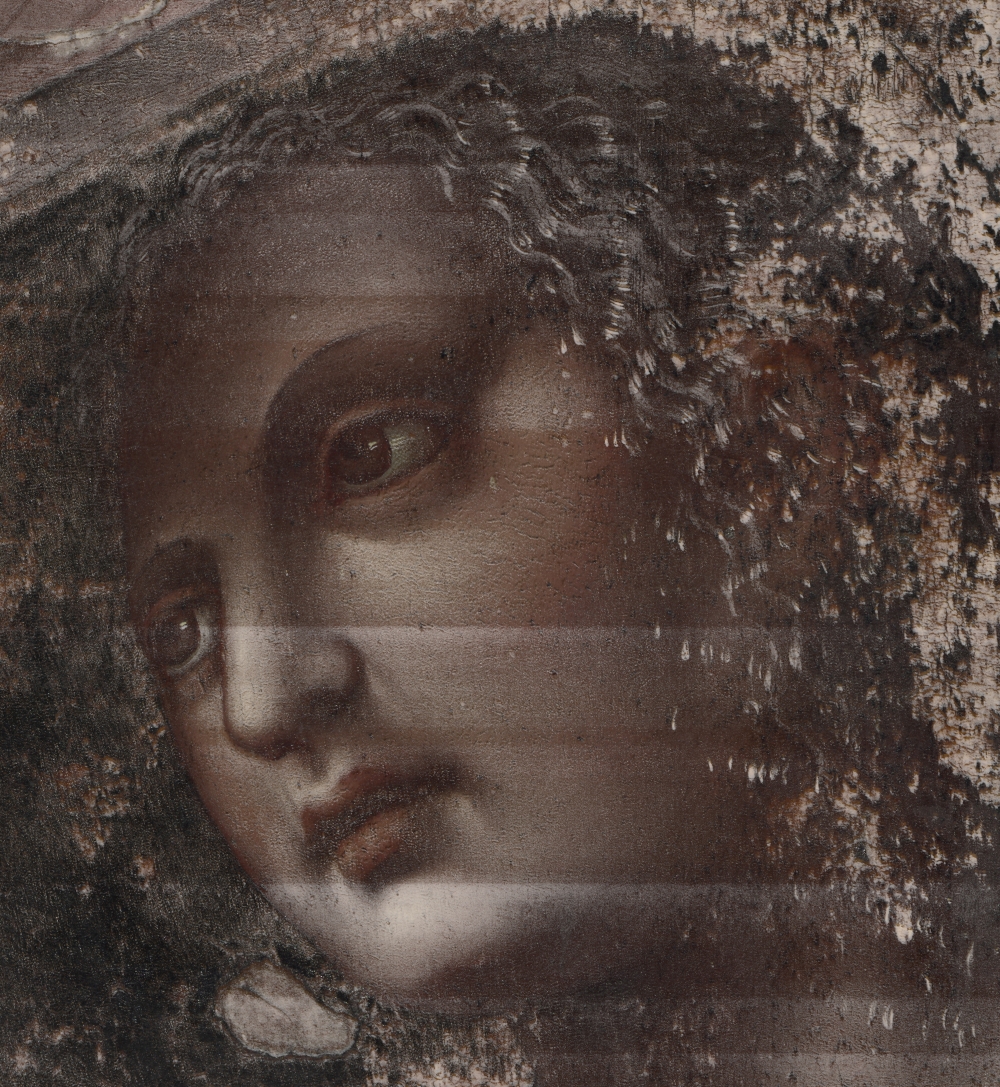
These comparisons concern the oval of the face, the soft curls, and the inclination of the gaze. They do not allow the figure to be identified with certainty, but place the Figure within a shared Leonardesque expression: idealized youthful types and ambiguity of features.
The image results from the superimposition of a multispectral LAM image and a visible-light image, in order to make the hair more legible.
Morphology of the Figure
– Androgyny, curly hair
– Perceptible sfumato (eyes)
– Textile frieze identical to the Uffizi drawing
The Figure and the Initial Cartoon
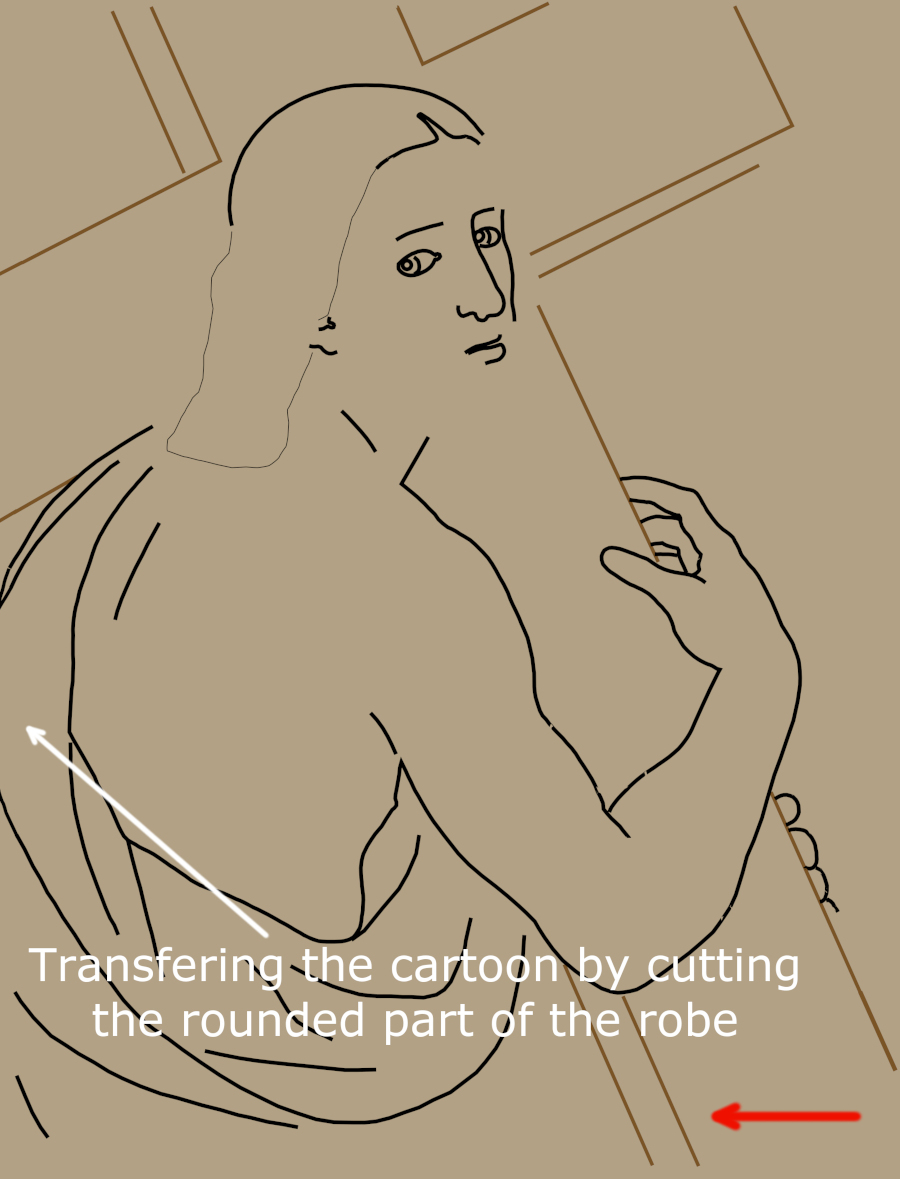
Technical analyses suggest that the Figure was not present in the preparatory cartoon for Christ.
- The technical analyses carried out by Maurizio Seracini suggest that the Figure was added later, during execution ;
- The transfer method appears to differ: spolvero for Christ, at least for the head and right hand; carbon transfer for the Figure ;
- The Figure may have been painted over a light grey ground laid directly on the preparation.
These elements suggest an addition during execution, transforming an image centred on Christ into a scene with two protagonists.
The Figure: addition during execution?
– Christ: spolvero; Figure: carbon transfer
– Addition during execution? Shift in the composition
The Question of Contact
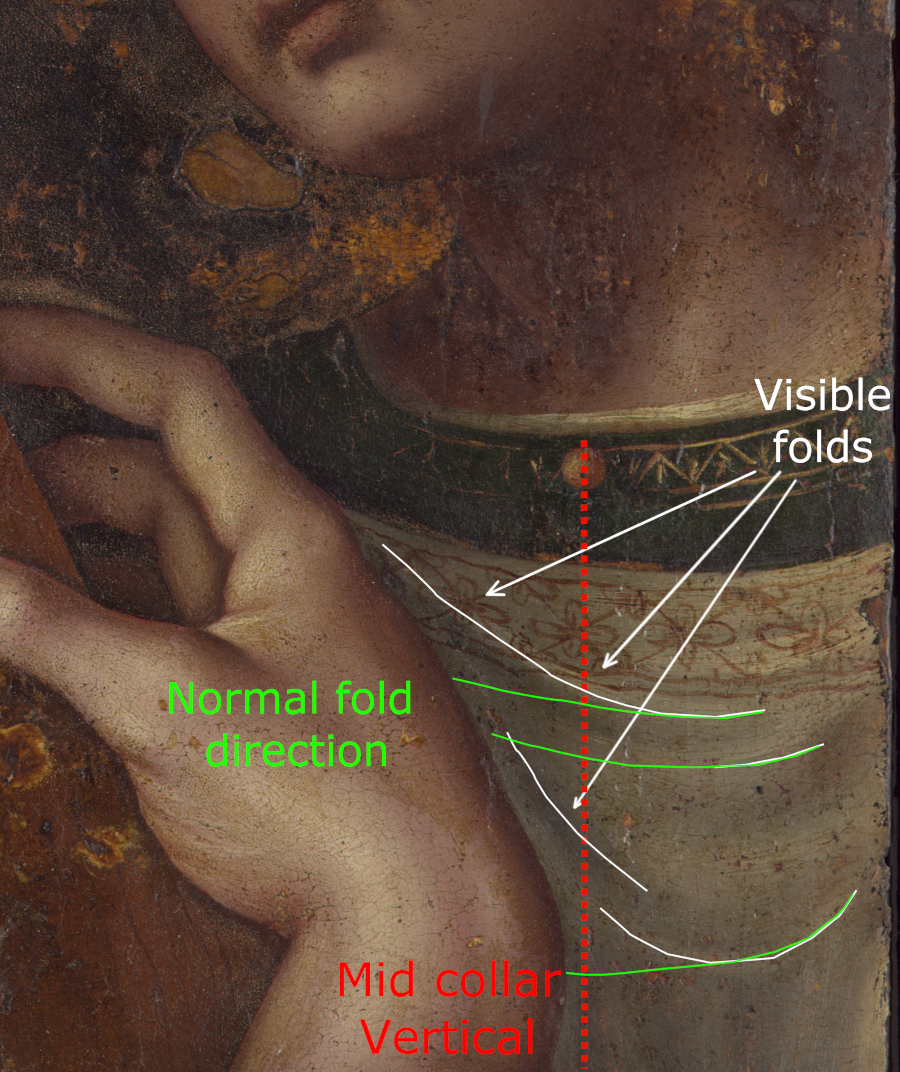
One detail reinforces the hypothesis of contact: the direction of the folds of the tunic on the side of Christ’s hand.
On the left, the folds show an unusual upward movement, as though slightly lifted. On the right, the drapery follows a more regular logic. This asymmetry could be explained by pressure exerted by Christ’s hand.
Textile historian Mary Harlow considers this hypothesis coherent and plausible, without it being possible to demonstrate it definitively.
If this contact is indeed suggested, the Figure would no longer be a mere secondary presence. It would enter into direct interaction with Christ, reinforcing both the narrative force and the iconographic singularity of the image.
Contact with Christ’s hand?
– Atypical upward folds
– Contact hypothesis considered plausible
Conclusion
The figure on the right is one of the most distinctive features of The Painting. Through its youthful and androgynous type, it refers to Leonardesque visual types disseminated in the Milanese milieu, without allowing secure identification.
Technical observations suggest that it may have been integrated during execution. Its presence changes the reading of the image: it no longer shows Christ alone, but a relationship with a figure who accompanies him and seems to interact with him, thereby reinforcing the narrative dimension and iconographic singularity of The Painting.