Halo of Christ Carrying the Cross: Later Addition and Impact
The halo, here represented by rays around Christ’s head, is a later addition. It does not belong to the initial state of The Painting. This intervention altered the reading of the image by emphasising more directly the sacred character of Christ. The following sections show precisely how this addition was identified: layer superimpositions, covered cracks, microscopic observations, X-radiography and multispectral imaging.
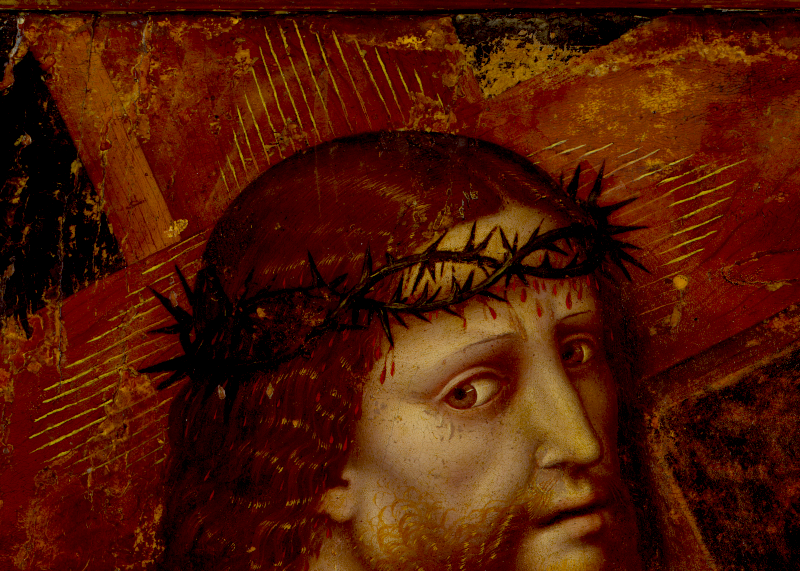
A Halo Painted over a Brown Veil
The halo was painted over a brown veil that darkens and reduces the visibility of the wood grain of the cross. The image on the left, “LAM 1634 (2021)”, reveals the underlying wood grain, which was more legible before this veil was applied.
A Halo Painted over an Already Cracked Surface
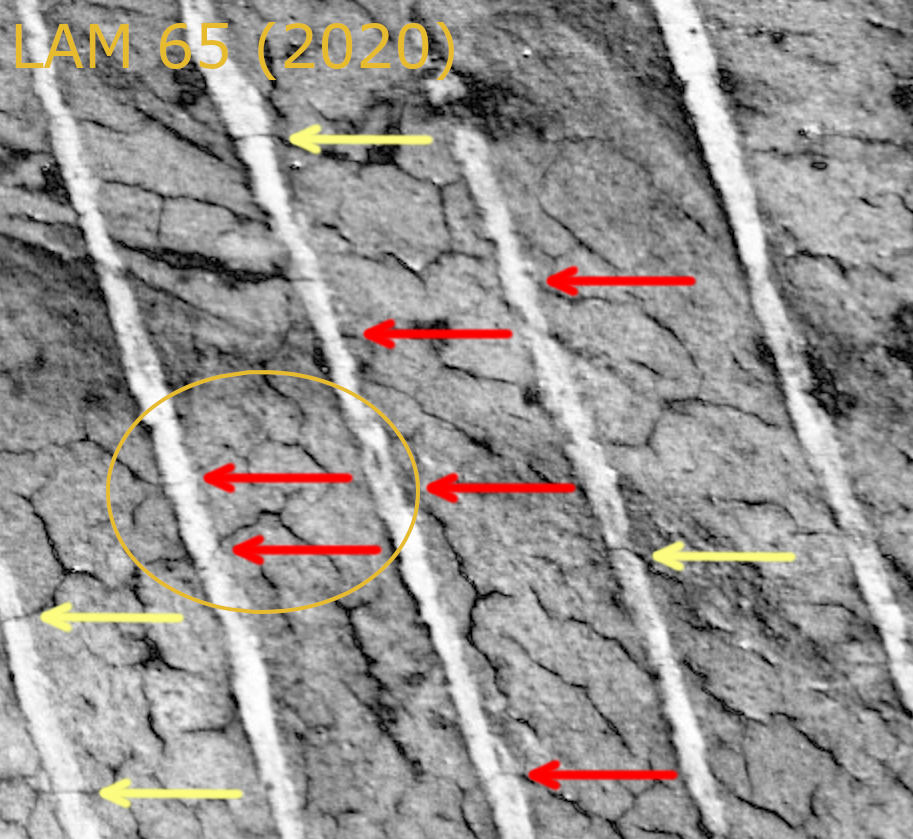
The observation is clear: the halo rays cover cracks that had already formed in the paint layer. Raking-light examination, macrophotography and imaging all converge in the same direction. The halo was applied over an older paint surface that had already aged. Some cracks then continued to evolve after this intervention. The halo is therefore later than the initial execution.
“Microscope images show that the halo rays are later than the formation of the cracks; the brushstrokes pass over the cracks.” — Conservation Cultural Heritage, Geneva, 2024.
The overpaints remain very well integrated into the original surface, suggesting an old intervention in the history of The Painting, possibly as early as the sixteenth century.
Confirmation through an independent analysis
This interpretation was supported in 2025 by the opinion of Ludovic Pauchard, Université Paris-Saclay and CNRS (France), a specialist in the analysis of craquelure in old paintings. In his view, the pattern of cracks in the area of the halo indicates that it was painted after the craquelure network had formed.
“Regarding the halo, the craquelure provides clearer evidence that it was painted a posteriori.”
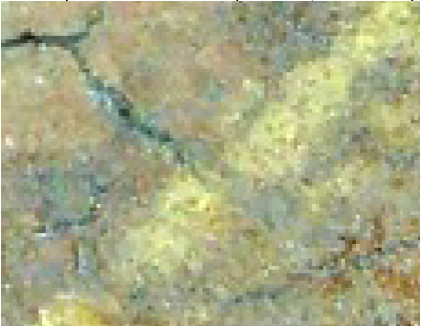
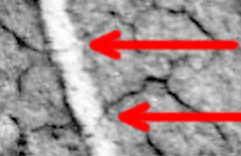
Dark crack covered by a yellow halo ray
Microscope image
Halo Rays and the Covering of the Thorns
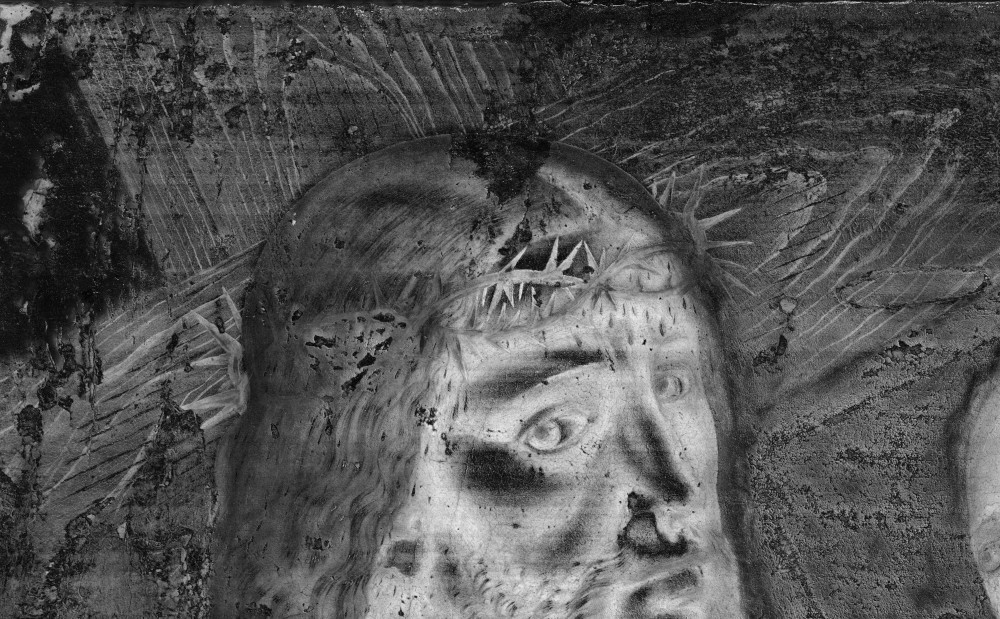
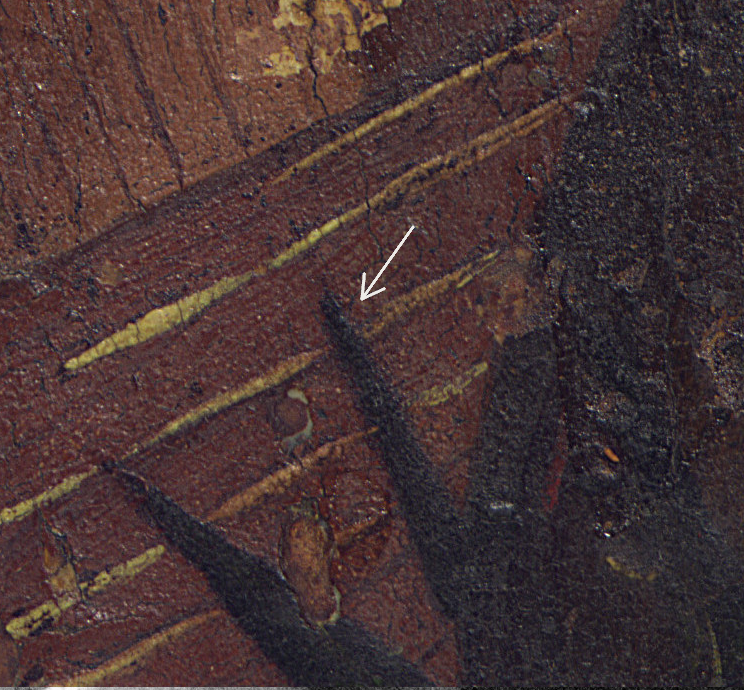
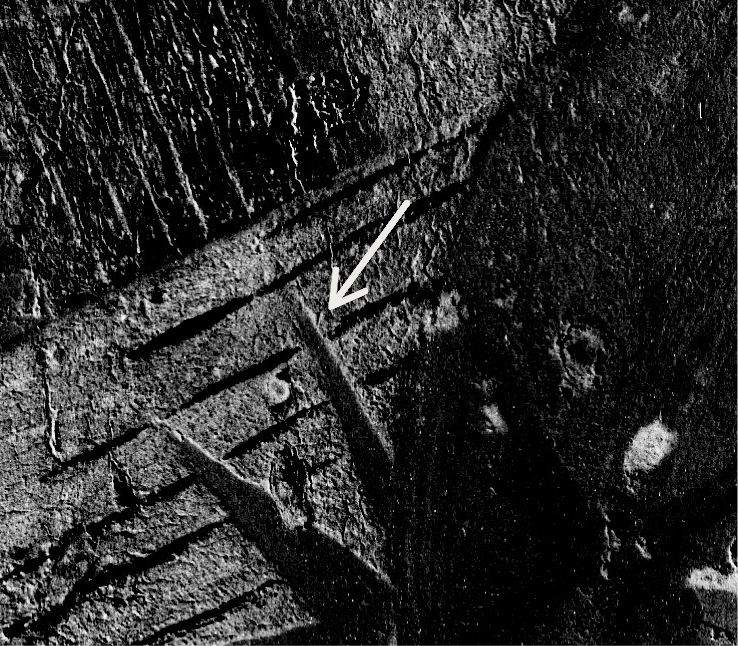
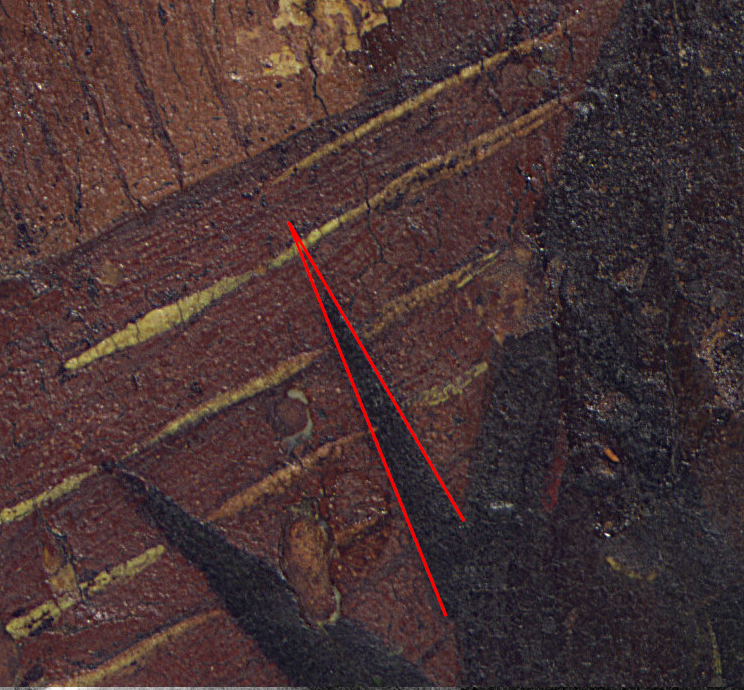
X-radiography shows that the halo rays were painted after the crown of thorns. This already establishes their later date. But one detail goes further. In the visible image, the tip of a thorn appears to be interrupted by a paint loss. Multispectral imaging, however, restores its complete outline to the very end. Yet a halo ray passes over this tip without interruption. This means that the halo was applied when this part was no longer visible on the surface. This covering forms a strong indication of a late addition.
From left to right: the visible image shows a truncated thorn tip; the multispectral image preserves its complete outline; the third vignette proposes a reconstruction.
Other Overpaints and Overall Coherence
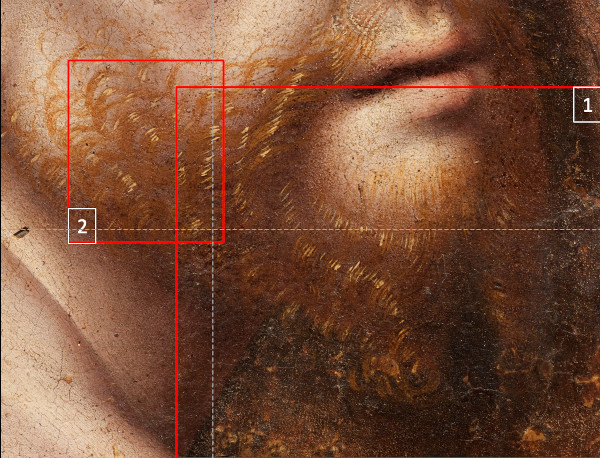
The halo is not an isolated case. Other later interventions have been noted: Christ’s beard, repainted over an already cracked surface, and certain lines of the robe, also retouched over pre-existing cracks (Study of The Painting, p. 152, p. 160). These observations, reported by Professor Seracini, suggest a probably grouped campaign of retouching.
See also Section 8 of the detailed study of the overpaints: the same lead-tin yellow pigment was identified in both the repaint of the halo and the repaint of the button on the Figure’s tunic.
Conclusion
The halo was therefore not part of the initial project. Added afterwards, probably as early as the sixteenth century, over an already cracked paint layer, it makes the scene more explicitly religious. Other indicators point in the same direction: the covering of the Figure by a black layer and the traces of devotional use on the reverse of the panel, which, according to Seracini, may have been caused by candle flames.