Technical Analysis of Christ Carrying the Cross
This page presents a technical analysis of The Painting: support, transfer of the drawing, paint layer, pentimenti, overpaint, and the contribution of imaging. It is distinct from the Scientific Expertise page, which is based on instrumental examinations and physico-chemical analyses.
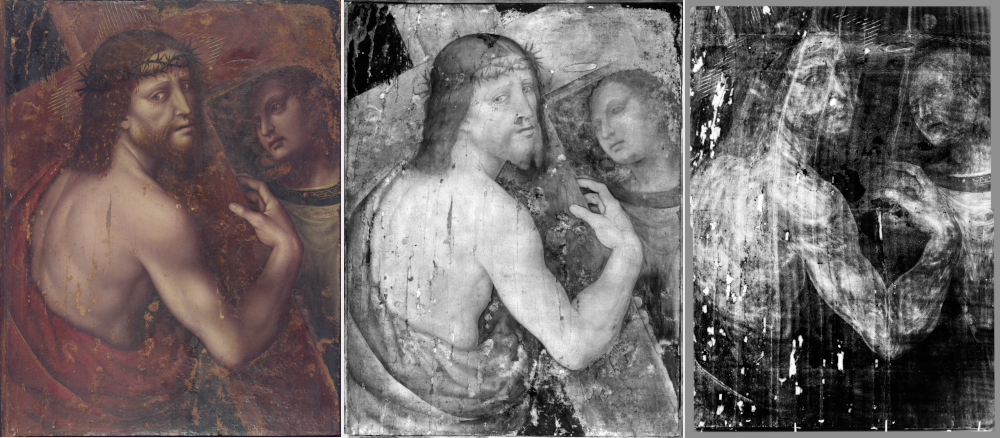
Scientific imaging
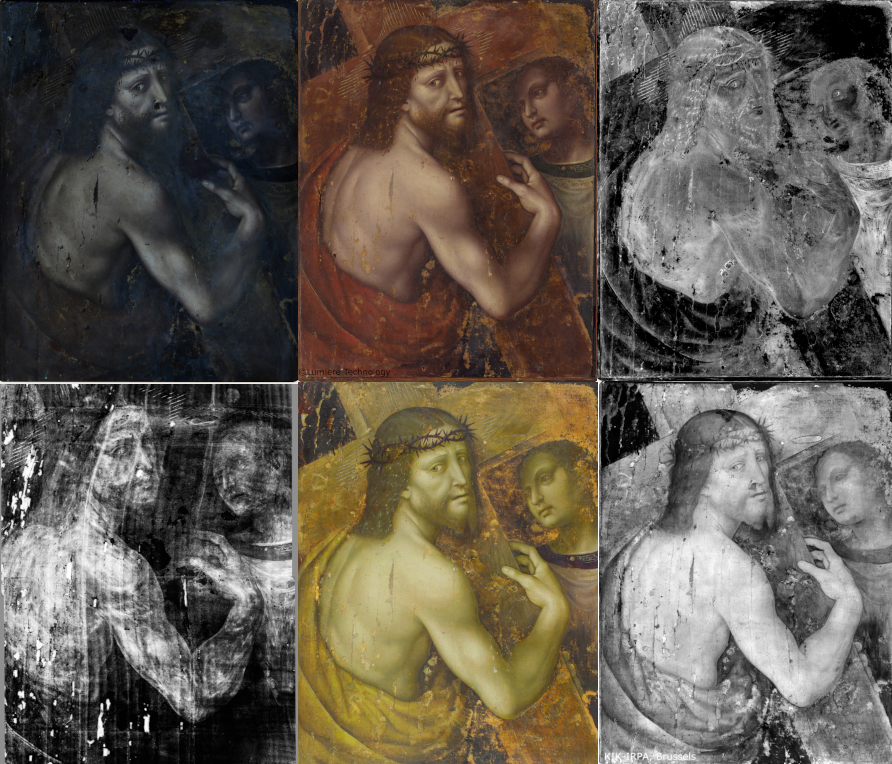
Scientific imaging forms the starting point of the analysis. Infrared reveals lines and certain modifications, while X-radiography highlights the densest areas, especially those rich in lead white. The mosaic opposite provides a synthetic reading.
See the dedicated page: Scientific imaging
The support
Front of the panel
— Poplar wood, dated by carbon-14 to a range compatible with a period between the late 15th century and the mid-17th century. See the dedicated page: Carbon-14 Dating
— Preparation and stratification compatible with Italian Renaissance practice.
— Methodical construction of the paint layers.
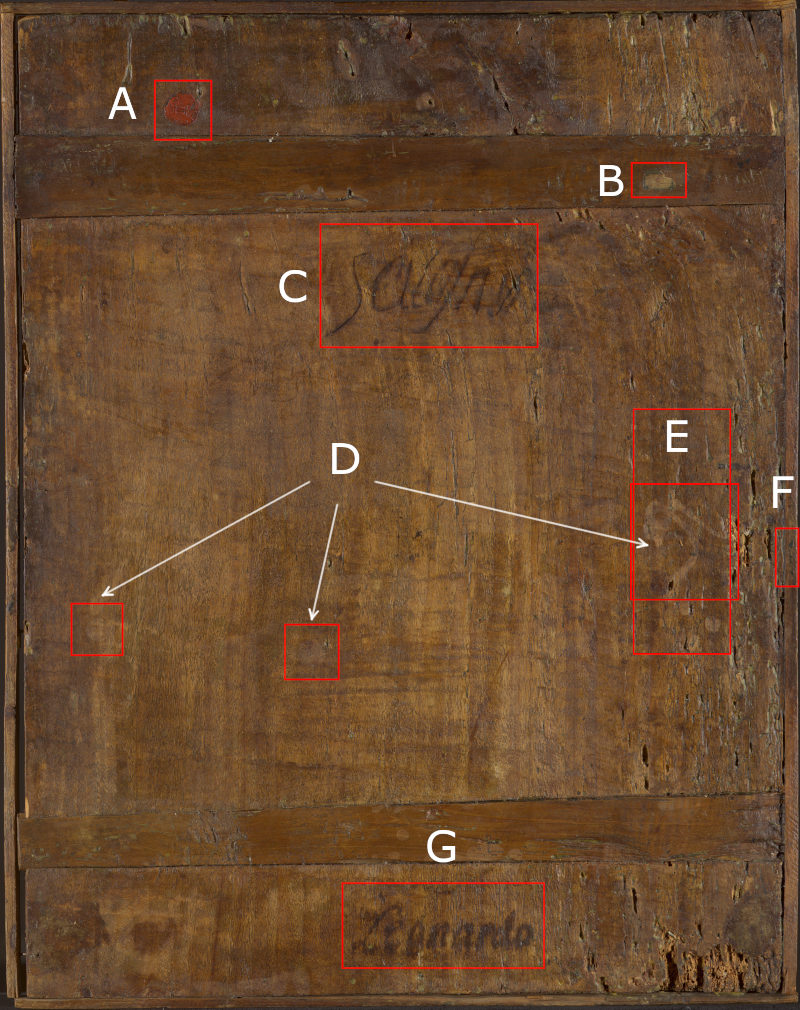
Reverse of the panel
— Roman red wax seal from the early nineteenth century.
— Old inscriptions: “Leonardo”, “Salajno”, “Salaj / ?” …
These elements document the material history of the panel, without directly informing the pictorial execution.
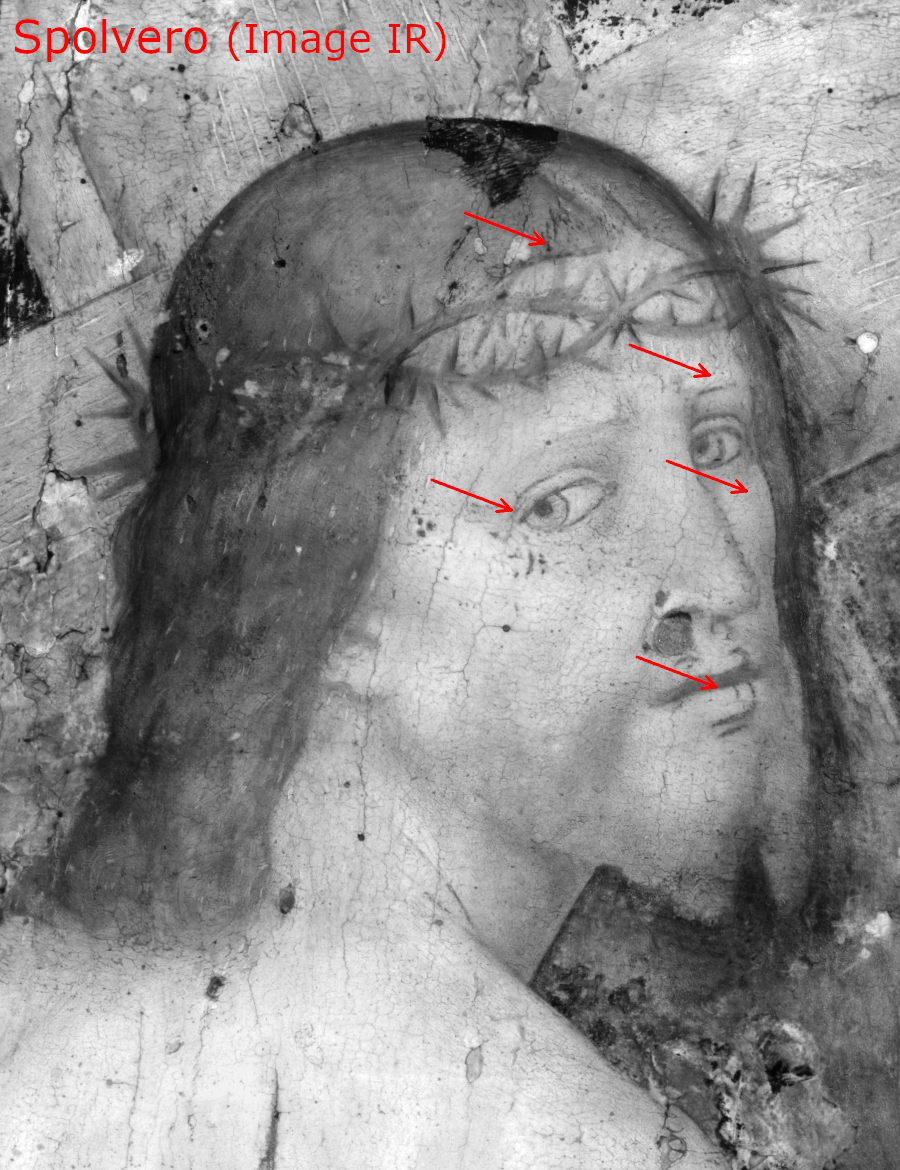
Transfer of the drawing: cartoon and spolvero
The composition derives from a model common to the Milanese Christs, probably transmitted by cartoon.
The visible perforations, on Christ’s hand and face, indicate a mechanical transfer by spolvero, a procedure commonly used in Italian workshops.
See the dedicated page: The cartoon – transfer of the drawing
Paint layer and modelling
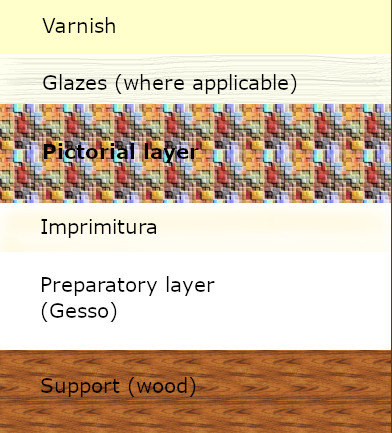
The stratigraphy of the paint layer follows a structure typical of Italian Renaissance painting. A preparatory layer of gesso is first applied to the wooden support, followed by an imprimatura. The paint layers proper then follow, possibly completed by glazes, before the final varnish.
The University of Bologna (2022) considers that the observed technique does not correspond to that documented in Giampietrino.
See the dedicated page: The paint layer
Sfumato
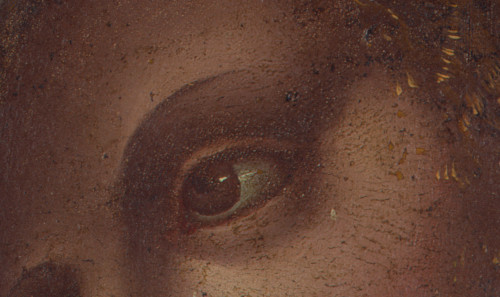
Effects of sfumato appear in certain passages of the face and around the eye, where the transitions between shadow and light remain deliberately softened.
The current state of conservation, marked by old overpaint and partial varnish removal, nevertheless reduces their visibility.
See the dedicated page: Sfumato
Pentimenti
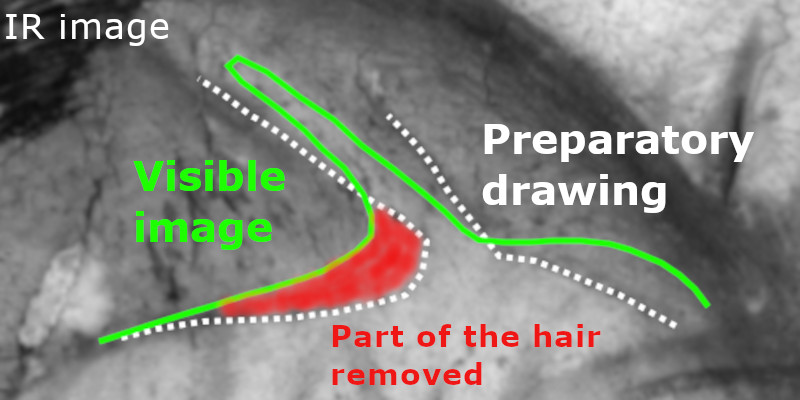
Pentimenti are corrections made during execution. They are often more legible in infrared, which reveals the preparatory drawing and certain modifications hidden beneath the final paint surface.
Several pentimenti concern the hairline, the crown of thorns, the left eye and the hand. They are also accompanied by localised losses of material, sometimes linked to lead white.
See the dedicated page: Pentimenti
Overpaint
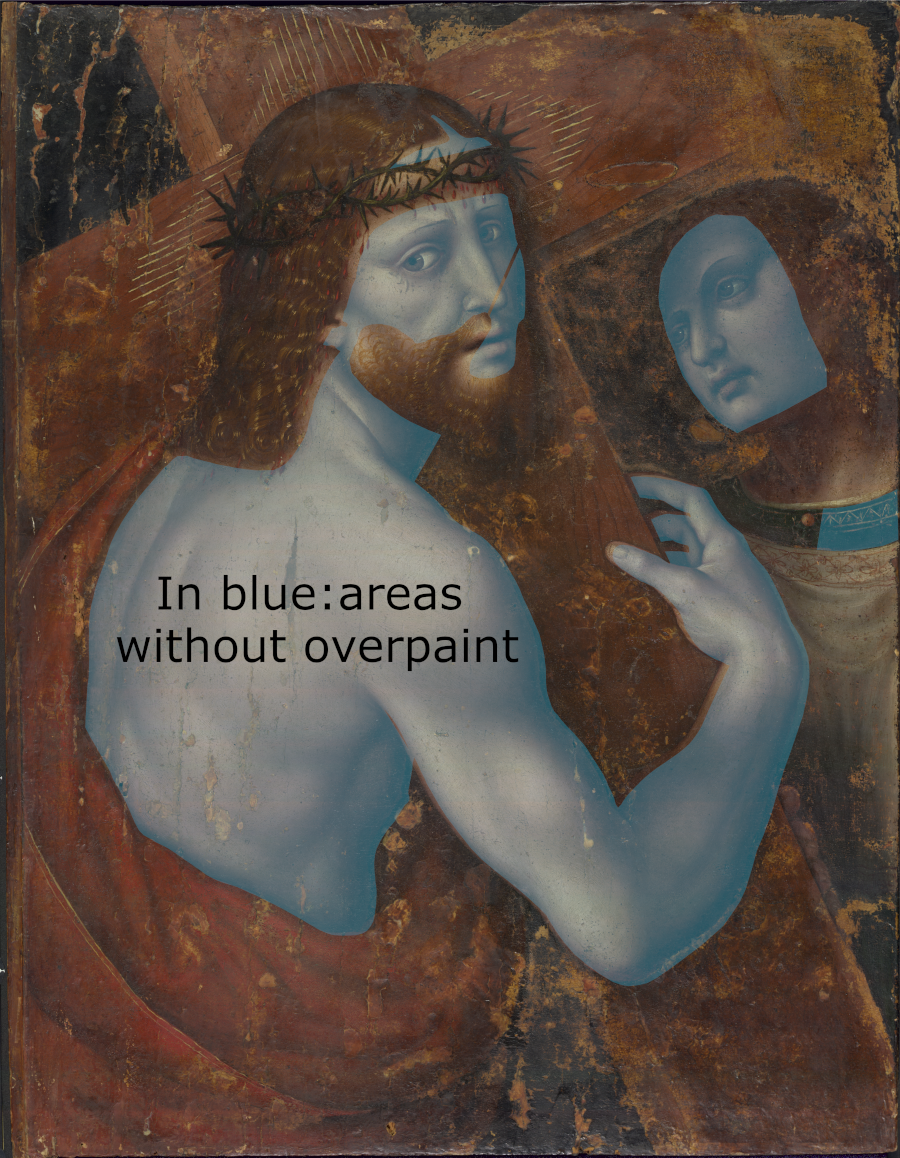
Old overpaint, sometimes closely integrated into the surface, complicates the reading of the work. In the image opposite, the areas in blue correspond, a priori, to the non-overpainted parts. They therefore serve as reference points for distinguishing the original material from later interventions.
See the dedicated page: Overpaint
X-radiography
X-radiography completes the analysis by revealing the internal distribution of pictorial materials, certain reworkings, and elements related to the support.
In the case of The Painting, it played a major role in the rediscovery of the figure on the right, long concealed beneath a dark layer.
See the dedicated page: X-radiography of the Painting

X-radiography — right arm and shoulder
“Arm muscles painted and distinct” — radiologist, 1960s
Summary
The technical analysis of The Painting highlights a support compatible with the Italian Renaissance, transfer by spolvero, a stratified execution with pentimenti visible in infrared, and a working logic distinct from that documented for Giampietrino.